The Real Jardín Botánico is Madrid’s royal botanical garden, founded in 1755, now run as a scientific institution by the CSIC (Spain’s national research council) rather than as a city park. It sits beside the Prado Museum, holds thousands of catalogued plant species across terraced grounds, and charges an entry fee, unlike the free public parks nearby.
What exactly is the Real Jardín Botánico?
It is a working botanical institution, not a decorative garden attached to a palace. The Real Jardín Botánico de Madrid (often shortened to RJB) combines a public garden open to visitors with a research herbarium, a scientific library and active plant taxonomy work. That dual role — garden and laboratory — is why it looks and operates differently from a municipal park.
Who runs it, and why does that matter?
Since 1857, the garden has been under state, not municipal, control, and it is currently managed by the CSIC — the Consejo Superior de Investigaciones Científicas, Spain’s main public research body. That matters for a visitor because the garden is organised the way a scientific collection is organised: by family, region and use, with labelling aimed at identification rather than atmosphere. It also means the RJB answers to national science policy rather than to Madrid’s park authorities, which is part of why it charges admission while the city’s own green spaces generally do not.
How old is the garden, and has it always been on this site?
The institution dates to 1755, when Ferdinand VI ordered a royal medicinal garden established near the Manzanares river, at a site then known as Migas Calientes. It moved to its current location on the Paseo del Prado in 1781, under Charles III, the same king responsible for the Prado building itself and much of the wider Paseo del Prado project. The move put the garden on land that had previously been orchards belonging to the crown, directly beside what would become the Prado Museum.
Who designed the garden as it stands today?
The layout was designed by Juan de Villanueva, the architect also responsible for the Prado’s original building, working alongside the botanist Casimiro Gómez Ortega, who directed the garden’s early scientific programme. Villanueva’s stone gateways, the terraced plan and the garden’s principal pavilion date from this late-18th-century phase and are part of why the site is protected as a listed historic garden.
What is actually inside the Real Jardín Botánico?
The garden holds a living plant collection organised for study as much as for viewing, alongside built structures that support the research side of the institution.
- Thousands of plant species and cultivated varieties, arranged by botanical family, geographic origin and economic or medicinal use — figures are updated periodically on the CSIC’s own site for the garden.
- A rose garden (rosaleda) and dedicated beds for medicinal, aromatic and useful plants, reflecting the garden’s original purpose as a training ground for royal physicians and pharmacists.
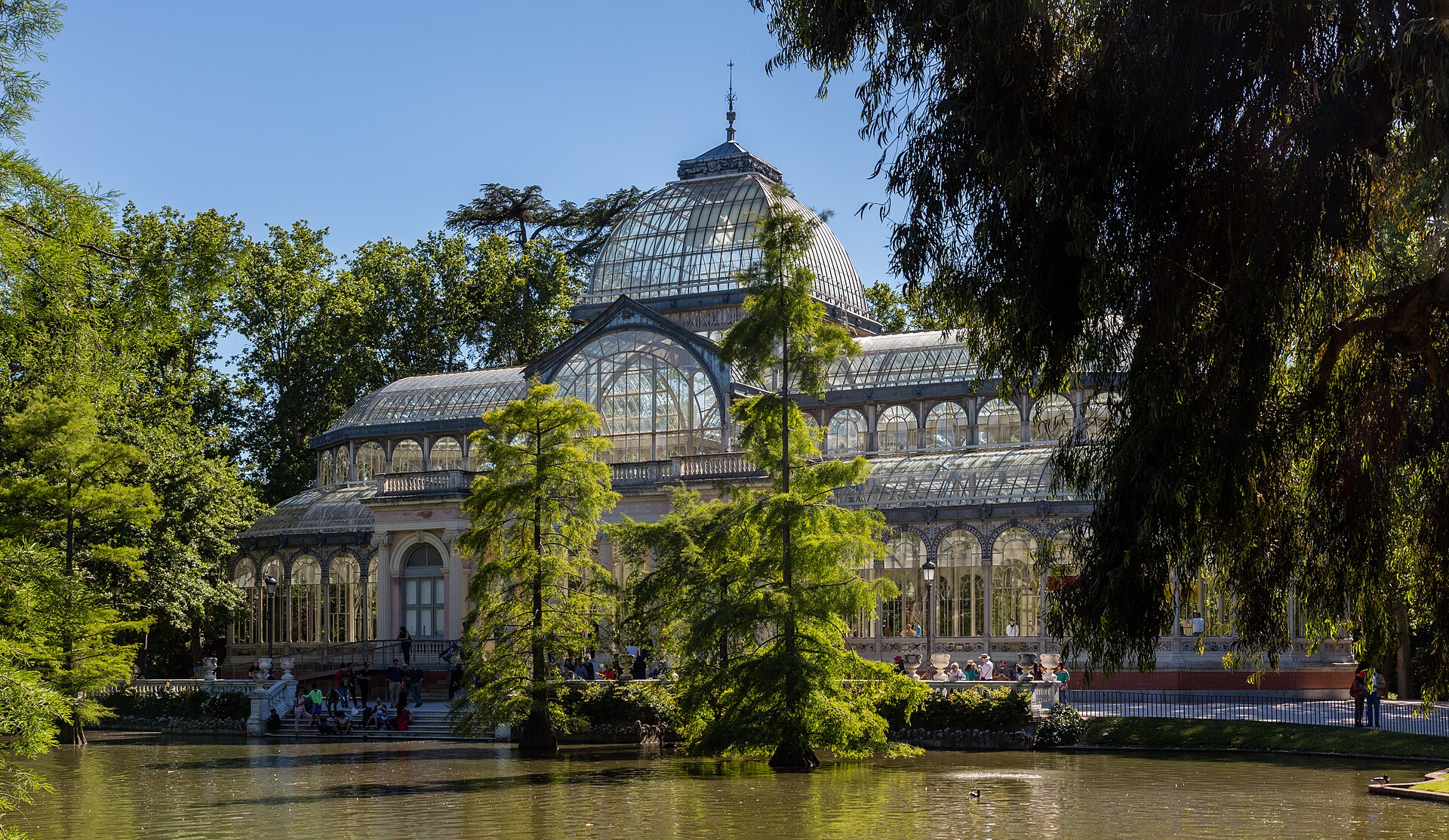
- Glasshouses, including the Pabellón Villanueva, used for temporary botanical and scientific exhibitions rather than permanent horticultural display.
- A herbarium and botanical library maintained by the CSIC, used for taxonomic research and generally not part of the public visit.
- Specimen and heritage trees, some dating from the 18th and 19th centuries, cared for as part of the garden’s long-term collection rather than replaced on a decorative schedule.
How is the garden laid out?
The plan rises in three rectangular terraces from the lower entrance on Plaza de Murillo, opposite the Prado, up to the higher gate on Calle Alfonso XII, near Retiro. Each terrace has its own character within the same grid: the lowest holds ornamental and taxonomic beds close to the entrance, the middle terrace is given over largely to the rose garden and shaded walks, and the upper terrace contains the plant-family collection used most directly for teaching and research. Straight axial paths and clipped hedging reflect the garden’s origin as a formal 18th-century scientific layout rather than an English-style landscape garden.

How does it relate to the Prado and to Retiro?
The Real Jardín Botánico occupies the gap between two of the areas covered elsewhere on this site: the museum quarter along the Paseo del Prado and the green space of Parque del Retiro. Physically, it is wedged between the Prado’s south end and Retiro’s western boundary, making it a natural stop for anyone walking between the two. Institutionally, it has nothing to do with either — it predates the Prado as an organised royal project by decades and has always been managed separately from the palace grounds that became Retiro.
Is it free to enter?
No. The Real Jardín Botánico charges an admission fee, which is one of the clearest ways it differs from Retiro or Madrid Río, both of which are free public parks. Fees, concessions and any free-entry windows are set by the CSIC and change periodically, so current prices should be confirmed on the garden’s own website before a visit rather than assumed from older listings. Combined tickets or discounts with nearby museums, where they exist, are also announced there rather than by the museums themselves.
Does it fit with a museum-focused day?
It sits inside what this site’s guides describe as Madrid’s museum mile, alongside institutions covered in the Museums & Galleries archive and the wider Madrid guide. Anyone building a day around the Paseo del Prado, including the Prado itself, the Thyssen-Bornemisza and the Reina Sofía, will pass its gates; the Paseo del Arte pass covers those three museums but not the garden, since it is a CSIC-run scientific site rather than an art museum. Visitors weighing up a full day among the Prado-area collections, including the natural history material at the Museo Nacional de Ciencias Naturales, may find the botanical garden a useful, quieter counterpoint to gallery viewing rather than a substitute for it.
When does the garden change through the year?
Like most gardens, its character shifts with the seasons rather than staying fixed, and opening hours generally extend in summer and contract in winter — a pattern shared with many Madrid sites, as covered in the general guide to typical opening hours in Madrid. Spring brings the rose garden into bloom and is generally the busiest period for the site; the driest months of summer, discussed in the wider piece on Madrid’s climate through the year, change how the outdoor collections look and are watered. As with most ticketed sites, closures around Madrid’s public holidays should be checked directly with the CSIC rather than assumed.
How do you get to the Real Jardín Botánico?
Its main entrance faces Plaza de Murillo, directly across from the Prado’s Murillo gate, in the district covered by the wider Neighbourhoods archive for this part of central Madrid. The nearest metro stations serve the Atocha and Retiro area; as with any stop in the museum district, transport specifics — lines, interchanges and step-free access — are best checked against the operator’s current information, alongside the general pieces in the Getting Around archive. On foot, it is a short, flat walk from either the Prado or Retiro’s Puerta de Felipe IV, making it easy to fold into a route already covering either site, as outlined in guides within the Itineraries & Day Plans archive.
Why does the distinction between garden and park matter?
Confusing the Real Jardín Botánico with an ordinary city park leads to two mistakes: expecting free entry, and expecting a landscape designed purely for strolling. It is neither. It is a fee-charging scientific institution with a public face, whose plant collections exist first for identification, conservation and study, and only secondarily for the pleasure of walking through them. That distinction — a research garden, not a recreation ground — is the most useful thing to carry in before visiting, and it is worth checking the CSIC’s own site for current hours, prices and any seasonal closures before planning a visit.
Access Madrid is an independent guide written from published, checkable sources. We have not visited the places described here and we do not publish personal recommendations or invented ‘local favourites’ — where something is singled out as notable, we say who says so. Opening times, fares, closures and prices change at short notice, so treat everything here as a starting point and confirm with the museum, operator or venue directly before building a day around it. We give no advice on visas, insurance, health or safety; use your own government’s official guidance for those.
Featured image: Photo by Diego Delso, source, CC BY-SA 4.0
