Campo del Moro is the walled garden that runs along the western side of the Royal Palace of Madrid, between the palace itself and the Manzanares river. It is managed by Patrimonio Nacional, the state body that also runs the palace, and functions as a formal landscaped park rather than a public through-route or a plaza.
Where is it, and how do you get in?
The garden sits below the palace on the slope that drops from the Almudena Cathedral and Plaza de Oriente down to the river, facing Casa de Campo across the water. It has its own separate entrance, on Paseo de la Virgen del Puerto near the Príncipe Pío transport hub, rather than a connecting door from the palace’s public rooms.
This means a visit to the Royal Palace and a visit to Campo del Moro are, in practice, two separate outings with two separate entrances, even though they share the same building as a backdrop. Anyone walking the older streets around the palace as part of a route through Madrid de los Austrias will pass close to the garden’s perimeter without necessarily being able to see inside it, since much of the boundary is walled or fenced.
Why is it called Campo del Moro?
The name translates loosely as “Field of the Moor.” Tradition associated with the site holds that a Muslim force camped on this ground during a failed attempt to retake Madrid in 1109, under the Almoravid commander Ali ibn Yusuf, after the city had passed into Christian hands some decades earlier. That episode is repeated in most standard histories of the site, but it survives as an origin story attached to the land rather than as something that can be verified from physical remains in the garden itself.
The name stuck regardless of the accuracy of the legend, and it now refers specifically to this palace garden rather than to any wider district.
What is actually in the garden?
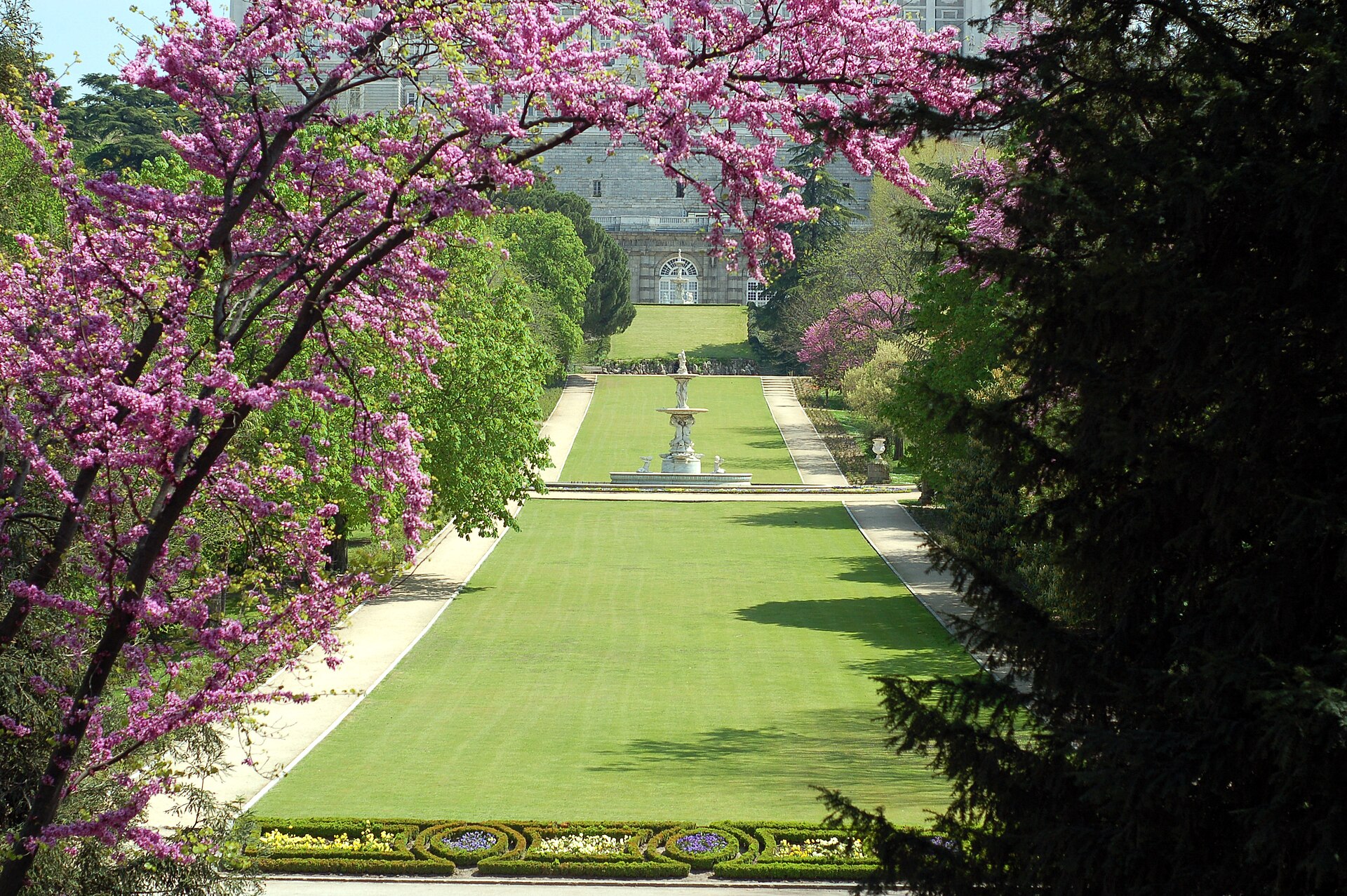
Campo del Moro is laid out in the English landscape style — sweeping lawns, mature tree cover, curving gravel paths — rather than the clipped geometric parterres associated with French formal gardens. That contrast matters for anyone trying to picture it: it reads as informal and wooded rather than as an ornamental courtyard.
Two fountains anchor the composition and are the garden’s best-documented features:
- The Fuente de las Conchas (Fountain of the Shells), set on the main axis facing the palace’s western façade.
- The Fuente de los Tritones (Fountain of the Tritons), further into the grounds.
Patrimonio Nacional’s own materials describe both as part of the garden’s original nineteenth-century ornamentation, moved and adjusted over successive redesigns of the grounds. The garden also holds mature specimen trees, some dating back well over a century, and open lawn areas that give the clearest unobstructed view available anywhere of the palace’s river-facing side.
_04.jpg)
When was the garden created, and is it historic in its own right?
The land below the palace had been used, on and off, as royal grounds since at least the sixteenth century, but the garden visible today is substantially a nineteenth-century creation. It was landscaped during the reign of Isabel II in the style then fashionable for royal parks across Europe, and it was reworked further later in the century. Patrimonio Nacional dates the garden’s public opening to the late 1970s, considerably later than the palace itself, which has received visitors since the nineteenth century.
That gap matters for how to think about the site: the palace is a monument with centuries of continuous royal use behind it, while the garden as it now exists is a much younger landscaping project layered onto older royal land.
Is Campo del Moro open to the public, and what does it cost?
Access is intermittent by design. Patrimonio Nacional restricts opening days and hours, closes the garden for state events at the palace, and has historically kept entry free, though all of this is subject to change and should be confirmed on Patrimonio Nacional’s own website before planning a visit around it. The garden does not currently operate on the same timed-entry ticketing system used for some of the palace’s interior rooms, a system covered in more general terms in the guide to timed entry at Madrid’s major sites.
Because the garden is not always open, it is worth treating a visit as conditional rather than guaranteed, particularly for anyone building a single day around it.
How does it compare to the Sabatini Gardens next door?
Visitors sometimes conflate Campo del Moro with the Jardines de Sabatini, the smaller formal garden on the palace’s northern side, facing Calle de Bailén. The two are different gardens with different characters and different rules. Sabatini is small, geometric, freely and consistently open, and reachable directly from the street without a separate entrance process. Campo del Moro is larger, informal in layout, walled off from casual passage, and open only on Patrimonio Nacional’s schedule. Anyone hoping to walk into “the palace garden” on a whim is more likely to succeed at Sabatini; Campo del Moro requires checking ahead.
How does it fit with Madrid Río and Casa de Campo?
Geographically, Campo del Moro is the missing link between the historic centre and the river corridor. It sits directly above the stretch of Madrid Río that runs along the Manzanares, and it faces the eastern edge of Casa de Campo across the water — the largest green space in the city, reachable from this side by cable car or by crossing further downstream. None of these three green spaces connects directly to another by an internal path; each has its own access points, and Campo del Moro’s are the most restricted of the three.
For anyone assembling a green-space route through this part of the city, it makes more sense to treat Campo del Moro as a discrete, ticketed-hours stop rather than as a walkway between the palace and the river.
Practical notes for a visit
- Check current opening days and any admission terms directly on Patrimonio Nacional’s website before travelling, since these have changed over the years and are not fixed.
- The nearest metro and Cercanías access is around Príncipe Pío; the entrance faces Paseo de la Virgen del Puerto, on the river side rather than the cathedral side.
- The garden has limited shade in its open lawn sections, which is worth weighing against Madrid’s summer temperatures — a factor covered generally in the guide to how Madrid handles summer heat.
- Photography of the palace’s western façade from within the garden is one of the few vantage points that shows this side of the building at all, since it faces away from the main public plazas.
For context on how this garden sits alongside the rest of the city’s monuments and green space, see the broader guides to landmarks and sights and parks and outdoor space in Madrid, and the wider Madrid guide for how a visit here might connect to a fuller day in the city.
Access Madrid is an independent guide written from published, checkable sources. We have not visited the places described here and we do not publish personal recommendations or invented ‘local favourites’ — where something is singled out as notable, we say who says so. Opening times, fares, closures and prices change at short notice, so treat everything here as a starting point and confirm with the museum, operator or venue directly before building a day around it. We give no advice on visas, insurance, health or safety; use your own government’s official guidance for those.
Featured image: Photo by losmininos, source, CC BY-SA 2.0
