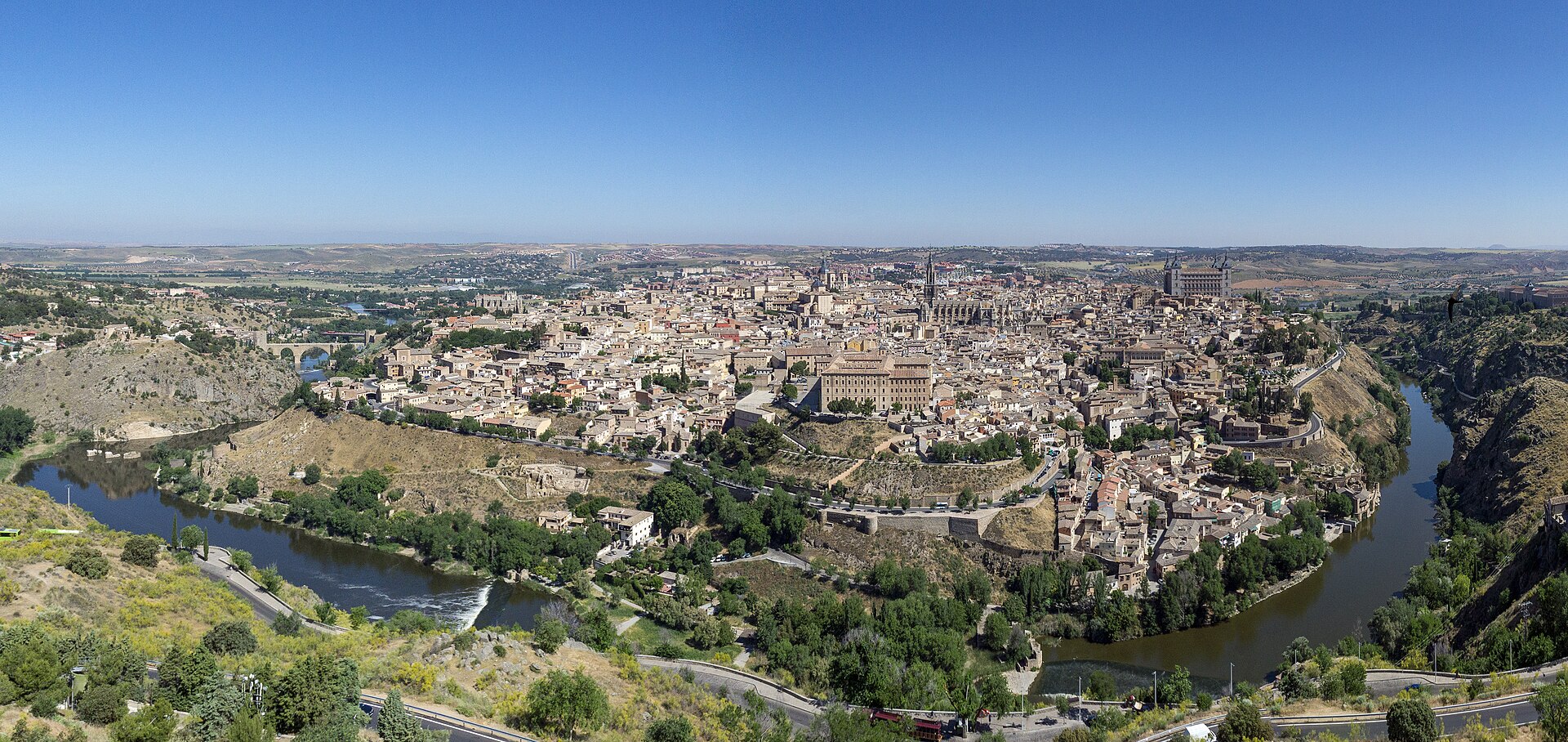
Toledo is a walled city on a granite hill about 70 kilometres south of Madrid, encircled almost entirely by a bend in the Tagus river. It was the capital of Spain until 1561 and is now the capital of the Castile-La Mancha region. UNESCO lists its entire old town as a World Heritage Site. High-speed rail puts it under 35 minutes from central Madrid, which is why it functions as a single day out rather than a trip requiring an overnight stay.
What is Toledo, exactly?
Toledo is the historic seat of Spanish monarchy and of the Catholic Church in Spain — the Archbishop of Toledo still holds the title of Primate of Spain. The city sits on a promontory almost surrounded by the Tagus, which gave it a natural defensive wall long before its stone one existed. Its street plan is medieval: narrow, steep, and largely unaltered since the Middle Ages, because the old town’s terrain has never allowed the kind of large-scale rebuilding that reshaped other Spanish cities.
Its importance predates Madrid’s existence as a capital. Toledo was a Roman city, then a Visigothic capital, then an important city under Muslim rule in al-Andalus, and later the political centre of Christian Castile. Philip II moved the royal court to Madrid in 1561, and Toledo’s political role never fully recovered — which is largely why its old town survives intact rather than being cleared for later development.
Why is Toledo a UNESCO World Heritage city?
UNESCO inscribed Toledo’s historic centre in 1986, citing its role as a former capital where successive civilisations — Roman, Visigothic, Islamic, Jewish and Christian — each left standing monuments rather than replacing what came before. That accumulation, rather than any single building, is the basis of the listing. Details of the inscription are published by UNESCO itself.
The result is a city where a Gothic cathedral, a former mosque converted into a church, and two surviving medieval synagogues stand within walking distance of one another, inside walls that themselves date from several different periods of construction and repair.
How far is Toledo from Madrid, and how do you get there?
Renfe’s AVE high-speed service connects Madrid Puerta de Atocha with Toledo in around 30 minutes, and it is by far the most straightforward way to make the trip in a single day. Regional and bus connections also exist. Timetables and current fares should always be checked on Renfe’s own site, since both change and this site does not track them.
For readers assembling several such trips, the general logistics of reaching towns around Madrid by train and bus are covered separately in how to reach Madrid’s day-trip towns by public transport, and the city’s main stations are explained in the piece on Madrid’s main railway stations. Renfe’s own booking and information site is the authoritative source for train times.
Once in Toledo, the old town itself is walked rather than driven — much of it is pedestrian by necessity, since the street widths and gradients rule out most vehicle traffic. Some visitors reach the upper town from the train station via a series of outdoor escalators built into the hillside, an unglamorous but genuinely useful piece of local infrastructure.

What is inside Toledo’s old town?
The Catedral Primada is the city’s largest monument: a Gothic cathedral begun in 1226 on the site of a former mosque, and the seat of the Primate of Spain. Its holdings include work by El Greco, who spent most of his working life in Toledo, and the cathedral’s sacristy is often cited by art historians for the density of major paintings kept in a single room.
Other durable landmarks include:
- Alcázar de Toledo — a fortress on the city’s highest point, rebuilt repeatedly over the centuries and now housing the regional army museum.
- Sinagoga de Santa María la Blanca and Sinagoga del Tránsito — two of Europe’s best-preserved medieval synagogues, both converted to churches after the expulsion of Spain’s Jewish population in 1492 and later restored as heritage sites.
- Mosque of Cristo de la Luz — a small former mosque dating to the 10th century, one of the oldest surviving Islamic buildings in Spain.
- Museo del Greco — a museum dedicated to the painter’s life and work in the city, distinct from his paintings held in the cathedral and in Madrid’s Prado.
- Puente de Alcántara and Puente de San Martín — the two historic bridges spanning the Tagus gorge, both of Roman or medieval origin and still in use.
These sit within a compact old town that can genuinely be crossed on foot in under an hour, though the gradient is steady throughout — Toledo’s hill is not gentle.
What does Toledo mean by the “city of three cultures”?
The phrase refers to the long coexistence, and eventual conflict, of Christian, Jewish and Muslim communities in the city under Castilian and earlier rule. It is a description used by the city’s own tourism authority and by regional heritage bodies, not a neutral historical term, and readers should treat it as an interpretive framing rather than a fixed fact.
What is verifiable is the physical record: synagogues built with Islamic-style stucco decoration, a converted mosque still standing near the cathedral, and a former Jewish quarter (Judería) whose street pattern survives largely intact. The three communities’ fortunes were not equal or continuous — Jewish and Muslim populations were both eventually expelled from Spain by royal decree at the end of the 15th century — and Toledo’s monuments record that history as much as any harmonious coexistence.
Is Toledo a day trip, or worth an overnight?
Toledo is one of the few towns near Madrid genuinely built for a single day out. The AVE connection is fast enough that a reasonably early departure allows a full day inside the walls with a return before evening, and the old town’s monuments are close enough together that a first-time visitor does not need two days to see the major sites.
An overnight stay changes the experience mainly in one respect: the old town after the day’s coach traffic has left is markedly quieter, and its lit skyline over the Tagus gorge at night is a different sight from the daytime one. Whether that trade-off is worth an extra night is a matter of preference the operator’s own site cannot answer for a reader — but for most people coming from Madrid, a well-planned day is sufficient. For comparison, whether Cuenca works better as a day trip or an overnight makes a useful contrast, since Cuenca’s transport links are less convenient than Toledo’s.
How does Toledo compare to Madrid’s other day trips?
Toledo is usually grouped with Segovia and Aranjuez as one of the classic rail day trips from Madrid, though each offers something different: Segovia for its Roman aqueduct and cathedral skyline, Aranjuez for its royal palace and gardens, Toledo for the density and layering of an entire former capital. Readers weighing several of these against each other will find the broader pattern of day-trip logistics covered in the Day Trips archive and in the Madrid guide hub.
Because Toledo draws heavy coach and tour traffic, especially around midday, some of its major sites operate timed or limited entry at peak periods — a pattern also seen at busy sites within Madrid itself, discussed generally in the piece on timed entry at Madrid’s major sites. Toledo’s cathedral and Alcázar publish their own current entry arrangements, which should be checked directly rather than assumed.
What should Madrid residents know before going?
For anyone living in Madrid rather than visiting once, Toledo is close enough to justify a repeat visit outside peak season — spring and autumn weekday travel avoids both the summer heat on the exposed hillside streets and the heaviest tour-group traffic. The AVE frequency is dense enough that a spontaneous half-day trip is realistic for a resident with a Renfe card or an online booking, without the advance planning a first-time visitor might assume is necessary.
Broader questions about planning trips out of the city, and about how Madrid’s own transport and seasonal rhythms work for residents, are covered across the Madrid practical hub and the Planning & Practicalities archive, alongside the day-to-day detail collected in the Living in Madrid hub.
Access Madrid is an independent guide written from published, checkable sources. We have not visited the places described here and we do not publish personal recommendations or invented ‘local favourites’ — where something is singled out as notable, we say who says so. Opening times, fares, closures and prices change at short notice, so treat everything here as a starting point and confirm with the museum, operator or venue directly before building a day around it. We give no advice on visas, insurance, health or safety; use your own government’s official guidance for those.