Aranjuez is a town about 47 kilometres south of Madrid, built around a former royal residence and its gardens on the banks of the Tagus river. It functioned as a spring and autumn retreat for the Spanish court from the 16th century onward, and UNESCO has inscribed its palace, town plan and gardens as a single cultural landscape.
What is Aranjuez, exactly?
Aranjuez is a municipality in the Comunidad de Madrid, sitting where the Tagus and Jarama rivers meet fertile flatland unusual for the region’s dry plateau. That water and soil made it valuable to the Spanish crown centuries before it became a day-trip destination, and the town that grew up around the royal estate still carries an 18th-century grid plan rather than the layered medieval street pattern found in nearby Toledo.
Why does it have a royal palace?
The site was already a hunting ground of the medieval military order of Santiago before the crown acquired it. Philip II began formal building work in the 16th century, and later Bourbon monarchs, especially Charles III and Ferdinand VI, expanded the palace and its grounds into a full working residence, used deliberately as a spring retreat from Madrid rather than a permanent capital.
What is inside the Palacio Real de Aranjuez?
The palace is managed by Patrimonio Nacional, the state body responsible for former Spanish royal properties, and its own listings describe state rooms, royal apartments and a notable Porcelain Room lined with modelled ceramic decoration produced at Madrid’s Buen Retiro porcelain factory. Furnishings and decorative schemes largely reflect 18th- and 19th-century royal taste rather than the palace’s earlier Habsburg-era phases.
Patrimonio Nacional’s own site is the source to check for current opening days, closures and ticket prices, since these change and are not fixed facts about the building itself.
What are the gardens like, and how many are there?
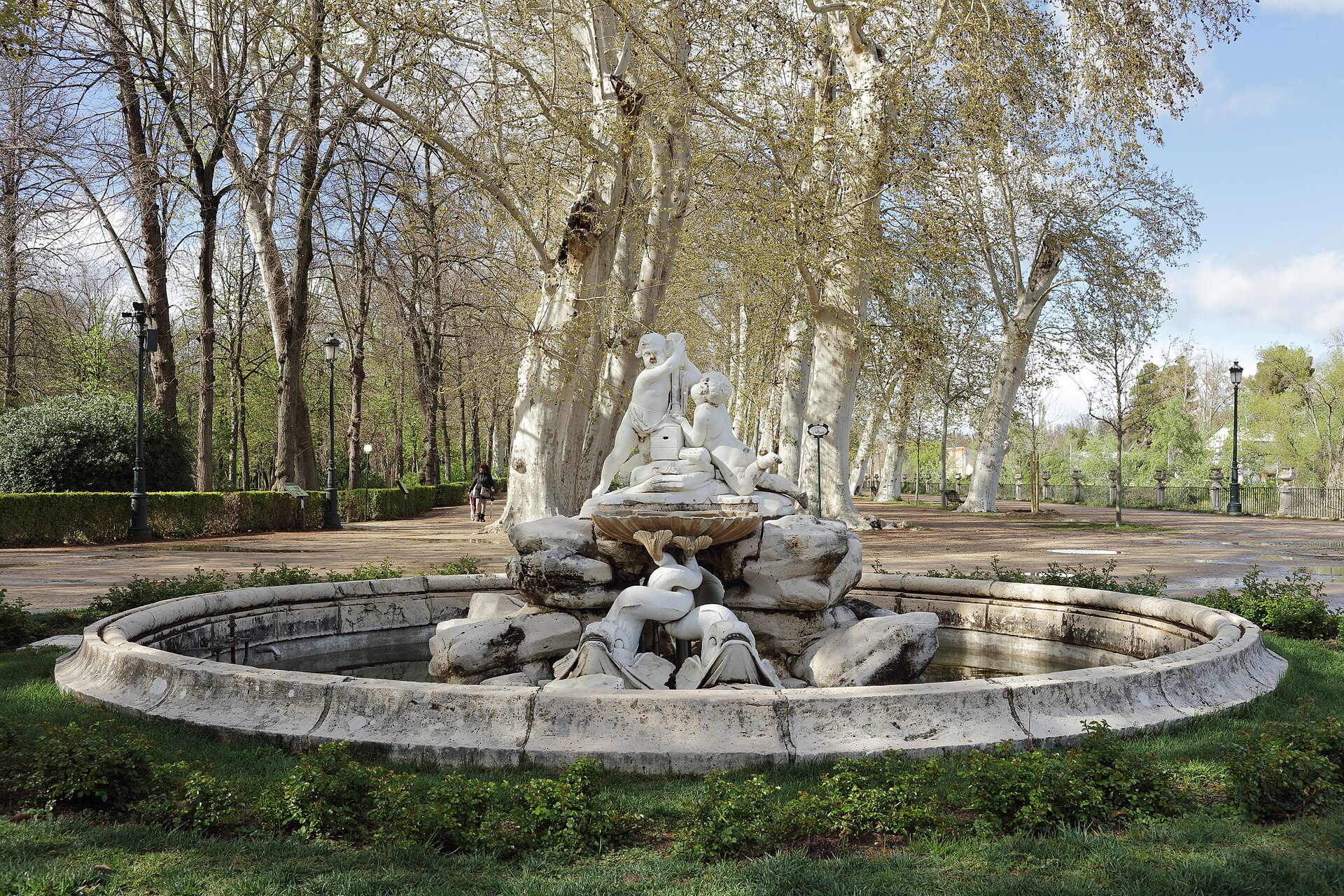
Aranjuez has several distinct gardens rather than one continuous park. The Jardín de la Isla sits on a former river island and dates largely to the 16th century; the Jardín del Príncipe is a much larger 18th-century landscape garden laid out along the Tagus, and it contains the Casa del Labrador, a smaller pavilion built for Charles IV in a style modelled on the era’s fashionable “cottage” pleasure houses despite its lavish interior. Together they cover a far greater area than the palace itself.
Readers comparing this to Madrid’s own royal garden can find the equivalent city-centre grounds described in the guide to Campo del Moro, and Aranjuez’s botanical planting is worth setting against the capital’s own Real Jardín Botánico.

Is Aranjuez a UNESCO site?
Yes. UNESCO inscribed the “Aranjuez Cultural Landscape” on its World Heritage List, and its citation covers the interaction of the palace, gardens, the planned town and the surrounding agricultural land over three centuries, rather than the palace as an isolated monument. That distinction matters: the listing is about the whole working landscape, not a single building.
What else is Aranjuez known for?
Aranjuez has a long-standing reputation, referenced in Spanish agricultural and gastronomic sources, for strawberries (fresas) and white asparagus grown in the fertile land around the town, a product of the same river-fed soil that made it attractive to the crown in the first place. The composer Joaquín Rodrigo also named his best-known guitar work, the “Concierto de Aranjuez,” after the town, a reference to its gardens rather than a description of any specific event held there.
How do you get to Aranjuez from Madrid?
Aranjuez sits on a Cercanías regional rail line running from Madrid, making it reachable without a car. Readers unfamiliar with the difference between this regional network and the city metro should see the explainer on how Cercanías differs from the Metro, and the overview of Madrid’s main railway stations for where these services depart. Renfe, the state rail operator, is the authority to check for current timetables and fares, since these are not fixed and should not be assumed from older listings.
How does Aranjuez compare to Madrid’s other day trips?
Aranjuez is flatter, greener and more garden-focused than most of the region’s other day trips, which tend to centre on hilltop old towns or fortified monuments. It reads differently from the walled medieval city of Toledo, the Roman aqueduct and old town of Segovia, or the austere royal monastery at El Escorial. Where those sites emphasise stone, height and defence, Aranjuez is built around water, cultivated land and formal garden design, and its royal history is expressed through leisure architecture rather than fortification.
What is the town itself like beyond the palace?
The town centre follows an orderly 18th-century layout of straight streets and porticoed squares, distinct from the winding medieval cores found elsewhere in the region. It functions as a genuine working town with its own residents and services, not solely as an attraction built around the palace grounds, and it retains a market culture tied to the surrounding market gardens. Readers interested in how market halls function more broadly across the region can see the overview in Food & Markets.
How should a visit be planned?
Because Aranjuez combines an indoor palace with extensive outdoor gardens, weather matters more here than at some other day trips; the gardens are large and mostly unshaded in parts, and Patrimonio Nacional’s opening pattern for the palace interior is not the same as access to the garden grounds, which often keep longer or separate hours. General guidance on structuring a day trip, including transport timing and what a single day realistically allows, is covered in the archive for Day Trips, and readers building a broader itinerary around Madrid itself can start from the main Madrid guide hub.
Anyone travelling from outside Spain should confirm current entry and travel requirements through their own government’s official travel advice rather than relying on third-party guides, including this one.
Access Madrid is an independent guide written from published, checkable sources. We have not visited the places described here and we do not publish personal recommendations or invented ‘local favourites’ — where something is singled out as notable, we say who says so. Opening times, fares, closures and prices change at short notice, so treat everything here as a starting point and confirm with the museum, operator or venue directly before building a day around it. We give no advice on visas, insurance, health or safety; use your own government’s official guidance for those.
Featured image: Photo by Fernando García from Madrid, España, source, CC BY 2.0
