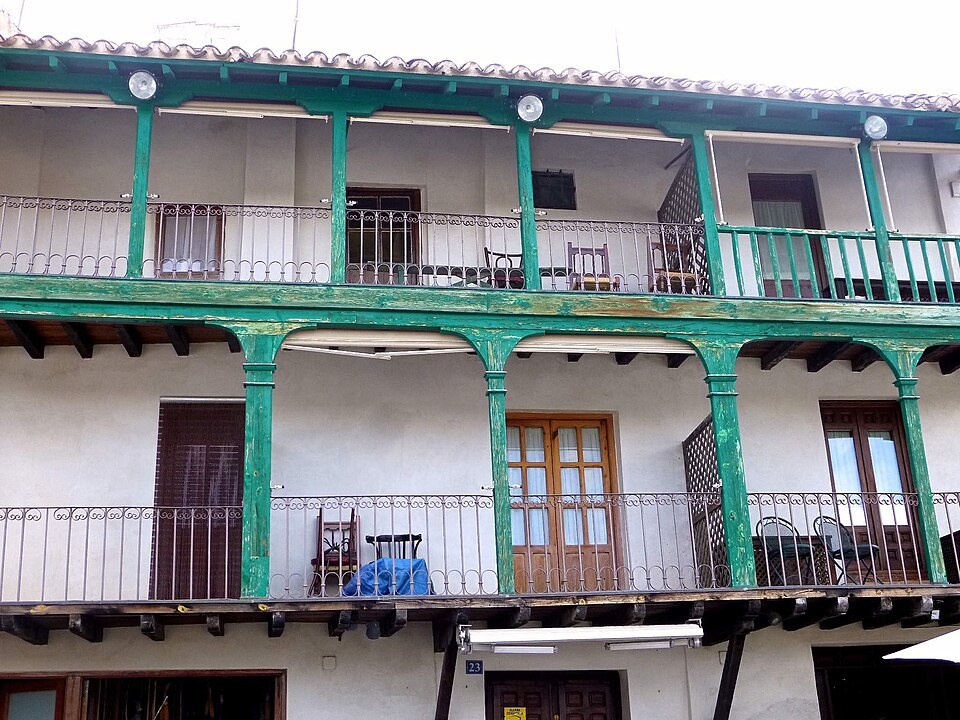
Chinchón is a small town in the Community of Madrid, about 45 kilometres southeast of the capital, built around an irregular, arcaded Plaza Mayor lined with tiered wooden balconies. It is known for that square, for a locally produced anís liquor, for a Goya painting in its parish church, and for a castle that later became a distillery.
Where is Chinchón, and how big is it?
Chinchón sits in the Las Vegas district southeast of Madrid, in flat agricultural country near the Tajuña river. It is a genuinely small municipality — official population figures put it at roughly 5,000 residents — and it functions as the administrative centre of its surrounding comarca rather than as a satellite of the capital. It has no rail connection; it is reached entirely by road.
What is the Plaza Mayor known for?
Chinchón’s Plaza Mayor is the reason the town appears in most guides to the region. It is an irregular, sloping square enclosed by buildings whose upper floors are wrapped in wooden galleries and balconies, stacked in tiers, supported on stone columns at ground level. The square has been declared a protected historic site by Spanish heritage authorities, and it has a documented double life: as a public gathering space, and — during festivals — as an improvised bullring, with the balconies serving as private viewing boxes, a use recorded in the town’s own festival history going back centuries.
The plaza also hosts a Passion play during Easter week, performed with the square itself as the stage. Madrid’s regional tourism authorities list Chinchón’s Holy Week observances among the region’s declared events of tourist interest — a formal designation, not a marketing phrase, and one worth checking on the regional tourism board’s own site if the timing of a visit matters.
What does Chinchón have to do with anís?
Chinchón is closely associated with anís, an aniseed-flavoured spirit that has been produced in the town since at least the 18th century and still carries the town’s name as a brand. The industry grew up around the castle on the edge of town, which was repurposed as a distillery and warehouse space after its original defensive function ended. The connection between the town and the drink is old enough that “Chinchón” functions as shorthand for the spirit itself in parts of Spain, the way a place name sometimes becomes a product name.
What else is there to see in the town?
Two buildings account for most of what is written about Chinchón beyond the square itself:
- The Castillo de los Condes de Chinchón — a castle built for the Counts of Chinchón, standing on rising ground above the town. It was later used for industrial storage connected to the anís trade rather than kept as a residence, which is part of why its interior is not generally open in the way a fully restored monument would be.
- The Iglesia de Nuestra Señora de la Asunción — the parish church, which holds a painting of the Assumption of the Virgin attributed to Francisco de Goya. Goya’s brother Camilo served as chaplain of the church, which is the documented reason the commission went to him.
The town’s former Augustinian convent, a 17th-century building, now operates as a state-run Parador — one of the network of hotels Spain’s Paradores organisation runs inside historic buildings across the country. Its status as a repurposed convent is a matter of record on the Paradores’ own site, independent of any view on staying there.

How do you get from Madrid to Chinchón?
There is no train service to Chinchón, so the town falls outside the Cercanías network described elsewhere on this site. Access is by road: an interurban bus route operated under the Community of Madrid’s transport consortium connects the capital with the town, and driving is the other common option, given the short distance. Because route numbers and timetables change, the transport consortium’s own site is the place to confirm current service before planning a trip — the same caution this site applies to any timetable, whether for a Madrid railway station or a bus line.
What is Chinchón’s food known for?
Garlic is a recognised regional product of the Las Vegas area around Chinchón, and the town’s restaurants are commonly associated with roast meats served in the local, hearty style typical of small towns in inland Spain — the kind of cooking this site covers more generally in its pieces on dishes associated with the Madrid region and on the structure of a menú del día. Specific restaurant recommendations are not something this site makes without a named, checkable source — a Michelin listing or an official designation — so none appear here.
Is Chinchón worth combining with another day trip?
Chinchón sits close enough to Aranjuez, the royal garden town on the Tajo river, that the two are sometimes covered together in itinerary planning, though they are reached by different means — Aranjuez has its own Cercanías line, while Chinchón does not. Anyone planning either as a single outing from Madrid may find it useful to read the dedicated explainer on what Aranjuez is and how it works as a day trip before deciding whether to attempt both in one day or treat them separately.
When is a reasonable time to visit?
Chinchón’s calendar follows the same broad seasonal pattern as the rest of the region — hot, dry summers and a milder rest of the year — covered in more detail in this site’s guide to Madrid’s climate through the year. Its Easter Passion play draws the most attention to a specific set of dates, and its festival calendar generally means the Plaza Mayor is busier and sometimes closed to casual entry during organised events, so checking the town hall’s or the regional tourism board’s published calendar before travelling is worth doing rather than assuming a fixed schedule.
Where does Chinchón fit for someone planning from Madrid?
For a first-time visitor to the wider region, Chinchón is a short, self-contained outing rather than a full day’s itinerary on its own — most published guidance treats it as a half-day trip built around the Plaza Mayor, the castle exterior, and the church. Readers building a broader plan around Madrid itself may find it useful to start with this site’s guide to a first visit to Madrid in a sensible order, or to browse the wider day trips archive and the main Madrid guide for how Chinchón sits alongside other towns commonly reached from the capital.
Access Madrid is an independent guide written from published, checkable sources. We have not visited the places described here and we do not publish personal recommendations or invented ‘local favourites’ — where something is singled out as notable, we say who says so. Opening times, fares, closures and prices change at short notice, so treat everything here as a starting point and confirm with the museum, operator or venue directly before building a day around it. We give no advice on visas, insurance, health or safety; use your own government’s official guidance for those.
Featured image: Photo by M.Peinado from Alcalá de Henares, España, source, CC BY 2.0
