Some links on this page are affiliate links. If you book through one, this site may earn a commission at no extra cost to you. It never changes which option we recommend, and the prices below are the same either way.
Cuenca works well as a day trip if the plan is limited to the old town and its museums — the high-speed train makes it roughly an hour each way from Madrid. It becomes an overnight if the plan includes the Ciudad Encantada, the wider Serranía de Cuenca, or simply seeing the hanging houses lit at dusk, since the last fast train back leaves earlier in the evening than in Madrid itself.
How far is Cuenca from Madrid?
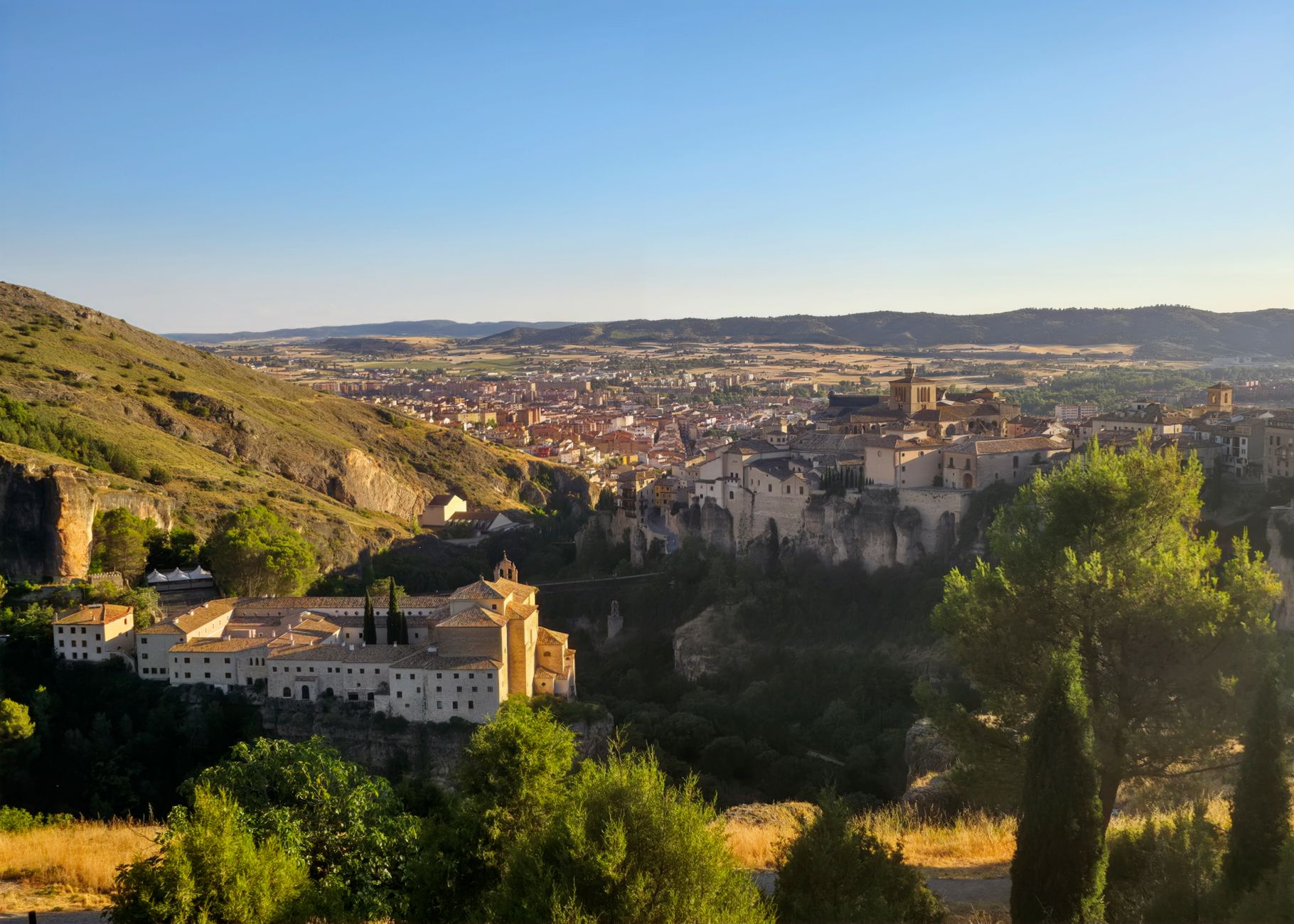
Cuenca is about 165 km southeast of Madrid, in the autonomous community of Castilla-La Mancha, at the edge of a limestone upland known as the Serranía de Cuenca. It sits on a narrow spur of rock between two river gorges — the Júcar and the Huécar — which is the whole reason its old town looks the way it does.
The practical distance is set by the train. Renfe runs AVE and Alvia high-speed services from Madrid’s Puerta de Atocha to a station called Cuenca-Fernando Zóbel, on the edge of the modern town, with a journey time Renfe’s own site lists at around 55 minutes to just over an hour depending on the service. That is faster than the equivalent regional line was for decades, and it is the reason Cuenca now reads as a comfortable day trip rather than a full expedition. Details on stations and connections are covered on this site’s guide to Madrid’s main railway stations and its broader look at trains from Madrid to other Spanish cities; current timetables and fares should always be confirmed on Renfe’s own site, since both change.
Driving is a similar length of trip in clear traffic but with none of the flexibility of a fixed timetable, and parking inside the old walled town is limited by its medieval street layout — most visitors arriving by car use the lower, modern part of the city and walk or take a local bus up.
What is actually in Cuenca?
Cuenca’s historic significance rests on one specific fact: UNESCO inscribed the walled city as a World Heritage Site in 1996, citing its medieval street plan and its position on the rock spur between the two gorges as an unusually intact example of a fortified hill town.
- Casas Colgadas (the Hanging Houses) — a row of medieval houses built directly onto the cliff edge above the Huécar gorge, their wooden balconies cantilevered out over the drop. They are the single most reproduced image of Cuenca and the clearest physical explanation of the town’s site.
- Museo de Arte Abstracto Español — housed inside one of the Casas Colgadas itself, this museum holds a significant collection of Spanish abstract art from the 1950s onward, assembled originally around the painter Fernando Zóbel, after whom the railway station is named. It is a national-reference collection for the period, not a minor local gallery.
- Cuenca Cathedral — a Gothic cathedral on the Plaza Mayor, unusual in Spain for incorporating early Anglo-Norman Gothic elements, reflecting the period of its 12th- and 13th-century construction under Alfonso VIII.
- The old town’s street plan itself — narrow, stepped, and largely pedestrian, running the length of the spur between the two gorges, with the Plaza Mayor as its effective centre.
None of this requires more than a day to see properly. The old town is compact, and its sights are within walking distance of each other, if steeply so.
What can’t be done in a single day?
The Ciudad Encantada is the main reason travellers extend the trip. It is a formation of limestone rocks eroded into distinctive shapes over millions of years, spread across a marked walking route roughly 35 km from Cuenca’s old town, inside the Serranía de Cuenca natural park. It has no rail connection — reaching it requires a car, an organised transfer, or a taxi, and the round trip plus the walking route itself takes most of a separate day.
If you stay over to see it, a car covers both legs: the drive out from Madrid and the 35 km from the old town to the rocks. Compare Madrid car rental prices.
The wider Serranía de Cuenca — gorge walks, the source of the Cuervo river, smaller villages in the hills — falls into the same category: genuinely reachable from Cuenca, but not from Madrid within a single day trip on top of the old town.
An overnight stay also changes what the old town itself offers. The Casas Colgadas and the gorge views are commonly photographed in evening light, and Cuenca’s Semana Santa (Holy Week) processions, which UNESCO has separately recognised as an item of Intangible Cultural Heritage alongside those of several other Spanish cities, run into the night — an experience unavailable to anyone catching an afternoon train home. As with any dated event, exact timings shift with the church calendar and should be checked against the current year before planning around them.
How much time does the old town actually need?
A comfortable visit to the walled town — cathedral, Casas Colgadas, the abstract art museum, and a walk along the gorge paths — fits into four to six hours of unhurried movement, which is what makes the round trip from Madrid workable within a single day once train times are set against opening hours.
The constraint is not distance but terrain. Cuenca’s old town is built on a steep rock spur, and its streets are stepped rather than flat for long stretches. This is not a city to move through quickly, and travellers used to the level ground of central Madrid should budget more time than the map distance suggests. This site’s broader guide to itineraries and day plans covers how terrain, not just distance, should shape a day’s pacing.
Museum opening patterns follow the general Spanish rhythm covered in this site’s guide to Madrid opening hours — many sites close for a midday stretch or close entirely on Mondays, and the Museo de Arte Abstracto Español’s own site should be checked for current hours before a day trip is built around it specifically.
Is Cuenca better than Toledo or Segovia as a day trip?
It depends on what the day is for. Toledo and Segovia sit closer to Madrid and offer denser concentrations of major monuments within their old towns; Cuenca offers a single, sharply defined landscape — the gorge-top town — with fewer competing sights but a more distinctive setting.
Readers comparing options can see the equivalent breakdowns for Toledo and Segovia, both of which set out train times and what each town actually contains. Cuenca is the better choice for travellers specifically drawn to the hanging houses, the abstract art collection, or the idea of a walled town defined by two gorges rather than a river valley or an aqueduct.
So: day trip or overnight?
For the old town alone — cathedral, Casas Colgadas, the museum, the gorge walks — a day trip from Madrid is entirely workable given current train times, and most visitors treat it that way.
An overnight is worth it specifically for the Ciudad Encantada, for evening and night views of the hanging houses over the gorge, or for visiting during Semana Santa, when the city’s processions run late and hotel space in the old town is limited by demand. Anyone building this into a longer stay in the region should treat it as a planning decision made around what is actually wanted from the trip, not a default upgrade — a distinction this site’s broader day trips archive applies across all of the towns reachable from Madrid.
Those weighing Cuenca against a wider stay in the capital may also find it useful to see how the city fits into a longer visit via this site’s guide to planning a first visit to Madrid in a sensible order, which covers where day trips like this one typically sit within a week’s itinerary.
Access Madrid is an independent guide written from published, checkable sources. We have not visited the places described here and we do not publish personal recommendations or invented ‘local favourites’ — where something is singled out as notable, we say who says so. Opening times, fares, closures and prices change at short notice, so treat everything here as a starting point and confirm with the museum, operator or venue directly before building a day around it. We give no advice on visas, insurance, health or safety; use your own government’s official guidance for those.