Alcalá de Henares is a city of around 200,000 people in the eastern part of the Community of Madrid, roughly 35 kilometres from the capital. It is built around one of Europe’s oldest universities and is the recorded birthplace of Miguel de Cervantes. UNESCO lists its university and historic centre as a World Heritage Site.
Where is Alcalá de Henares, and is it part of Madrid?
Alcalá de Henares is an independent municipality, not a district of the capital. It sits in the Henares river valley, which gives the city its name, and belongs administratively to the Community of Madrid — the same regional government that covers the capital and its surrounding towns.
Because it falls within the region’s transport network, it is reachable on the same Cercanías commuter rail system used for daily travel around Madrid, which is one reason it functions as a straightforward day trip rather than a separate journey requiring a change of operator or ticket type.
How do you get there from Madrid?
The most direct route is Cercanías line C-2, which runs from Chamartín through Recoletos, Atocha, and other central stops out to Alcalá de Henares. Renfe operates the service, and journey time is generally under 40 minutes from central Madrid stations.
Because Alcalá lies outside the metro’s own fare zones, it is not reached by metro; readers relying on a standard metro-only card should check the zonal structure before travelling — the difference between Cercanías and metro ticketing is explained in more detail in the guide to how Cercanías compares with the Metro. General background on Madrid’s main stations, including which ones serve Cercanías lines, is covered in the piece on Madrid’s main railway stations.
Why does Alcalá de Henares have UNESCO status?
UNESCO inscribed the “University and Historic Precinct of Alcalá de Henares” as a World Heritage Site in 1998. According to UNESCO’s own listing, the city is recognised as the first purpose-planned university town, later used as a model for other university cities in Europe and the Americas.
The inscription covers the historic centre as a whole rather than a single building: the university complex, the surrounding street plan, and a number of religious and civic buildings tied to the city’s role as a centre of learning from the late 15th century onward.
What is the University of Alcalá, and does it still function?
The Universidad de Alcalá was founded in 1499 under Cardinal Francisco Jiménez de Cisneros, then archbishop of Toledo, as a centre for theological and humanist study. Its principal historic building, known as the Colegio de San Ildefonso, includes the Paraninfo hall, still used today for formal university ceremonies.
The university continues to operate as a public institution with active faculties, so the historic core sits alongside a working modern university rather than functioning purely as a preserved monument. The Paraninfo is the venue each year for the presentation of the Premio Cervantes, the Spanish-language literature prize awarded by Spain’s Ministry of Culture, typically held on 23 April and generally attended by the reigning monarch.
What is the Cervantes connection, specifically?
Miguel de Cervantes, author of Don Quixote, was baptised in Alcalá de Henares in 1547, and municipal and academic records treat the city as his birthplace. A house on Calle Mayor, restored and presented as the Museo Casa Natal de Cervantes, is run as a museum dedicated to his life and period, with reconstructed period rooms and material on his work.
The city’s main square, Plaza de Cervantes, carries his name and a statue of the author, and sits at the centre of the historic precinct alongside the Cisneros-era religious foundations that make up much of the UNESCO-listed area.
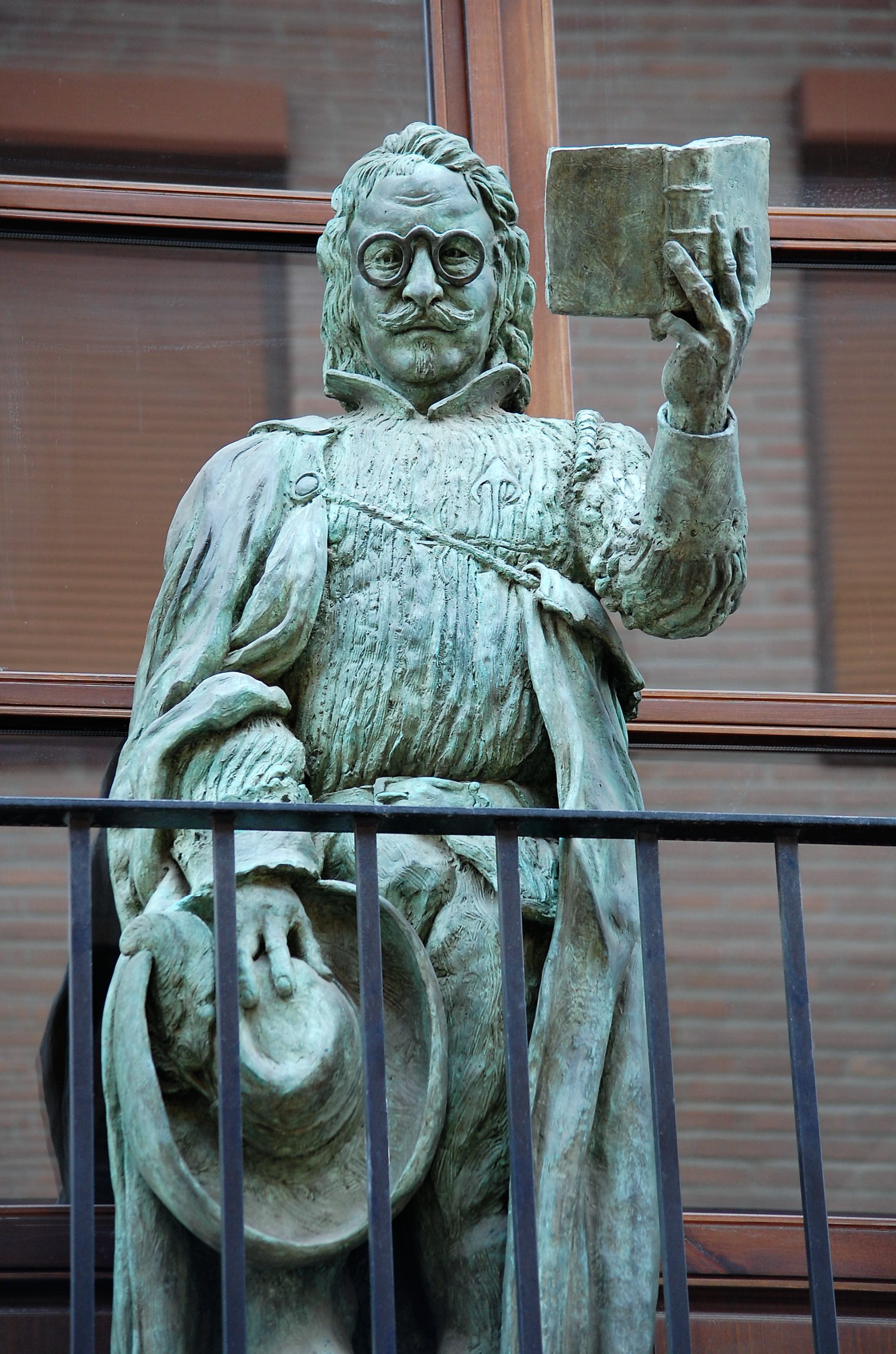
_estatua_de_Francisco_de_Quevedo_en_la_calle_Escritorios.png)
What is the Corral de Comedias, and why is it notable?
The Corral de Comedias in Alcalá de Henares is a theatre building dating to the early 17th century, built in the “corral” format typical of Spanish Golden Age theatre, where performances took place in an open courtyard enclosed by surrounding buildings. Alcalá’s municipal and tourism authorities describe it as one of the oldest theatres of this kind still standing in Europe, restored and still used for performances.
It sits within walking distance of Plaza de Cervantes and the university buildings, and forms part of the same historic quarter covered by the UNESCO inscription rather than a separate site elsewhere in the city.
What else is in the historic centre?
Beyond the university and the theatre, the historic precinct includes several buildings tied to the city’s ecclesiastical and administrative history:
- The Catedral Magistral, one of a small number of churches in Spain with “magistral” status, tied historically to a chapter of theologians connected to the university.
- The Palacio Arzobispal, the former archbishop’s palace, part of Alcalá’s long role as a seat of the archdiocese of Toledo before that role shifted elsewhere.
- A number of former convents and colegios built to house religious orders that taught within the university system, several of which survive as institutional or municipal buildings today.
Storks nesting on several of the taller historic towers are a recorded seasonal feature of the city, noted by regional tourism material, and their nests are visible on rooftops around the old town for much of the year.
Is Alcalá de Henares worth a full day, or can it be done faster?
The historic centre is compact enough that the main sites — the university buildings, Plaza de Cervantes, the Cervantes birthplace museum, and the Corral de Comedias — can reasonably be covered within a half day, particularly compared with day trips that involve longer rail journeys, such as those covered in the guides to Toledo or Segovia.
Because of the shorter Cercanías journey, some visitors combine Alcalá with another half-day plan in Madrid itself rather than treating it as a standalone excursion. The broader hub on day trips from Madrid sets out how Alcalá compares with other options such as El Escorial in terms of distance and scope.
How does a visit fit around opening days and the Cervantes calendar?
As with most Spanish monuments and university buildings, several sites in Alcalá close on Mondays or run reduced hours outside peak season, and hours for the Casa Natal de Cervantes and the university’s guided visits are set independently by their respective operators. Readers should confirm current hours directly with the university and the museum before travelling, since neither publishes a fixed year-round schedule.
The Premio Cervantes ceremony each spring is the one fixed point in the city’s calendar with national visibility, but it is an institutional event with restricted access rather than a public festival, so it affects visiting logistics around the university more than it opens up anything extra to see.
How does Alcalá de Henares fit into planning a wider Madrid trip?
For visitors building a longer itinerary, Alcalá works well as a contrast to central Madrid’s museum-heavy core, since its interest lies in a single coherent historic quarter rather than in separate collections. It pairs naturally with background reading on Madrid’s own landmarks and monuments or its museums and galleries, and general trip planning — including how rail and Cercanías travel fit into wider journeys around the region — is covered in the practical hub on getting around and planning in Madrid. Those continuing on to other Spanish cities from Madrid can also check the overview of rail connections from Madrid, since Alcalá’s station also serves some longer-distance routes east.
For a wider sense of how day trips, neighbourhoods, and the capital’s core sights sit together, the main Madrid guide is the starting point for structuring a visit around Alcalá alongside the city itself.
Access Madrid is an independent guide written from published, checkable sources. We have not visited the places described here and we do not publish personal recommendations or invented ‘local favourites’ — where something is singled out as notable, we say who says so. Opening times, fares, closures and prices change at short notice, so treat everything here as a starting point and confirm with the museum, operator or venue directly before building a day around it. We give no advice on visas, insurance, health or safety; use your own government’s official guidance for those.
Featured image: Photo by Raimundo Pastor, source, CC BY-SA 4.0
_Plaza_de_Cervantes.png)