The Barrio de las Letras is a small district in central Madrid, roughly bounded by the Carrera de San Jerónimo, the Paseo del Prado, Calle de Atocha and Plaza de Santa Ana. It takes its name from the writers of Spain’s Golden Age — Miguel de Cervantes, Lope de Vega, Francisco de Quevedo and Luis de Góngora — who lived, worked and in some cases feuded within a few streets of one another here in the late 1500s and 1600s.
Where exactly is the Barrio de las Letras?
It sits inside the Centro district, wedged between the Museo del Prado to the east and Puerta del Sol to the west, with Plaza de Santa Ana forming its rough centre. It is not a separate municipal ward with fixed administrative borders — the name describes a historic quarter recognised by convention rather than by city boundary maps, though Madrid’s tourist board and street signage both use it.
Its streets carry the names of the writers associated with them: Calle de Cervantes, Calle de Lope de Vega, Calle de Quevedo, Calle de Huertas. That naming is not a modern branding exercise — many of these street names date back centuries, which is part of why the literary association has stuck so firmly to this particular patch of the city rather than being applied loosely to central Madrid generally.
Why is it called the Barrio de las Letras?
The name refers to “letters” in the literary sense — de las Letras means “of letters,” as in literature — because an unusual concentration of major Spanish Golden Age writers lived within this small area during roughly the same decades. It is a district defined by residence, not by any single building or monument.
Madrid in the late sixteenth and early seventeenth centuries was the newly established capital of Spain, and the printing trade, theatres and patronage networks that supported writers clustered near the court. The area around what is now Plaza de Santa Ana and Calle de las Huertas became a natural base: close to the Palacio Real and to the corrales de comedias, the open-air theatres where plays were performed for a paying public.
Who actually lived there?
Several major figures of Spanish literature are documented as having lived within the district, in some cases only streets apart.
- Miguel de Cervantes, author of Don Quixote, lived and died on what is now Calle de Cervantes. He is buried nearby in the Convento de las Trinitarias Descalzas on Calle de Lope de Vega, a working convent that remains a place of religious observance rather than a museum.
- Lope de Vega, the prolific playwright often credited with founding Spanish national theatre, lived on the street that now bears his name. His house survives and is open to the public as the Casa Museo Lope de Vega, managed as a historic house museum with period rooms and a small garden reconstructed from his own writings about it.
- Francisco de Quevedo, satirist and poet, had residences in the same area and is associated with the Convento de las Trinitarias as well, though the exact site of his burial has been debated by historians.
- Luis de Góngora, Quevedo’s great rival in verse, also lived in the district for periods of his life.
Literary historians have long documented the antagonism between Quevedo and Góngora, who traded insults in verse for years, and the more complicated professional relationship between Cervantes and Lope de Vega, who were contemporaries, rivals for public favour, and — according to biographers of both men — never on especially warm terms.
What can be visited today?
The most direct way into this history is the Casa Museo Lope de Vega, the writer’s reconstructed home, which functions as a conventional house museum with a documented collection of period furnishings and manuscripts. Entry is typically free but subject to timed slots; the museum’s own site is the only reliable source for current opening arrangements.
The Convento de las Trinitarias Descalzas, where Cervantes is buried, remains an active convent rather than a visitor attraction, and access to the interior is limited accordingly.
The Ateneo de Madrid, a cultural and literary society founded in the nineteenth century, has its historic seat within the district and maintains a library open to members and, at times, to researchers by arrangement — a living institutional link to the area’s literary identity rather than a static monument.
The Teatro Español, on Plaza de Santa Ana, occupies the site of one of Madrid’s original corrales de comedias, the public theatres where plays by Lope de Vega and his contemporaries were first staged. The current building dates from later rebuilding, but the site’s theatrical use is continuous from the sixteenth century.
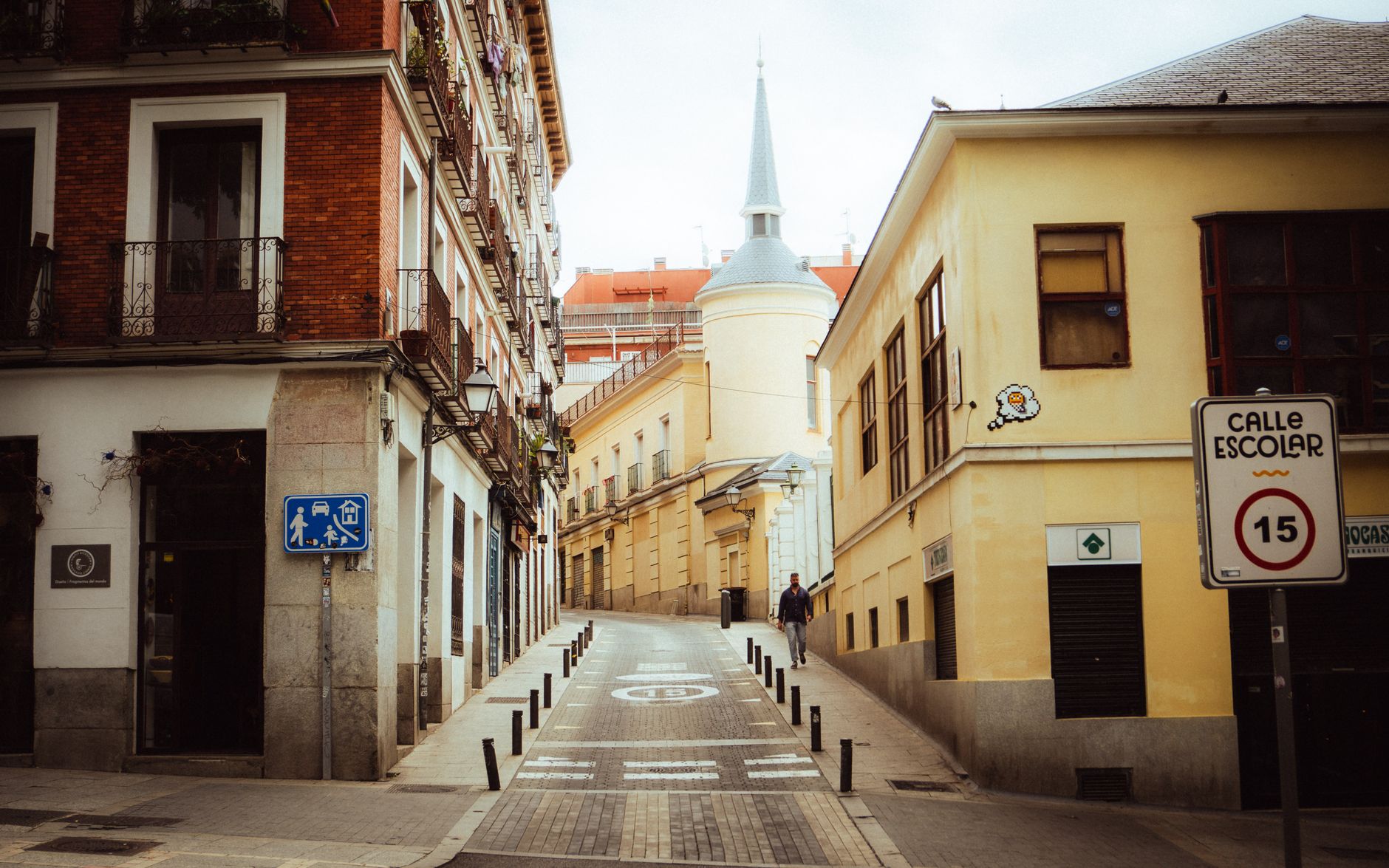
What are the bronze letters set into the pavement?
Visitors to the district often notice lines of text embedded in bronze lettering along the pavements of several streets, quoting passages from the writers associated with the area. This is a Madrid City Council initiative intended to mark the literary character of the quarter for pedestrians; the council’s own tourism materials describe it as a way of making the district’s history legible at street level rather than confined to plaques or museum labels.
How does the Barrio de las Letras fit with the rest of central Madrid?
The district borders some of the city’s most visited institutions without being defined by them. The Museo del Prado, the Museo Thyssen-Bornemisza and the Reina Sofía — together often described as Madrid’s Golden Triangle of Art — sit just along the Paseo del Prado, within easy walking distance of the literary quarter’s eastern edge. The Prado’s own collection and the district’s literary history developed independently, but they now sit within a few minutes of each other on foot.
To the west, the district runs into the streets around Puerta del Sol, Madrid’s symbolic centre and the site of Kilometre Zero. Plaza Mayor, the city’s grand seventeenth-century square, lies a short walk further west, built during the same period the Barrio de las Letras’ writers were working.
To the south and southwest, the district gives way to La Latina, Madrid’s older medieval quarter, and beyond it to Lavapiés, historically one of the city’s most mixed working-class neighbourhoods. The Círculo de Bellas Artes, a cultural institution on Calle de Alcalá with its own rooftop and exhibition programme, sits just north of the area, on the way toward Gran Vía.
For a broader sense of how Madrid’s inner districts differ from one another — grid layouts, historic quarters, and neighbourhoods shaped by very different eras of the city’s growth — the Neighbourhoods section covers the full set.
What is the district like to live in today?
For residents, the Barrio de las Letras functions as a dense, walkable pocket of central Madrid with narrow streets that were laid out long before cars, which shapes everything from parking to how noise travels at night. Its central location, close to government buildings on the Carrera de San Jerónimo including the Congress of Deputies, means a mix of long-term residential apartments, short-let tourist flats and ground-floor commercial premises, a combination residents and city planners have both commented on in relation to housing pressure in Madrid’s historic centre generally.
The area has no metro station bearing its name; the nearest connections run through Sol, Sevilla, Antón Martín and Banco de España, all a short walk from different points within the district. As with much of central Madrid, seasonal patterns matter: the district is quieter in August, when many Madrid residents leave the city, and busier around cultural events tied to the Prado and Reina Sofía’s programming, though specific dates and hours for any institution should always be confirmed on the operator’s own site rather than assumed from previous years.
Anyone planning to combine a visit to the Barrio de las Letras with the major museums nearby should note that several, including the Prado and Reina Sofía, operate free-entry windows on specific days and hours — a system explained in more detail in the site’s guide to how Madrid’s national museum free-entry windows work. Many of Madrid’s museums, including some near this district, also close entirely on Mondays, a pattern covered separately in the site’s explainer on why so many Madrid museums close on Mondays.
For a wider view of Madrid’s landmark buildings and monuments beyond this one district, the Landmarks & Sights archive covers the city’s major sites individually, from gates and squares to churches and towers.
Access Madrid is an independent guide written from published, checkable sources. We have not visited the places described here and we do not publish personal recommendations or invented ‘local favourites’ — where something is singled out as notable, we say who says so. Opening times, fares, closures and prices change at short notice, so treat everything here as a starting point and confirm with the museum, operator or venue directly before building a day around it. We give no advice on visas, insurance, health or safety; use your own government’s official guidance for those.