Chamberí is a district in central-north Madrid, built up mostly in the 19th and early 20th centuries for civil servants, professionals and the military. Beneath its main square, Plaza de Chamberí, sits a metro station that opened in 1919, closed in 1966, and now survives intact as a small free museum called Andén 0 — Platform Zero.
Where is Chamberí, and what kind of district is it?
Chamberí is one of Madrid’s 21 administrative districts, sitting just north of the Centro district and Malasaña, and west of the Barrio de Salamanca. It runs roughly from Calle de Bravo Murillo and the Glorieta de Cuatro Caminos in the north down toward Glorieta de Bilbao in the south, with the Paseo de la Castellana forming part of its eastern edge.
The district is itself divided into six official barrios: Gaztambide, Arapiles, Trafalgar, Almagro, Vallehermoso and Ríos Rosas. Each has a distinct character. Almagro, close to the Castellana, is dense with 19th-century apartment blocks and consulates. Trafalgar and Vallehermoso are quieter and more residential. None of these barrios were built as a single planned estate — Chamberí grew piecemeal, absorbing an older working-class quarter of the same name and gradually filling in with the apartment buildings, known locally by their period as casas de vecinos, that still define its streetscape.
Unlike the grid-planned Barrio de Salamanca to its east, Chamberí was never laid out on a single rational plan. It sits between the older street pattern of the historic centre and the 19th-century Ensanche (the “widening” or extension of Madrid beyond its old walls), and its street plan reflects that transition — irregular in the south, closer to a grid further north.
What is Chamberí known for today?
Chamberí functions today as a largely residential, middle-class district with a strong concentration of independent shops, markets and 19th and 20th-century apartment buildings, rather than as a district built around a single landmark.
Its market hall, the Mercado de Vallehermoso, and its neighbourhood squares are the kind of infrastructure that defines daily life rather than tourism. The district borders the university and hospital zone around Nuevo Ministerios, and its southern edge near Glorieta de Bilbao shades into the nightlife of Malasaña and Chueca. For visitors, Chamberí is usually encountered on the way to or from the Museo Sorolla, the painter Joaquín Sorolla’s former house and studio, which sits inside the district and is covered separately in this guide’s entry on the Museo Sorolla.
What is the “ghost station” under Chamberí?
It is Estación de Chamberí, a Madrid Metro station on Line 1 that opened in 1919 and was permanently closed to passengers in 1966. Rather than being demolished, it was sealed and left largely untouched for over 40 years before being restored and reopened in 2008 as a public museum.
Chamberí was one of the eight original stations on Madrid’s first metro line, which opened on 17 October 1919 — the first underground railway in Spain, and among the earliest in continental Europe. The line ran between Cuatro Caminos and Puerta del Sol, and Chamberí sat roughly midway along it, serving the square above.
The problem, decades later, was geometry rather than use. As Madrid’s metro carriages grew longer through the 20th century, Metro de Madrid needed to lengthen station platforms across the network to accommodate them. Chamberí sat too close to the neighbouring stations, Bilbao and Iglesia, for its platforms to be extended without demolishing buildings on the square above. Rather than rebuild it, the operator simply closed the station in 1966 and ran trains straight through it without stopping — a decision that effectively froze the station’s fittings, tiling and advertising in their mid-1960s state.
Why was it left alone for so long?
For over 40 years the sealed station was of no practical use to the metro network and was not developed for any other purpose, which is precisely why its original 1919 tiling, iron structure and vintage advertisements survived largely intact rather than being modernised or stripped out.
Passengers on Line 1 travelling between Bilbao and Iglesia passed straight through the old platforms without most of them registering that a full station, doors, tiled walls and all, still existed on either side of the tracks. This is the origin of the popular name “ghost station” (estación fantasma), a term used informally rather than an official designation.
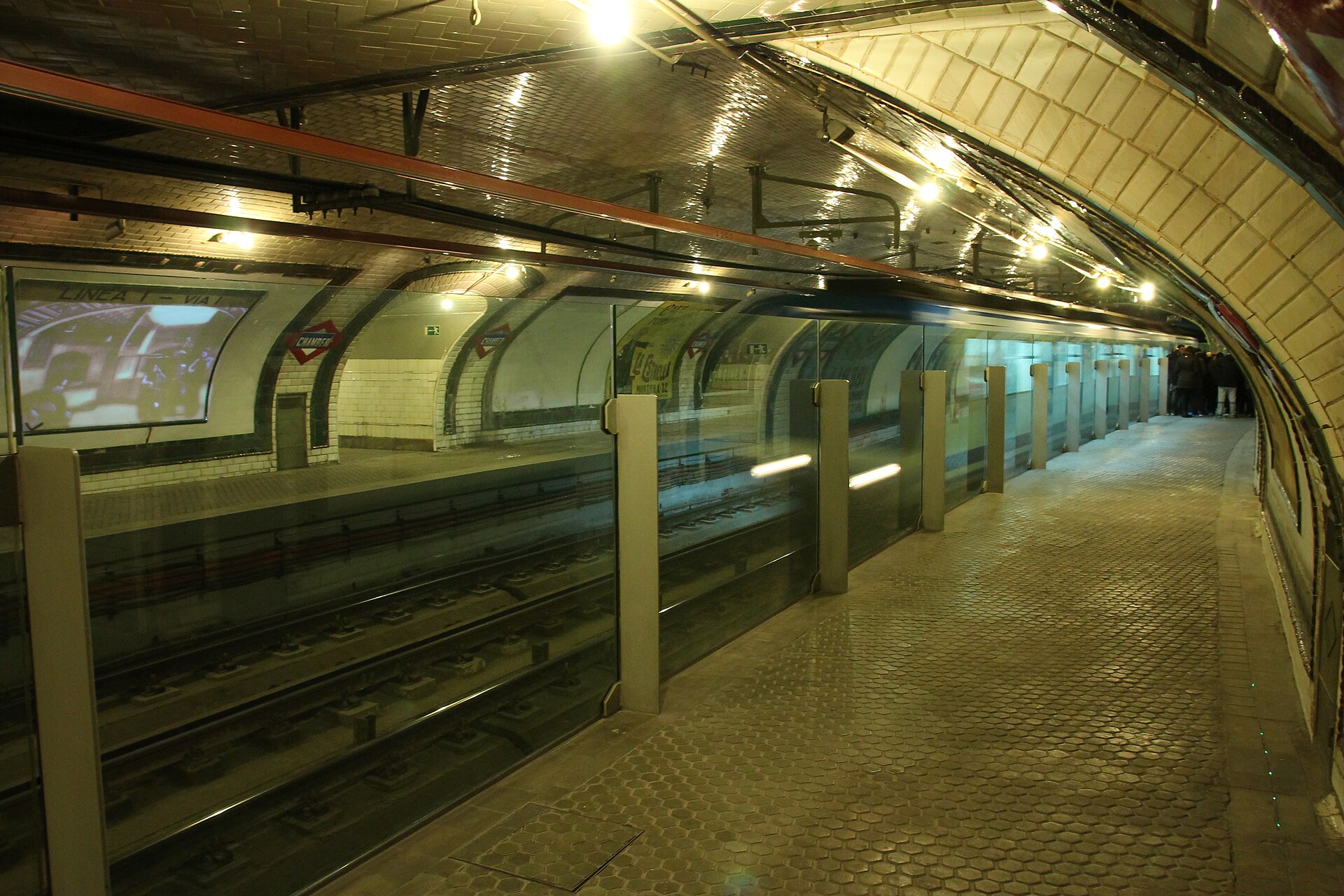

What can be seen at Andén 0 today?
Andén 0 preserves the original 1919 station largely as it was at closure, including its iron columns, ceramic tiling and, notably, the enamelled advertising panels that lined the platform walls — adverts for products no longer sold, in a graphic style typical of early 20th-century Spanish commercial art, left untouched by decades of shifting fashions in design because the station was closed to the public throughout.
Some of the original architectural detailing is attributed by Metro de Madrid to the input of Antonio Palacios, the architect closely associated with Madrid’s early 20th-century civic buildings and with the design language of the city’s first metro stations more broadly. A glass pavilion was added at ground level in Plaza de Chamberí as part of the 2008 restoration, marking the entrance and allowing daylight and visibility down into the old platform area from street level — a modern addition that sits deliberately apart from the historic fabric below.
Visitors can currently see one original platform, restored signage, some rolling stock associated with the early network, and explanatory material on the history of Madrid’s first metro line. Access is managed by Metro de Madrid, typically through timed visits and often requiring advance booking; because opening arrangements, visit formats and any admission conditions change, readers should confirm current details directly on Metro de Madrid’s own website before planning a visit.
Is Chamberí station connected to the working metro network?
No. Chamberí is preserved as a museum space and is not a functioning stop — Line 1 trains still run through the original tunnel alignment past the old platforms without stopping, exactly as they have since 1966, and the museum is accessed separately at street level rather than through the working metro system.
The nearest working stations, Iglesia and Bilbao, remain in ordinary passenger service and are the stops a traveller would use to reach the Plaza de Chamberí area on today’s network. This distinction matters practically: a Metro de Madrid travel card gets a rider to the neighbourhood, not into Andén 0 itself, which has its own separate visit arrangement.
How does Chamberí compare with Madrid’s other central districts?
Chamberí is quieter and more residential than districts built around a single dominant identity or nightlife scene, distinguishing it from neighbours like Chueca, known for LGBTQ+ nightlife and design shops, or Lavapiés, defined by its immigrant history and multicultural street life.
It shares more in character with parts of the Barrio de Salamanca — solid 19th and early 20th-century apartment buildings, tree-lined streets, local markets — without Salamanca’s high-end retail concentration or rigid grid plan. Readers building out a wider view of how Madrid’s districts differ from one another can find further comparisons in this guide’s neighbourhoods section, and readers focused specifically on landmarks and museums across the city can browse the landmarks and sights archive and the museums and galleries archive for related entries, including the city’s own official history museum, covered separately in the guide’s piece on the Museo de Historia de Madrid.
What should a reader confirm before visiting?
Because Andén 0 operates on a restricted visiting system rather than open public hours, and because Metro de Madrid periodically adjusts how bookings work, the only reliable source for current visit days, times and any reservation requirement is Metro de Madrid’s own website.
The same applies to fares for reaching the district on the working metro network: Madrid’s transport system uses a zone-based structure and a rechargeable card, and specific prices are set and updated by the regional transport authority rather than fixed for the long term, so current fares should always be checked on the operator’s own site rather than assumed from older listings.
Access Madrid is an independent guide written from published, checkable sources. We have not visited the places described here and we do not publish personal recommendations or invented ‘local favourites’ — where something is singled out as notable, we say who says so. Opening times, fares, closures and prices change at short notice, so treat everything here as a starting point and confirm with the museum, operator or venue directly before building a day around it. We give no advice on visas, insurance, health or safety; use your own government’s official guidance for those.