Chueca is a small neighbourhood in central Madrid, part of the Centro district, built around a square called Plaza de Chueca. It is Madrid’s best-known LGBTQ+ district, a status it acquired from the late 1980s onward, and it hosts much of the city’s Pride celebration each summer. Before that, it was simply a dense, working-class 19th-century quarter.
Where exactly is Chueca in Madrid?
Chueca sits within the barrio of Justicia, one of six administrative barrios that make up Madrid’s central district, Centro. It occupies the streets north of Gran Vía and east of the Malasaña district, roughly bounded by Calle de Hortaleza, Calle de Fuencarral and Calle de Barquillo. The Metro station Chueca, on Line 5, marks its centre, a short walk from Gran Vía itself.
The neighbourhood is compact — a grid of 19th-century blocks a few streets wide — which is part of why its identity is so legible on the ground. It borders Malasaña, another district whose name and character have their own distinct history, and it sits within easy walking distance of Gran Vía, the avenue cut through this part of the city in the early 20th century.
Where does the name “Chueca” come from?
The name comes from Federico Chueca (1846–1908), a Madrid-born composer best known for zarzuela, the Spanish musical theatre form that flourished in the capital in the late 19th century. The small square at the heart of the neighbourhood, Plaza de Chueca, was named for him, and the surrounding streets took the name from the square. The Metro station opened under the same name.
Chueca the composer had no direct connection to the district’s later identity — the naming reflects a common Madrid pattern of honouring cultural figures with a local square, as with plazas named for painters, writers and musicians across the city centre.
What was the neighbourhood like before it became known as Chueca?
The streets now called Chueca were laid out in the 19th century as part of the Ensanche-era expansion of central Madrid, filled with mixed-use apartment blocks housing artisans, small tradespeople and shopkeepers. Through much of the 20th century it was a dense, unremarkable residential quarter — solidly working- and lower-middle-class, with the kind of small workshops and family businesses typical of Madrid’s old centre.
By the 1970s and early 1980s, like several central neighbourhoods, it had entered a period of decline: ageing housing stock, falling rents, and a reputation as a rundown area rather than a destination. That combination of cheap rents and central location is precisely what made it available for the transformation that followed.
How did Chueca become Madrid’s LGBTQ+ district?
Chueca’s shift into a recognised LGBTQ+ neighbourhood took shape from the late 1980s through the 1990s, following Spain’s transition to democracy after 1975 and the cultural opening associated with the Movida Madrileña, the countercultural scene that centred on Madrid in those years. Falling rents in a run-down central district made it an accessible base for LGBTQ+-owned bars, businesses and organisations at a time when such visibility was newly possible in Spanish public life.
The Colectivo de Lesbianas, Gais, Transexuales y Bisexuales de Madrid (COGAM), an advocacy organisation founded in 1986, is closely associated with the neighbourhood’s community life and has long been based nearby. Through the 1990s, businesses openly serving and owned by LGBTQ+ Madrileños concentrated in Chueca in a way that had not happened elsewhere in the city, and the area’s public identity shifted accordingly — a process often described in Spanish press and municipal material as the “rehabilitation” of the barrio, in both a social and a literal, building-renovation sense.
Spain legalised same-sex marriage nationally in 2005, a milestone that postdates Chueca’s establishment as a district but reinforced its role as a recognised centre of LGBTQ+ life in the capital.
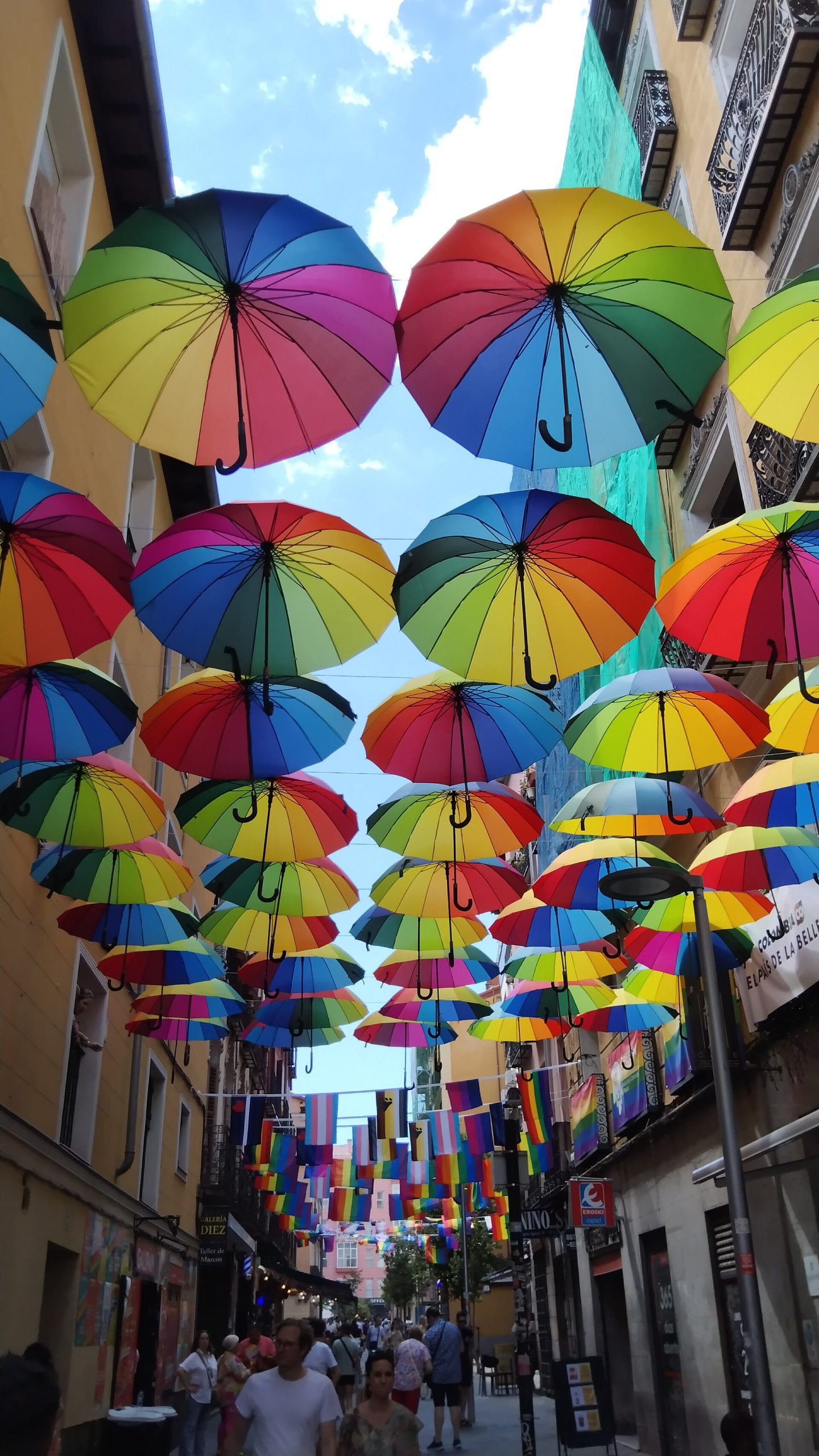

What is Madrid Pride, and how does it relate to Chueca?
Madrid Pride — known locally as Orgullo or by the acronym MADO — is an annual LGBTQ+ celebration held over several days, typically in late June or early July, timed around the anniversary of the 1969 Stonewall uprising in New York, as with Pride events in many other cities. Chueca is its geographic centre: the neighbourhood’s streets and squares host much of the public programming, and the parade route runs through central Madrid past the district.
Madrid’s Pride has grown into one of the largest such events in Europe by the city’s own tourism promotion, though attendance figures vary by source and year. Exact dates and the parade route change annually, and both are published by Madrid’s city tourism authority ahead of each edition — readers should confirm current details on the operator’s own site rather than relying on a fixed date here.
Outside Pride week, Chueca functions as the city’s principal LGBTQ+ nightlife and social district year-round, a role distinct from, and considerably more concentrated than, its historical function as an ordinary residential quarter.
What is the Mercado de San Antón?
The Mercado de San Antón is a covered market on Calle de Augusto Figueroa, within Chueca, that combines traditional market stalls with a multi-storey format of food counters, a rooftop terrace area and retail space. It is one of several Madrid neighbourhood markets — alongside Mercado de San Miguel near Plaza Mayor and others — that have been renovated in recent decades into combined grocery-and-dining venues, a pattern that has reshaped several of the city’s historic markets.
As a market rather than a monument, its opening hours and stallholders change over time; readers should confirm current details on the market’s own site rather than a fixed listing here.
Has Chueca changed since the 1990s?
Yes, and in ways that residents and local commentary in the Spanish press have both noted. Rents in the neighbourhood rose sharply as it became a recognised, desirable central district, a familiar pattern in areas that undergo this kind of cultural and commercial revival. Some longtime LGBTQ+-owned businesses have closed or relocated as the area has become more mixed and, at points, more oriented toward general nightlife and tourism rather than exclusively LGBTQ+ clientele.
That said, Chueca retains its institutional and symbolic role: it remains the recognised centre of LGBTQ+ Madrid, the base for organisations such as COGAM, and the focal point of Pride. The neighbourhood’s built fabric — the 19th-century apartment blocks, the small scale of Plaza de Chueca itself — has changed comparatively little; what has changed is who occupies the ground floors and at what rent.
How does Chueca fit with the neighbourhoods around it?
Chueca is one of several small, historically distinct districts packed into central Madrid, each with its own identity and its own account of how it got that way. Malasaña, immediately west, takes its name from a very different 18th-century episode. La Latina, south of the old centre, is Madrid’s oldest quarter by a different measure again. Lavapiés, further south, has its own layered migration history. Together with Chueca, these neighbourhoods form the patchwork that makes central Madrid legible only barrio by barrio rather than as one undifferentiated “old town” — a broader pattern explored across this site’s neighbourhoods coverage.
Architecturally, Chueca also sits close to the cultural institutions clustered around Gran Vía, including the Círculo de Bellas Artes, giving the district a dual identity: a residential 19th-century quarter with a specific recent social history, and a stop on the wider map of central Madrid’s landmark architecture, covered in this site’s landmarks and sights archive.
Access Madrid is an independent guide written from published, checkable sources. We have not visited the places described here and we do not publish personal recommendations or invented ‘local favourites’ — where something is singled out as notable, we say who says so. Opening times, fares, closures and prices change at short notice, so treat everything here as a starting point and confirm with the museum, operator or venue directly before building a day around it. We give no advice on visas, insurance, health or safety; use your own government’s official guidance for those.
Featured image: Photo by Artistosteles, source, CC BY 4.0
