The Golden Triangle of Art (Triángulo del Arte) is the informal name for three major museums strung along Madrid’s Paseo del Prado: the Museo del Prado, the Museo Thyssen-Bornemisza, and the Museo Reina Sofía. Between them they cover roughly eight centuries of European art, from medieval altarpieces to twentieth-century avant-garde, within a walk of under two kilometres.
What exactly is the Golden Triangle of Art?
It is a marketing and planning term, not an official institution — a way of describing three independent, separately run museums that happen to sit close enough together to be treated as a single art district. Each has its own director, collection policy, and admission system.
The phrase is used by Madrid’s own tourism promotion and by the museums themselves when describing joint passes or shared history. It has no legal status; it simply names a pattern that a visitor or resident can observe on a map.
Where does it sit in the city, and how close are the three museums?
All three museums face or stand near Paseo del Prado, the tree-lined boulevard that runs between Plaza de Cibeles and Atocha, with the Parque del Buen Retiro immediately to the east. The Prado occupies the middle of that axis; the Thyssen-Bornemisza sits opposite it, near Plaza de Cánovas del Castillo; the Reina Sofía is at the southern end, beside Atocha station.
The distance between the Prado and the Thyssen is a short walk across the boulevard. The Reina Sofía is roughly a fifteen- to twenty-minute walk further south, or a couple of stops by metro. This concentration is unusual for a European capital — most cities spread their major galleries across the whole city rather than one street.
In 2021, UNESCO added this stretch — inscribed as “Paseo del Prado and Buen Retiro, a Landscape of Arts and Sciences” — to its World Heritage List, recognising the boulevard, the park, and the cluster of cultural institutions along it as a single historic ensemble. Details of the inscription are published on UNESCO’s own World Heritage List entry.
What does each museum actually hold?
The three collections are deliberately different in period and character, which is a large part of why they work as a set rather than as three versions of the same thing.
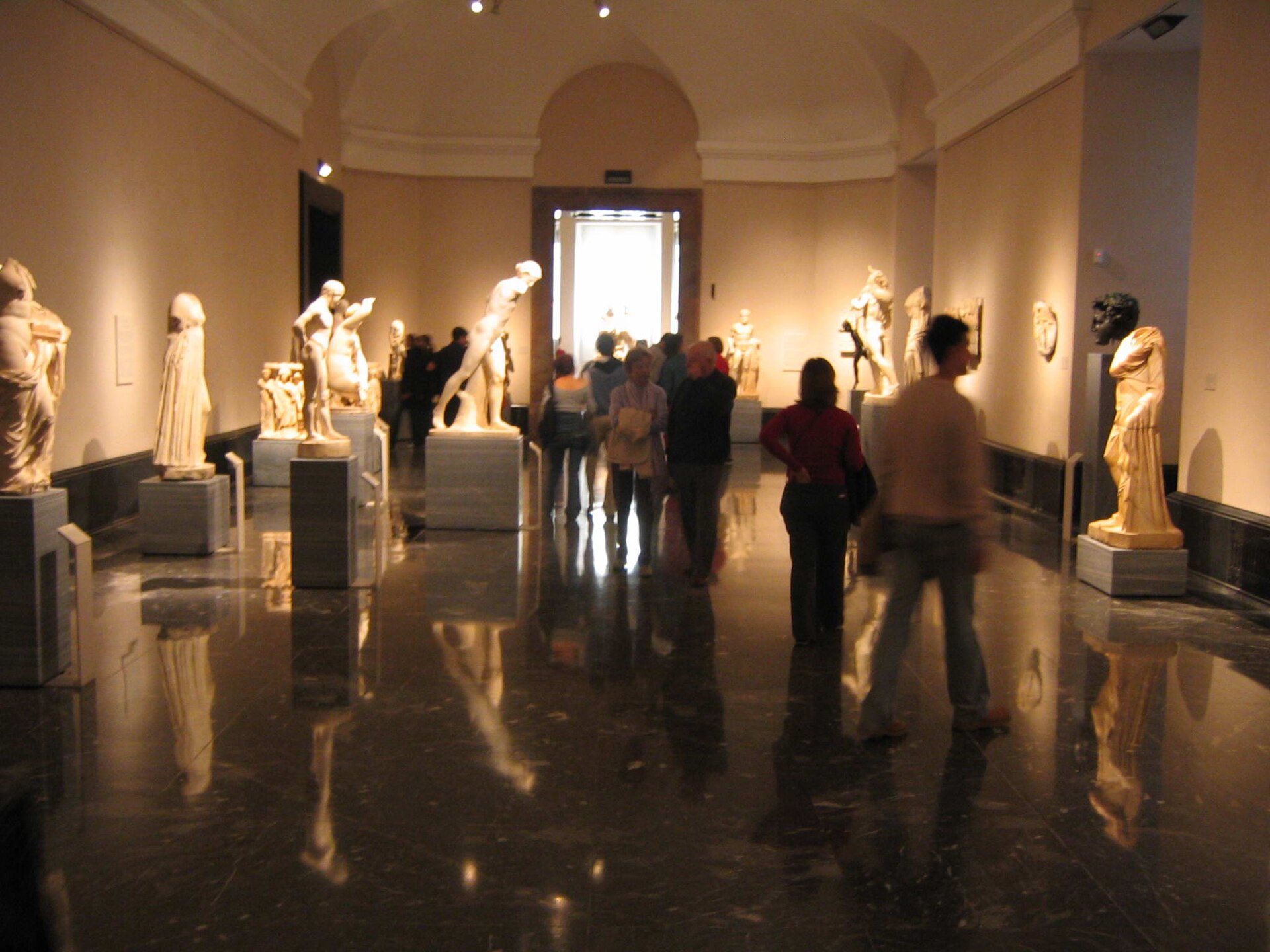
- Museo del Prado — Spain’s national gallery, built on the royal collections of the Habsburg and Bourbon monarchs. Its strength is Spanish, Italian, and Flemish painting from the twelfth to the early nineteenth century, including the largest holdings anywhere of Velázquez and Goya. A fuller account of how the collection is organised and what to expect room by room is covered in this site’s guide to the Prado’s collection.
- Museo Thyssen-Bornemisza — a formerly private collection, assembled across the twentieth century by the Thyssen-Bornemisza family and acquired by the Spanish state in 1993. Its own catalogue describes it as filling gaps the Prado does not cover: early Northern European painting, Impressionism, German Expressionism, and American art through the twentieth century, arranged as a chronological walk through Western painting.
- Museo Reina Sofía — Spain’s national museum of modern and contemporary art, holding Picasso’s Guernica as its best-known single work, alongside major collections of Dalí, Miró, and later Spanish and international contemporary art.
Read together, chronologically, the three collections form something close to a continuous timeline of European art from the medieval period to the present — which is the case the “triangle” framing is built on.
.jpg)
Why are the three treated as a set rather than three separate stops?
Two things reinforce the grouping: geography and chronology. The physical closeness is a historical accident of where royal and later state institutions chose to build; the chronological fit is more deliberate, since the Thyssen-Bornemisza collection was assembled partly to bridge the gap between the Prado’s old masters and the Reina Sofía’s modern works.
The result is that a reader moving from one museum to the next, in either direction, is moving broadly forward or backward through art history rather than repeating the same territory. This is the argument the museums and Madrid’s tourism promotion use when describing the three as a unit, and it holds up reasonably well against the actual contents of each collection.
Is there a combined ticket for the three museums?
The three museums jointly offer a combined pass, commonly referred to as the Paseo del Arte pass, covering single admission to all three at a reduced total cost compared with buying three separate tickets. Details, current pricing, and validity periods are set by the museums themselves and should be confirmed on their official sites before visiting, since ticket structures and prices change.
- Museo del Prado — official site
- Museo Thyssen-Bornemisza — official site
- Museo Reina Sofía — official site
Each museum also runs its own separate ticketing, timed-entry system, and — in most cases — a window of free or reduced admission on certain days or hours. These free periods differ by museum and change from time to time, so they are worth checking directly on each institution’s site rather than relying on a fixed schedule.
Do the three museums close on the same days?
No. Each of the three keeps its own weekly closing day and its own annual closure dates around major holidays, and these do not line up with one another. A visitor planning to see all three across a short stay should check each museum’s current calendar rather than assume a single closing pattern applies across the triangle.
This staggering is one practical reason the “triangle” works well for a multi-day visit: it is difficult, but not impossible, to plan a route where every museum is closed on the same day.
How should a visit across the three be planned?
There is no official order, but a few structural points are worth knowing before deciding:
- The Prado is the largest of the three by a significant margin and holds the most single-visit content; most guidance from the museum itself suggests allowing considerably more time there than at either of the others.
- The Thyssen-Bornemisza is comparatively compact and can reasonably be covered in a shorter visit, given its more linear, chronological hang.
- The Reina Sofía is large but concentrated around fewer headline works, with Guernica typically drawing the heaviest concentration of visitors within it.
None of the three museums allows a single ticket to be split across multiple non-consecutive days without checking their own re-entry rules, so a combined ticket is generally used across one trip rather than banked for later use.
Does the Golden Triangle matter to Madrid residents, not just visitors?
Yes, in a few concrete ways. The Prado and Reina Sofía are both state-run national museums, and Spain’s Ministry of Culture sets rules — separate from any tourist pass — under which certain groups, including some EU residents under a set age threshold, are entitled to free or reduced entry. These rules and thresholds are published by the museums themselves and are worth checking directly, since they are not part of the tourist-facing Paseo del Arte pass.
Each museum also offers its own annual membership or “friends” scheme, typically covering unlimited entry, priority access to temporary exhibitions, and sometimes reciprocal benefits at partner institutions abroad — a different proposition from the short-stay combined ticket aimed at visitors.
For someone who lives in Madrid, the practical value of the triangle is less about covering all three in one day and more about the fact that free evening or discounted hours recur on a predictable weekly rhythm, making it realistic to treat the museums as an ongoing resource rather than a single event.
Where does this fit in Madrid’s wider museum scene?
The Golden Triangle is the most concentrated and best known cluster, but it is not the whole of Madrid’s museum landscape. The city holds a considerably wider range of collections, from decorative arts to archaeology to contemporary galleries, set out in the museums and galleries section of this guide.
Anyone using the Prado as a starting point may also find it useful to read the separate breakdown of how the Prado’s own collection is arranged, since its scale makes planning a visit there materially different from the other two museums in the triangle.
As with everything on this site, the aim here is to describe what these institutions are and how they relate to one another, sourced from what each museum publishes about itself — not to rank them. More on how this guide approaches sourcing is set out on the site’s introductory page, and the fuller archive of museum coverage is the place to look for detail on individual collections beyond the triangle itself.
Access Madrid is an independent guide written from published, checkable sources. We have not visited the places described here and we do not publish personal recommendations or invented ‘local favourites’ — where something is singled out as notable, we say who says so. Opening times, fares, closures and prices change at short notice, so treat everything here as a starting point and confirm with the museum, operator or venue directly before building a day around it. We give no advice on visas, insurance, health or safety; use your own government’s official guidance for those.
Related reading
Living in Madrid, Madrid, Practically, What Is the Museo Nacional de Ciencias Naturales?, What Is the Monasterio de las Descalzas Reales in Madrid?.
Featured image: Photo by Carlos Reusser Monsalvez from Santiago, Chile, source, CC BY 2.0
.jpg)