The Museo Reina Sofía is Spain’s national museum of modern and contemporary art, holding work from roughly 1900 to the present. Its best-known piece is Pablo Picasso’s Guernica, which arrived in Madrid in 1981 — six years after Franco’s death — under conditions Picasso himself set decades earlier: no return to Spain until democracy was restored.
What is the Museo Reina Sofía?
The Reina Sofía is one of Spain’s national museums, occupying the former Hospital General San Carlos, an 18th-century building near Atocha station in central Madrid. It takes its name from Queen Sofía and opened as a museum in 1992, though the building had already been used for temporary exhibitions through the 1980s.
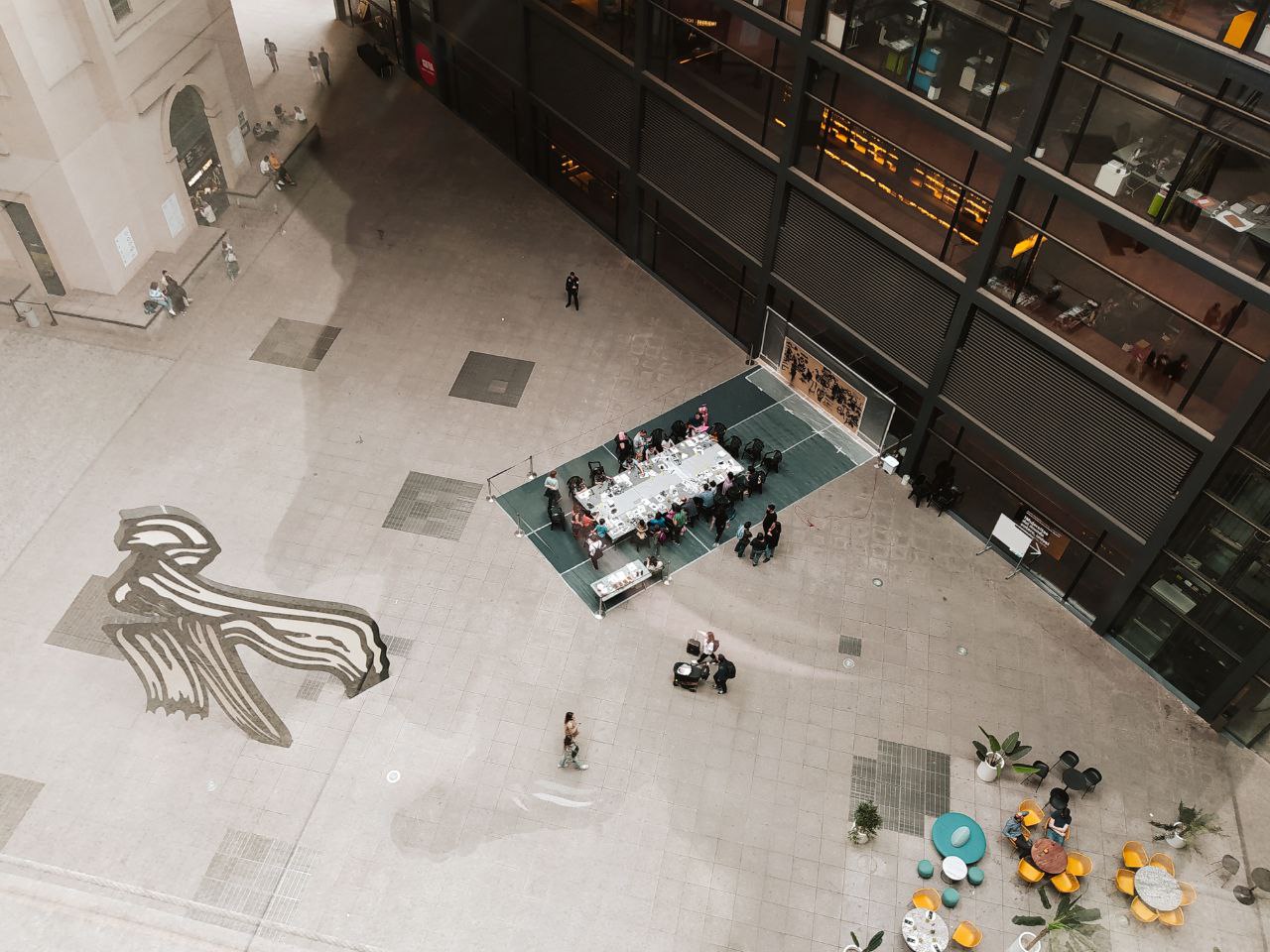
The original neoclassical hospital block was extended twice. Glass exterior lift towers were added to the courtyard facades in the 1980s, and in 2005 the French architect Jean Nouvel added a large new wing with additional galleries, an auditorium and a library, set around a triangular courtyard. The museum’s own site sets out this building history in detail.
Together with the Museo del Prado and the Museo Thyssen-Bornemisza, the Reina Sofía forms what is widely referred to as Madrid’s Golden Triangle of Art, three national collections within easy walking distance of one another along the Paseo del Prado.
What does the collection actually contain?
The permanent collection covers Spanish and international art from the early 20th century onward, arranged broadly by period rather than by artist. According to the museum’s own account of its holdings, the lower and earlier galleries trace movements from around 1900 to the Spanish Civil War, including Cubism, Surrealism and the Spanish avant-garde; later galleries carry the collection forward into the postwar period and contemporary practice.
- Pablo Picasso — the largest single holding relevant to Guernica, including preparatory studies for the painting.
- Salvador Dalí — a substantial body of Surrealist work, among the most visited holdings in the museum.
- Joan Miró — paintings and works on paper spanning several decades.
- Juan Gris — an important representation of Spanish Cubism.
- Antoni Tàpies, Antonio Saura and Eduardo Chillida — central figures in Spanish postwar abstraction.
- International postwar and contemporary artists, shown alongside the Spanish collection to place it in a wider context.
The museum also holds an extensive library and documentation centre on 20th-century art, which is a research resource rather than a public gallery. Anyone wanting the current room-by-room layout should consult the Reina Sofía’s own floor plans, since galleries are periodically reorganised around temporary exhibitions.
For context on how this collection differs in period and character from Madrid’s other major museum, the explanation of what is in the Museo del Prado covers the older, pre-20th-century collection the Reina Sofía deliberately picks up from.
What is Guernica, and why does it matter?
Guernica is a large monochrome oil painting, roughly 3.5 by 7.8 metres, completed by Picasso in 1937. It depicts the suffering caused by aerial bombing, painted in direct response to the destruction of the Basque town of Gernika (Guernica in Spanish) on 26 April 1937, when German Condor Legion aircraft and Italian air units, acting in support of Franco’s Nationalist forces during the Spanish Civil War, bombed the town’s civilian population.
Picasso had already been commissioned by the Spanish Republican government to produce a large work for the Spanish Pavilion at the 1937 International Exposition in Paris. The bombing, reported widely in the international press within days, became the subject. The painting was completed in time for the exposition that summer and has since been read, internationally, as one of the most direct artistic responses to modern warfare.

How did Guernica come to be in Madrid?
After the 1937 Paris exposition, the painting toured internationally through the late 1930s and 1940s, in part to raise awareness of the Republican cause during and after the Civil War. With Franco’s Nationalists victorious and the Republic defeated, Picasso — who lived the rest of his life outside Spain — arranged for the painting to be held for safekeeping at the Museum of Modern Art (MoMA) in New York, which displayed it on extended loan for over four decades. MoMA’s own institutional history confirms this arrangement and the condition attached to it.
Picasso stipulated that the painting should not return to Spain until the country had a functioning democracy and public political freedoms had been restored. Franco died in 1975 and Spain moved through a transition to democratic government over the following years; Picasso himself had died in 1973 and did not see the transfer take place.
Following negotiations between the Spanish government and MoMA, the painting was transferred to Madrid in 1981, arriving on the fortieth anniversary of the year commonly cited for its completion and just as Spain’s new constitutional order was consolidating. It was first shown at the Casón del Buen Retiro, then an annex of the Prado, displayed behind bulletproof glass amid continuing debate about the wisdom of exhibiting it unprotected.
When the Museo Reina Sofía opened as a dedicated museum of 20th-century art in 1992, Guernica moved there, where the museum’s own account of its collection places it as the centrepiece of the galleries covering the Civil War period.
Why doesn’t Guernica ever travel or go on loan?
The Reina Sofía does not lend Guernica to other institutions, a position the museum has stated publicly on several occasions when the question has arisen. The stated grounds are the painting’s fragility and its documented sensitivity to vibration and handling after decades of travel, restoration and remounting before 1981.
The point has been politically live as well as conservational. Basque regional institutions have, at various times, raised the question of whether the painting should be relocated to the Basque Country, given its subject, including formal requests reported in the Spanish press. The Reina Sofía and the Spanish state have maintained that the painting remains in Madrid, citing both its physical condition and its status as part of the national collection.
How does the Reina Sofía fit with Madrid’s other major museums?
The Reina Sofía is usually visited alongside the Prado and the Thyssen-Bornemisza, and the three institutions are commonly discussed together as complementary rather than overlapping. The Prado’s collection runs from medieval and Renaissance painting through the early 19th century; the Thyssen-Bornemisza fills gaps between and around both, from early Italian panel painting to 20th-century modernism; the Reina Sofía picks up from around 1900 and continues into contemporary work. The explanation of how the Golden Triangle of Art is organised sets out how the three collections divide the city’s art history between them, and where their holdings genuinely overlap.
For a broader sense of what else counts as a major public collection in the city beyond this trio, the Museums & Galleries section covers the rest of Madrid’s museum landscape, including smaller and more specialised institutions that don’t fit inside the Golden Triangle framing.
What should a visitor know before going?
Like the Prado, the Reina Sofía operates a published pattern of free entry windows at certain times, alongside standard paid admission at other times, and closes on at least one day a week — commonly reported as Tuesdays for the Reina Sofía, though this and all current opening times should be checked on the museum’s own website before a visit, since museum hours and free-access windows change and are not reliable to quote as fixed figures here.
Photography rules, cloakroom facilities and current exhibition layouts are similarly subject to change and are best confirmed directly with the museum rather than assumed from older sources.
Anyone planning to visit more than one of the three Golden Triangle museums in the same trip should check whether a combined pass is currently offered, since this has varied over time and the museums’ own sites are the only reliable source for current pricing and terms.
Readers new to how this site approaches Madrid’s museums and neighbourhoods more generally can find that explained on the Access Madrid introduction page, alongside the wider Museums & Galleries hub and the companion piece on what is held in the Museo del Prado.
Access Madrid is an independent guide written from published, checkable sources. We have not visited the places described here and we do not publish personal recommendations or invented ‘local favourites’ — where something is singled out as notable, we say who says so. Opening times, fares, closures and prices change at short notice, so treat everything here as a starting point and confirm with the museum, operator or venue directly before building a day around it. We give no advice on visas, insurance, health or safety; use your own government’s official guidance for those.
Related reading
Living in Madrid, Madrid, Practically, What Is the Museo Nacional de Ciencias Naturales?.
Featured image: Photo by Zarateman, source, CC BY-SA 4.0
_02.JPG)