The Thyssen-Bornemisza collection is a private hoard of European painting, assembled over three generations by the Thyssen-Bornemisza family, that traces art history from medieval panels to twentieth-century abstraction. Most of it was sold to the Spanish state in 1993 and now hangs in the Museo Thyssen-Bornemisza on Paseo del Prado, in Madrid.
What exactly is the Thyssen-Bornemisza collection?
It is one of the largest privately built art collections of the twentieth century, spanning roughly seven centuries of Western painting in a single, continuous run — something no public museum, built up piece by piece through purchase and donation, usually manages. It moves from Italian and Flemish primitives through the Renaissance, Baroque, Impressionism and German Expressionism, into Cubism, American painting and Pop Art.
The scale is what sets it apart. Where the Museo del Prado’s collection was built as a royal, then national, holding focused heavily on Spanish, Italian and Flemish masters, the Thyssen-Bornemisza collection was built by two private collectors chasing a personal idea of a complete history of Western painting — including entire schools, such as American art before 1900, that the Prado never collected at all.
Who built the collection, and why?
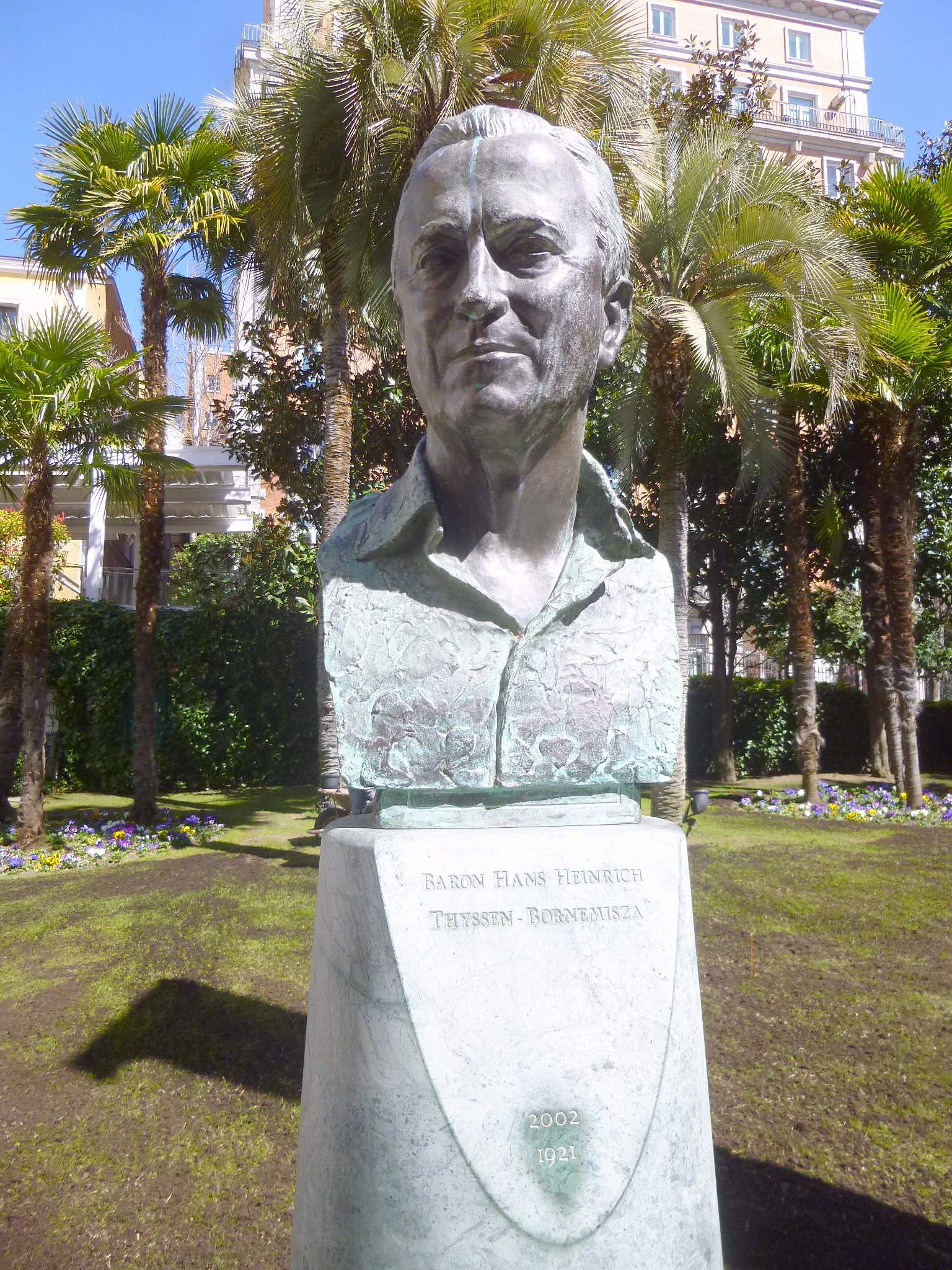
The collection has two distinct phases, built by father and son.
- Heinrich Thyssen-Bornemisza, a German-Hungarian industrialist, began collecting Old Masters in the 1920s, housing the growing hoard at Villa Favorita, the family estate on Lake Lugano in Switzerland.
- Hans Heinrich Thyssen-Bornemisza, his son, inherited the collection in 1947 and expanded it enormously, adding nineteenth- and twentieth-century painting — Impressionism, Expressionism, Cubism, American Realism and Pop Art — turning a strong Old Masters cabinet into a near-continuous survey of Western art.
By the 1980s the Villa Favorita collection was widely described, including by scholars who catalogued it, as the largest and most important private art collection in the world after that of the British royal family.
How did a Swiss-held private collection end up in Madrid?
In short: the Spanish state bought most of it. In 1988, the Spanish government agreed a lease of the core collection, and in 1993 it purchased the bulk of it outright for the museum that still bears the family name — a deal reported at the time at a price in the hundreds of millions of dollars, a figure the museum’s own institutional history references rather than one this site can independently verify.
The move to Madrid was not automatic. Other governments — reportedly including the United Kingdom and Germany — had pursued the collection as Hans Heinrich looked for a permanent home for it outside Switzerland in the 1980s. Spain’s bid succeeded, and the collection was installed in the Palacio de Villahermosa, a late eighteenth-century neoclassical building on Paseo del Prado that had been remodelled specifically to house it, opening as the Museo Thyssen-Bornemisza in 1992.
A second, separate step followed. Hans Heinrich’s wife, Carmen Cervera — a former Miss Spain, often referred to as Baroness Thyssen — held her own, smaller personal collection. Rather than sell it, she agreed to loan it long-term to the same museum, and in 2004 an extension wing opened to display it alongside the original purchase. Because this second collection remains a loan rather than a state purchase, its long-term future has periodically been the subject of negotiation and press reporting in Spain, and the museum’s own site is the place to check its current status.
What does the museum actually hold today?
Combining both collections, the Museo Thyssen-Bornemisza presents a chronological walk through Western painting that few single museums attempt. Its own published collection notes describe holdings spanning:
- Italian and Northern European painting from the fourteenth and fifteenth centuries, including early panel works
- Renaissance and Baroque painting, with works attributed to artists such as Titian, Caravaggio and Ghirlandaio
- Dutch and Flemish painting of the seventeenth century
- Impressionist and Post-Impressionist works, including pieces attributed to Renoir, Degas and Van Gogh
- German Expressionism, an area the Prado does not cover
- American painting from the eighteenth through twentieth centuries
- Cubism, Surrealism and Pop Art, including work attributed to Picasso, Kandinsky and Lichtenstein
The museum’s own galleries are arranged largely by century and school, floor by floor, so a visit moves in something close to art-historical order — an arrangement the museum’s own visitor guide sets out on its site.
Why is it grouped with the Prado and the Reina Sofía?
The Museo Thyssen-Bornemisza sits within walking distance of both, on or near Paseo del Prado, and Madrid’s own tourism promotion routinely groups the three as the city’s “Golden Triangle of Art” — a phrase used by the Madrid regional and city tourism bodies rather than an official museum designation. Together they are frequently described, including in that promotional material, as covering nearly the full span of Western art history between them: the Prado for Spanish, Italian and Flemish classical painting, the Reina Sofía for Spanish modern and contemporary art including Picasso’s Guernica, and the Thyssen-Bornemisza filling the gaps between and around both — Northern Renaissance, German Expressionism, American painting.
A fuller account of how the three relate, and what each one is actually for, is set out in Madrid’s Golden Triangle of Art: Three Museums Explained. Readers wanting the detail on the other two collections can find it in what is in the Museo del Prado, and how is it arranged and what is in the Reina Sofía, and how did Guernica arrive.
Does the collection still grow?
Yes, in a limited sense. The core, state-owned collection is broadly fixed as purchased in 1993. The Carmen Thyssen loan collection has been added to and has also toured — parts of it have periodically travelled to a separate Carmen Thyssen museum in Málaga, a fact reported in Spanish press coverage of the family’s holdings. Anyone researching a specific work is better served checking the museum’s own online catalogue than relying on a general description, since attributions and loan arrangements can shift.
What should a visitor or resident know about visiting practically?
Specific hours, ticket prices and free-entry windows are set by the museum and change; they should always be checked on the Museo Thyssen-Bornemisza’s own website rather than assumed from any guide, including this one. As a general pattern, major Madrid museums close on one weekday — commonly Monday, though not always the Thyssen-Bornemisza specifically — and many offer a reduced-price or free period on certain days or evenings, a structure worth confirming directly with the museum before planning around it.
For residents building a museum habit across a year rather than a single visit, it is worth checking whether the museum offers an annual pass or combined ticketing with the Prado and Reina Sofía, since Madrid’s major museums have at times coordinated joint-ticket offers — again, something to confirm on the operators’ own sites rather than assume is currently running.
Those planning a first visit to Madrid’s museum district more broadly can start with the wider Museums & Galleries section of this site, which sets out how the major collections in the city relate to one another before narrowing down to any single museum.
Why does the collection matter to how Madrid is understood today?
The Thyssen-Bornemisza purchase is one of the clearest examples of Spain’s post-1975 cultural strategy: using state money, after the end of the Franco era and Spain’s accession to the European Community, to position Madrid as a first-tier European art capital rather than a periphery to Paris and London. The Prado was already there; the Reina Sofía, opened in 1992 as a museum of modern and contemporary art, was built for that purpose. The Thyssen-Bornemisza purchase, agreed the same year the Reina Sofía opened, filled the historical gaps between them in a single transaction — which is part of why the three are so often discussed together rather than separately.
Related reading
Hello world!, Living in Madrid, Madrid, Practically
Access Madrid is an independent guide written from published, checkable sources. We have not visited the places described here and we do not publish personal recommendations or invented ‘local favourites’ — where something is singled out as notable, we say who says so. Opening times, fares, closures and prices change at short notice, so treat everything here as a starting point and confirm with the museum, operator or venue directly before building a day around it. We give no advice on visas, insurance, health or safety; use your own government’s official guidance for those.