What is Plaza Mayor?
Plaza Mayor is a large rectangular square in the historic centre of Madrid, enclosed on all four sides by uniform arcaded buildings. It was built in the early 17th century, under King Philip III, as a formal public space for markets, royal ceremony, bullfights and public spectacle — a controlled, enclosed alternative to the irregular open ground that had previously served that purpose.
Why did Madrid need a square like this?
Before Plaza Mayor existed, the site was occupied by the Plaza del Arrabal, an open market area outside the old city walls where traders sold food, cloth and livestock in an unregulated, ad hoc layout. As Madrid grew rapidly after Philip II moved the royal court there in 1561, this informal marketplace became increasingly inadequate for a capital that needed both commercial infrastructure and a stage for royal authority.
Philip III commissioned a formal replacement: an enclosed, symmetrical plaza that could regulate trade, control crowds, and — crucially — provide a fixed, monumental backdrop for the ceremonial life of the monarchy. The project reflects a broader pattern in Habsburg Spain, where architecture was used deliberately to project royal order onto a city that had grown without much planning.
Who designed it and when was it built?
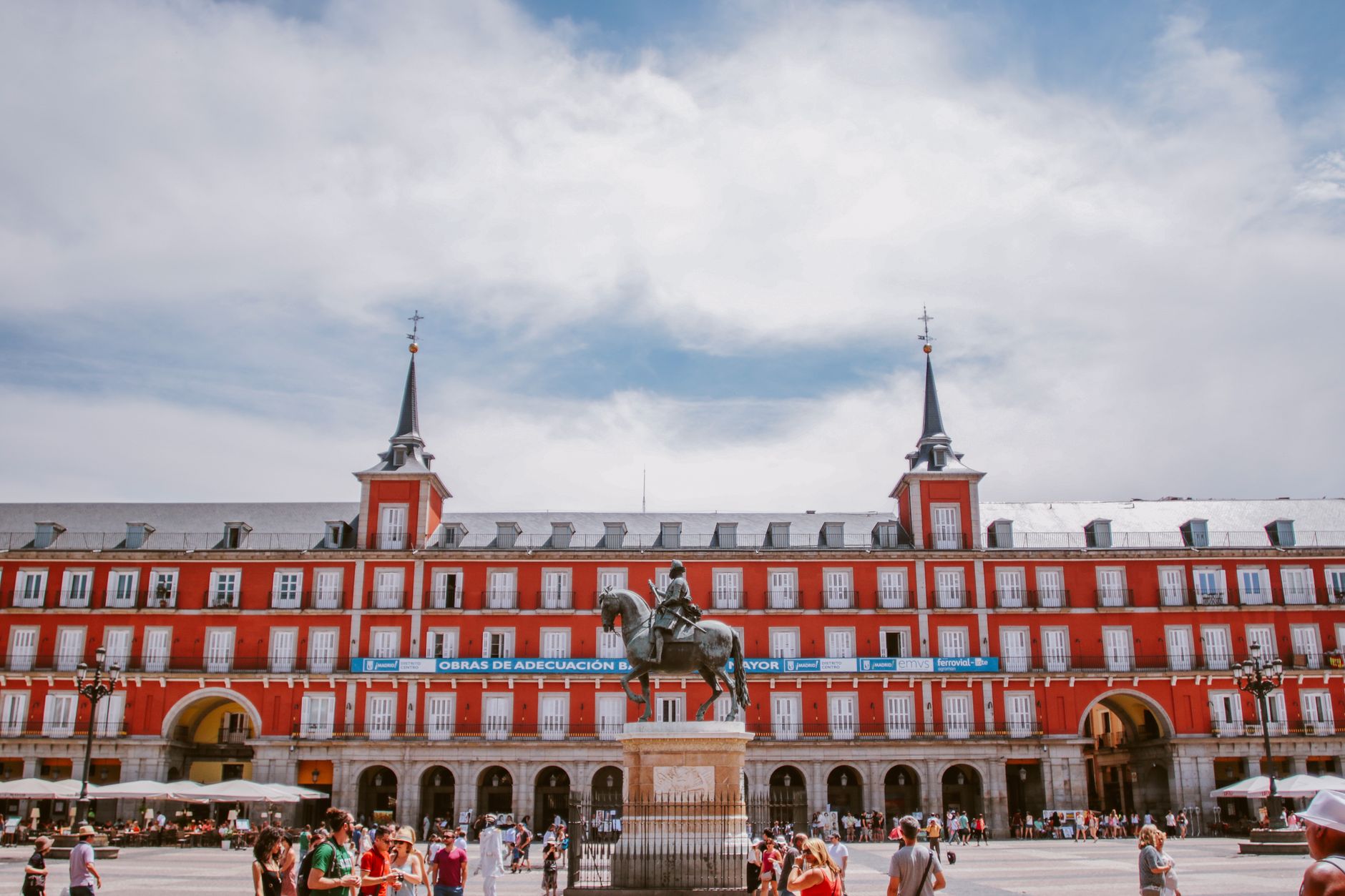
The design is credited to Juan Gómez de Mora, the royal architect responsible for several major works in Madrid during this period. Construction proceeded through the first two decades of the 17th century, with the square substantially complete by 1619, under the reign of Philip III — whose bronze equestrian statue still stands at its centre.
The statue itself has a documented, slightly unusual history: it was begun by the Florentine sculptor Giambologna and finished after his death by his pupil Pietro Tacca. It originally stood elsewhere in Madrid before being relocated to the plaza in the 19th century, where it remains today as the square’s central landmark.
What was Plaza Mayor actually used for?
For roughly two centuries, Plaza Mayor functioned as the working civic heart of Madrid, hosting a wide range of public events:
- Daily and seasonal markets for food, textiles and household goods
- Royal proclamations, coronations and public celebrations tied to the monarchy
- Bullfights, staged in the enclosed square before dedicated bullrings existed
- Autos de fe — public ceremonies of the Spanish Inquisition, including sentencing — held here on several documented occasions
- Executions and other forms of public punishment, carried out as a display of royal and religious authority
This combination — commerce, spectacle and state power sharing the same enclosed stage — is what makes the square historically significant beyond its architecture. It was built to be seen from, as much as to be walked through: balconies and windows on the surrounding buildings were rented out to spectators during major events, a practice documented in period accounts of the square’s use.
What is the Casa de la Panadería?
The Casa de la Panadería is the most distinctive building on the square, occupying the north side and easily identified by its twin corner towers and the painted facade covering its upper floors. Its name — “bakery house” — reflects its original function as the site of Madrid’s main bread market and bakery, a practical service alongside its role as a vantage point for royal spectators.
The current decorative frescoes covering its facade are not original; the building has been repainted and altered several times, and the present scheme dates from a 20th-century restoration. Today the Casa de la Panadería houses municipal offices and is not generally open to the public as an exhibition space, though its exterior remains one of the most photographed details of the square.
Did the square burn down?
Yes — repeatedly. Plaza Mayor suffered major fires in 1631, 1670 and again in 1790, each requiring substantial rebuilding. The most consequential of these was the 1790 fire, after which the architect Juan de Villanueva — better known for designing the building that would become the Museo del Prado — was tasked with the reconstruction.
Villanueva’s rebuilding gave the square much of its current, more restrained neoclassical character, replacing earlier decorative excess with a more disciplined, uniform facade treatment. What visitors see today is therefore not the exact structure completed in 1619, but a square that has been substantially rebuilt at least twice while preserving its original footprint and overall plan.
How does Plaza Mayor connect to the rest of old Madrid?
Plaza Mayor sits just off the Puerta del Sol, the square generally treated as the symbolic centre of the city and the point from which Spain’s road distances are measured. Nine arched entrances lead into Plaza Mayor from the surrounding streets, a design that channels foot traffic in from the dense medieval street pattern of the Austrias district while keeping the square itself enclosed and controllable — exactly the effect its Habsburg planners intended.
For readers interested in how this square fits into Madrid’s broader civic history, the Museo de Historia de Madrid holds material tracing the city’s development from this period onward, including maps and documents relevant to the Habsburg-era layout of the centre.
What happens in the square now?
Plaza Mayor no longer functions as a working food market or a site of state punishment, but it has retained a recognisably civic role. A long-running stamp and coin market takes place on Sunday mornings, a tradition with decades of continuous history in the square, and it hosts one of Madrid’s principal Christmas markets each December, with stalls selling decorations, seasonal goods and traditional novelty items — a pattern that recurs annually, though exact dates and stall arrangements should be confirmed closer to the time via the city council.
The ground floor arcades today house a mix of cafés, shops and restaurants, a commercial use that continues the square’s original market function in much reduced and reoriented form. The square itself remains fully pedestrian and open to the public at all hours, with no admission charge, since it functions as a public street space rather than a ticketed monument.
Is Plaza Mayor protected as a heritage site?
Plaza Mayor forms part of the historic centre of Madrid and is protected under Spanish heritage law as a Bien de Interés Cultural, the country’s highest tier of heritage designation, administered at the national level. This protects both the layout of the square and the facades of its surrounding buildings from unregulated alteration.
Readers planning to visit nearby institutions can find current opening arrangements on the Madrid city council’s own tourism site, which maintains practical information on the square and its immediate surroundings.
How does Plaza Mayor relate to Madrid’s museums?
Plaza Mayor is not itself a museum, but it sits within walking distance of several institutions that document the period and the royal culture that produced it. The Museo del Traje holds costume collections relevant to court dress of the era, while the Real Fábrica de Tapices explains the royal tapestry works that furnished palaces and formal spaces during the same Habsburg and Bourbon periods. Readers building a fuller picture of royal Madrid may also find the Landmarks & Sights archive and the Museums & Galleries archive useful starting points, alongside the Museo Cerralbo, a house-museum that illustrates aristocratic life in the city in later centuries.
Together, these collections fill in what the square itself no longer shows directly: the court, the commerce, and the public rituals that made Plaza Mayor a functioning instrument of royal authority for nearly two hundred years before it settled into its present, quieter civic role.
Access Madrid is an independent guide written from published, checkable sources. We have not visited the places described here and we do not publish personal recommendations or invented ‘local favourites’ — where something is singled out as notable, we say who says so. Opening times, fares, closures and prices change at short notice, so treat everything here as a starting point and confirm with the museum, operator or venue directly before building a day around it. We give no advice on visas, insurance, health or safety; use your own government’s official guidance for those.
Related reading
Living in Madrid, Madrid, Practically.
Featured image: Photo by Felipe Gabaldón, source, CC BY 2.0
