What is the Museo Cerralbo?
The Museo Cerralbo is a state-run museum in Madrid occupying the former private residence of Enrique de Aguilera y Gamboa, 17th Marqués de Cerralbo (1845–1922). He willed the house and its entire contents to the Spanish state on the condition it remain exactly as he had arranged it, so the museum is not a curated gallery but a preserved aristocratic home.
Who was the Marqués de Cerralbo?
He was a politician, writer and amateur archaeologist active in late 19th- and early 20th-century Spain, involved in Carlist politics and in early excavations at sites including Numancia. His personal wealth, connections and travel let him assemble paintings, arms, tapestries, archaeological finds and decorative objects over several decades, which he installed in the Madrid house he built as his family residence.
He had no direct heirs. Rather than see the collection dispersed at auction, as happened to many comparable private holdings of the period, he left the palace and its contents to the state, stipulating that the rooms be kept intact as an “ambiente” — an atmosphere — rather than reorganised by theme or period. The museum opened to the public in the 1940s and has operated under that condition ever since.
What does the collection actually contain?
The holdings span painting, sculpture, tapestry, arms and armour, furniture, ceramics, clocks, and archaeological material, distributed across roughly fifty rooms rather than grouped by type. It reflects the taste of a single 19th-century collector rather than an institutional acquisition policy.
- Paintings attributed to or associated with El Greco, Ribera, Alonso Cano, Zurbarán and Italian and Flemish schools, hung as they were originally placed rather than by school or chronology.
- A large ballroom lined with mirrors and gilded decoration, built for the family’s own social events.
- Archaeological objects gathered partly through the Marqués’s own excavation work, reflecting his interest in prehistoric and Roman-era Spain.
- Arms, armour, clocks, tapestries and decorative furniture typical of a wealthy Restoration-era Spanish household.
- A private chapel and library retained within the domestic layout of the house.
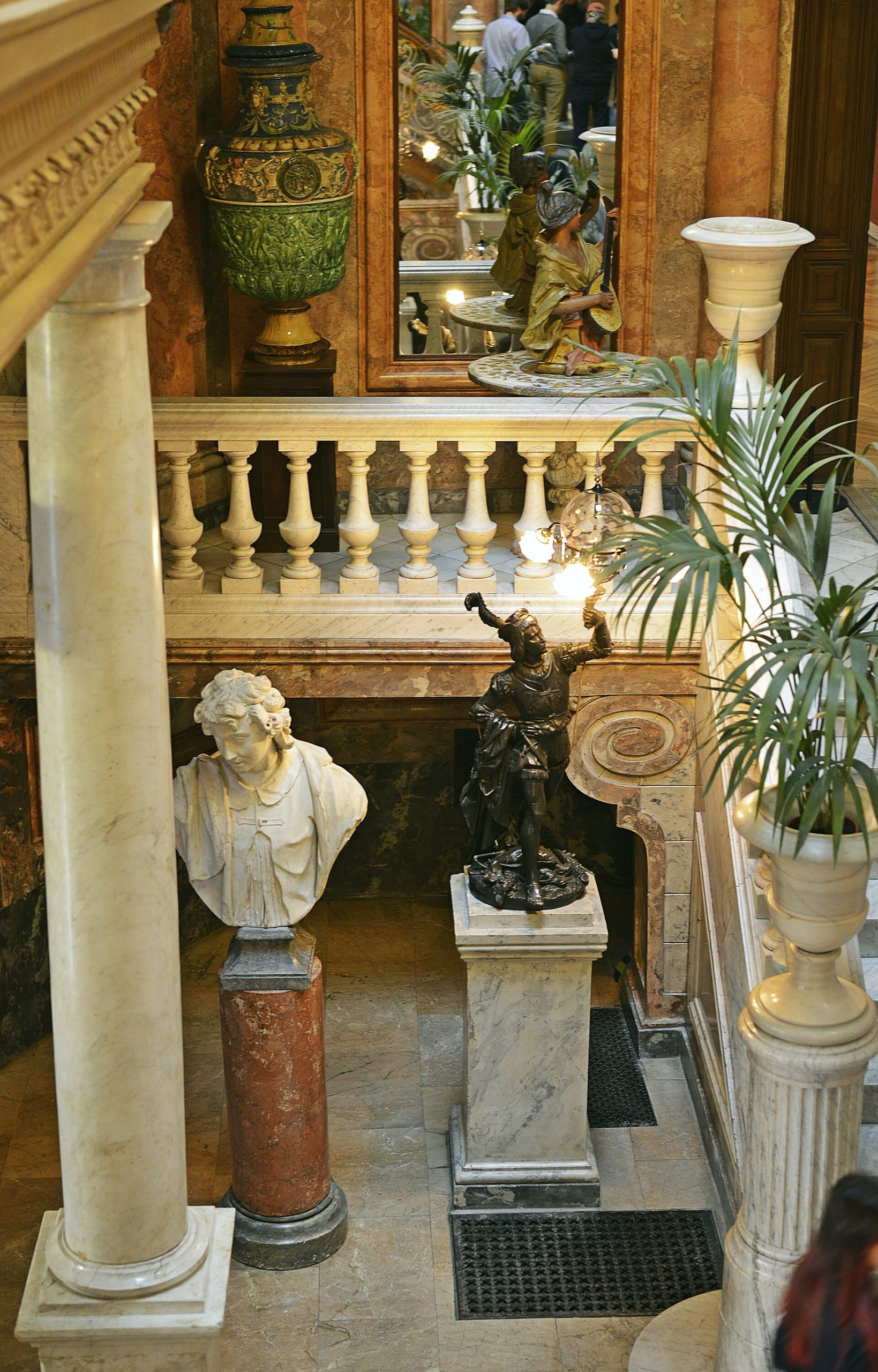
Because nothing has been rehung into a conventional gallery sequence, a visit reads more like walking through a lived-in house than through a museum in the usual sense — the density of objects in each room is itself part of what the museum documents.
Why does the museum look the way it does?
The Museo Cerralbo is preserved as a fixed “house-museum” because that was the explicit legal condition of the 1922 bequest — the collection could not be redistributed, restaged or thinned out for display logic, which is unusual among Madrid’s national museums.
Most large Madrid collections — the Prado, the Reina Sofía, the Thyssen-Bornemisza — were built or absorbed by institutions that continued to acquire, rehang and reinterpret their holdings over time. The Museo Cerralbo instead functions as a legal time capsule: a single collector’s rooms, furniture and hangings kept as a fixed condition of ownership. That makes it one of the clearer surviving examples in Madrid of how a wealthy private household of the period actually displayed its possessions, rather than how a museum later chose to present them.
The closest comparison in the city is the Museo Sorolla, also a preserved private house turned into a state museum, though built around a working artist’s studio and garden rather than an aristocrat’s reception rooms — the two make an instructive contrast in what “keeping a house as it was” can mean.
What is the building itself?
It is a late 19th-century Madrid palace built for the Marqués and his wife on Calle de Ventura Rodríguez, close to Plaza de España, in an eclectic historicist style typical of the period’s aristocratic residences. The house was designed as a functioning home with reception rooms, a chapel and family quarters, not as a public gallery, which is part of why its layout still reads as domestic rather than institutional.
The building and its fittings — mirrors, staircases, ceiling decoration — are considered part of the museum’s protected holding in the same way the objects inside it are, since the bequest covered the house as much as its contents.
Is it a national museum, and does it close on Mondays?
Yes — the Museo Cerralbo is administered as one of Spain’s state-owned museums under the Ministerio de Cultura, alongside institutions such as the Museo Arqueológico Nacional. Like most Madrid museums of this type, it follows a Monday closure pattern, though the exact weekly schedule should always be checked directly.
The reasons behind that widespread Monday closure across the city’s national museums — staffing, conservation work, shared scheduling conventions — are explained in more detail in why so many Madrid museums close on Mondays.
Does the Museo Cerralbo have free entry?
As a state museum, the Museo Cerralbo typically offers a free-entry window on specific days or hours set by the Ministerio de Cultura, in line with the pattern used across Spain’s national museum network. The specific days and hours change and should be confirmed on the museum’s own listing rather than assumed.
How that free-entry system generally works across Madrid’s state museums — including which categories of visitor usually qualify and how the windows are typically timed — is set out in how Madrid’s national museum free-entry windows work. For current opening hours, closures and ticketing at the Museo Cerralbo specifically, the Ministerio de Cultura’s own museum page is the authoritative source.
How does it compare to Madrid’s larger museums?
The Museo Cerralbo is far smaller and more specific than the Prado, the Reina Sofía or the Thyssen-Bornemisza, and it serves a different purpose: documenting one household’s taste rather than surveying the history of art. Where the Golden Triangle of Madrid museums — the Prado, Reina Sofía and Thyssen — each attempt some form of chronological or art-historical narrative, the Cerralbo makes no such claim. Its value is as a fixed record of 19th-century private collecting and domestic display, comparable in spirit (though not in scale) to how the Prado’s own collection reflects centuries of royal, rather than private, acquisition.
It is a manageable single-visit museum in terms of scale, in contrast to institutions where deciding how much ground to cover is itself a practical question — as with how much of the Prado can realistically be seen in one visit.
Where is it, and how do you get there?
The museum sits on Calle de Ventura Rodríguez, in the Palacio/Argüelles area just north of Plaza de España, within easy walking distance of the Gran Vía and the Royal Palace district. It falls within Madrid’s central public transport zone, served by nearby metro stations on lines running through Plaza de España, and by several city bus routes; exact stops and current service patterns are best checked on the Consorcio Regional de Transportes de Madrid’s own site before travelling.
Because it is a single historic house rather than a large campus, there is no equivalent of the Prado’s wing-by-wing planning question — the whole collection is seen in one continuous route through the preserved rooms.
Why does the Museo Cerralbo matter to how Madrid is understood?
It is one of the few places in the city where a 19th-century private household survives intact rather than being reconstructed from records or photographs, which makes it a primary source for understanding how wealth, taste and status were displayed in Restoration-era Madrid. Alongside the state’s larger galleries, it fills a specific gap: not what the nation chose to collect, but what one individual collector chose to live among.
For readers building a wider sense of what the city’s museums cover between them, the Museums & Galleries section sets the Museo Cerralbo alongside the archaeological, royal and modern-art holdings it complements rather than competes with.
Access Madrid is an independent guide written from published, checkable sources. We have not visited the places described here and we do not publish personal recommendations or invented ‘local favourites’ — where something is singled out as notable, we say who says so. Opening times, fares, closures and prices change at short notice, so treat everything here as a starting point and confirm with the museum, operator or venue directly before building a day around it. We give no advice on visas, insurance, health or safety; use your own government’s official guidance for those.