Madrid de los Austrias — “Habsburg Madrid” — is not an administrative district but a name for the oldest surviving core of the city, built up while the Spanish Habsburgs (called los Austrias in Spanish) ruled from Madrid between 1561 and 1700. It covers roughly the area around Plaza Mayor, Plaza de la Villa, and the old Morería, and is defined by narrow streets, brick-and-stone facades, and slate spires rather than by any city boundary line.
Where does the name come from?
The name refers to the House of Habsburg — in Spanish, la Casa de Austria — the dynasty that ruled Spain from Charles I (Charles V as Holy Roman Emperor) in 1516 to Charles II in 1700. Philip II moved the royal court to Madrid in 1561, converting a modest Castilian town into a capital almost overnight.
Everything built in the following century and a half, under Philip II, Philip III and Philip IV, forms the historic layer that later guidebooks and the city itself came to label Madrid de los Austrias. It is a period label applied retrospectively, not a name the neighbourhood carried at the time.
Is it an official neighbourhood or district?
No. Madrid’s formal administrative map divides the centre into wards (barrios) such as Palacio, Sol, and Embajadores, all within the wider Centro district. Madrid de los Austrias is a historical and touristic label that overlaps these official boundaries rather than replacing them — Madrid City Council’s own tourism materials use the term precisely this way, as a heritage zone rather than a governance unit.
In practice it sits between the Royal Palace to the west and Puerta del Sol to the east, folding in most of the barrio of Palacio and the northern half of La Latina.
What actually defines the area, architecturally?
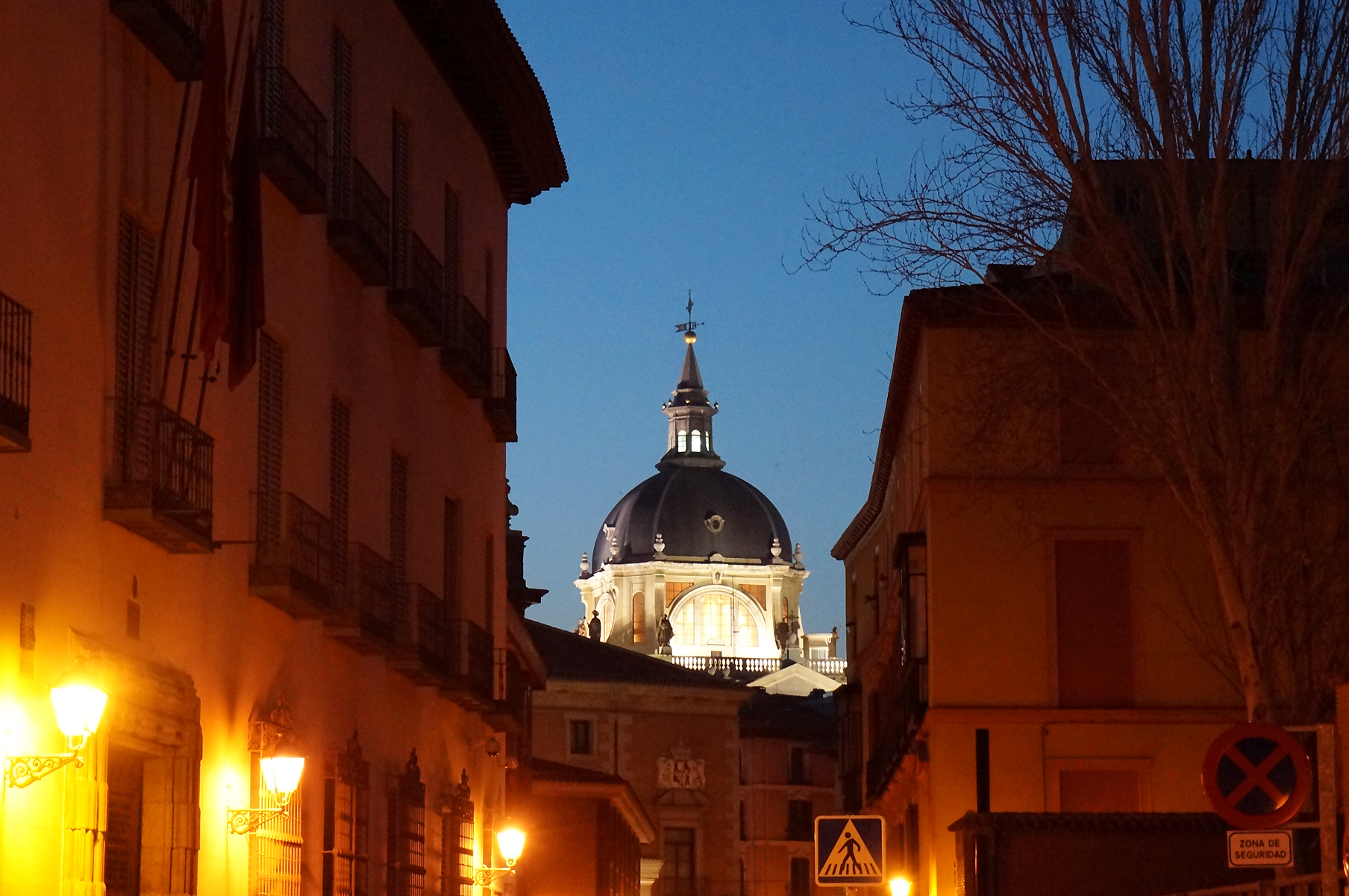
The area is defined by a building style historians often call arquitectura madrileña or estilo herreriano-derived civic architecture: red brick combined with grey granite trim, tight window bays, and steep slate roofs finished with pointed spires (chapiteles). It is a plainer, more austere register than the Bourbon-era buildings that came after it.
- Brick and stone (ladrillo y piedra) facades, often alternating in bands
- Slate-covered spires and towers, a look imported with Habsburg court taste
- Irregular, narrow medieval-derived street plans, since much of the underlying layout predates the Habsburgs
- Small enclosed plazas rather than broad avenues
This is visually distinct from the wide, ornamented 19th-century streets nearby, such as Gran Vía, cut through the city centuries later.
What are its key landmarks?
The centrepiece is Plaza Mayor, commissioned under Philip III and completed in 1619 on the site of an earlier market square, with the Casa de la Panadería as its most decorated building. From there, the area radiates outward through a set of smaller squares and religious foundations.
- Plaza de la Villa, the medieval seat of Madrid’s town government, with buildings spanning several centuries side by side
- The Monasterio de las Descalzas Reales, a royal convent founded in 1559 that still holds an important collection of Habsburg-era religious art
- The Basílica de San Francisco el Grande, on the site of an older Franciscan foundation, though its current neoclassical dome dates from the 18th century
- The Mercado de San Miguel, an early 20th-century iron-and-glass market building standing on ground that has held a market since the period covered by this label
The Royal Palace itself sits just outside the strictly Habsburg-built core: the current palace was built by the Bourbons after the medieval Alcázar burned down in 1734, so it belongs to the story of what replaced Habsburg Madrid rather than what constitutes it.
.jpg)
How does it relate to La Latina and Lavapiés?
Madrid de los Austrias shares its southern edge with La Latina, Madrid’s old quarter proper, and its associated Sunday market tradition around El Rastro. The two labels overlap rather than sit side by side: much of what tourism material calls Madrid de los Austrias is, administratively, the northern part of La Latina and the barrio of Palacio.
Further east, the old Muslim and Jewish quarters that predate the Habsburgs entirely blend into what is now Lavapiés, a reminder that the street layout in this whole corner of central Madrid is considerably older than the dynasty the name refers to.
What was here before the Habsburgs?
Madrid existed for centuries before Philip II arrived. Its origins trace to a 9th-century Muslim fortress (Mayrit) built under Emir Muhammad I of Córdoba, and the medieval town that grew around it left the irregular street pattern still visible today. The Habsburgs did not invent the street plan of this quarter — they built the monumental civic architecture on top of it.
This is why the area reads as two layers at once: a medieval tangle of lanes beneath a 16th- and 17th-century programme of squares, convents, and government buildings, much of it commissioned directly by the Habsburg court to give its new capital a suitable face.
What is it used for today?
Plaza de la Villa still functions as a civic space near Madrid’s city hall complex, and Plaza Mayor operates as both a public square and a commercial one, hosting a Christmas market each December and stamp-and-coin markets on Sunday mornings, a pattern that recurs annually rather than a fixed date worth listing here.
Several of the area’s religious foundations remain active institutions rather than museum pieces. The Descalzas Reales monastery still functions as a convent, which is part of why visiting hours there are more restricted than at a standard state museum — a detail worth confirming directly with Patrimonio Nacional, which manages the site, before planning around it.
How should someone plan a visit around it?
Because Madrid de los Austrias is a label rather than a formal district, there is no single ticket, gate, or opening time governing it — it is a walkable area of central Madrid, and each site inside it (a monastery, a basilica, a market hall) keeps its own schedule. Several of the museums nearest to it, including the ones inside the Royal Palace complex, follow the city-wide pattern described on this site’s guide to why so many Madrid museums close on Mondays.
For anyone building a wider itinerary around the historic centre, the area sits within easy reach of both Madrid’s major landmarks and the cluster of house-museums and national collections covered in the museums and galleries archive. For a fuller sense of how this quarter fits against Madrid’s other historic neighbourhoods, the neighbourhoods archive covers areas from Malasaña to Salamanca on the same basis: what each place is, not what it is sold as.
Readers travelling from outside Spain should check their own government’s current travel guidance before finalising plans, since this site does not provide visa, safety or entry advice.
Access Madrid is an independent guide written from published, checkable sources. We have not visited the places described here and we do not publish personal recommendations or invented ‘local favourites’ — where something is singled out as notable, we say who says so. Opening times, fares, closures and prices change at short notice, so treat everything here as a starting point and confirm with the museum, operator or venue directly before building a day around it. We give no advice on visas, insurance, health or safety; use your own government’s official guidance for those.
Featured image: Photo by FEDERICO JORDÁ from MADRID, ESPAÑA, source, CC BY 2.0
.jpg)