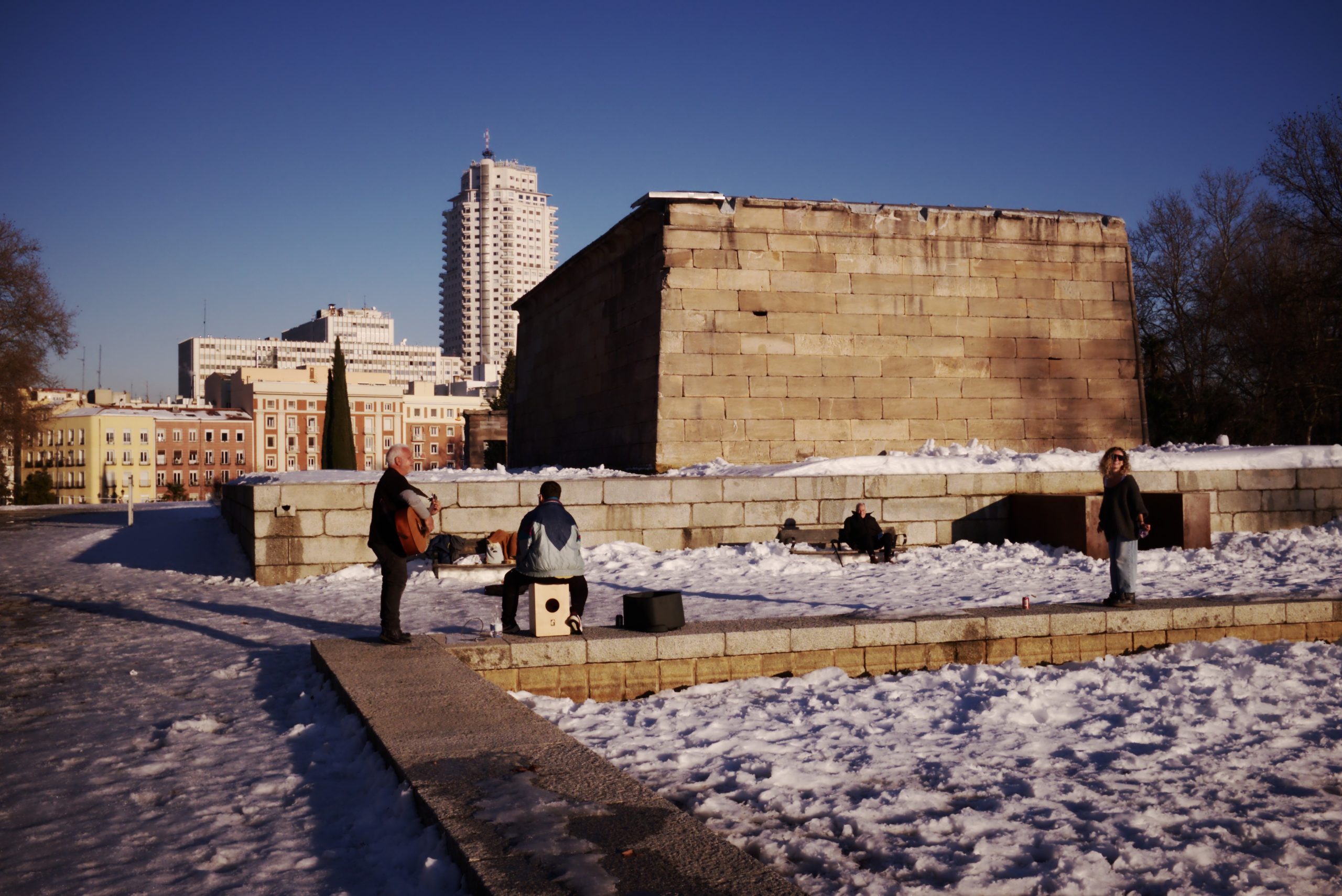
The Templo de Debod is a genuine ancient Egyptian temple, built around the 2nd century BC near Aswan, dismantled stone by stone in the 1960s, and rebuilt in Madrid’s Parque del Oeste. Egypt gave it to Spain in 1968, in thanks for Spanish engineering help during the international rescue of Nubian monuments threatened by the Aswan High Dam.
What is the Templo de Debod, exactly?
It is a stone temple originally built roughly 22 kilometres south of Aswan, on the west bank of the Nile, dedicated to the god Amun and later added to under Ptolemaic and Roman rule. It is not a replica, a folly, or a themed reconstruction: the blocks standing in Madrid are the original quarried stone, carved with hieroglyphic reliefs, moved in their entirety from Egypt.
The temple began as a small chapel built by a Nubian king, Adikhalamani, in the early 2nd century BC, later enlarged by Ptolemaic pharaohs and by Roman emperors including Augustus, who added a monumental gateway. Its plan is typical of small Egyptian temples of the period: a sequence of gateways (pylons) leading to a central sanctuary, aligned toward the river.
Why did an Egyptian temple need rescuing at all?
In the 1960s, Egypt built the Aswan High Dam to control the Nile’s flooding and generate power. The reservoir it created, Lake Nasser, would permanently submerge a string of ancient monuments in Nubia, most famously the temples at Abu Simbel.
UNESCO coordinated an international campaign, launched in 1960, to document, dismantle and relocate the threatened monuments before the water rose. Teams from multiple countries took part. Several temples were reassembled elsewhere in Egypt; others were given away entirely, as goodwill gifts to nations that had contributed archaeologists, funding or technical expertise to the rescue effort.
Spain was one of the countries that took part in the Nubian salvage campaign, and in 1968 the Egyptian government formally gave the Templo de Debod to Spain in recognition of that assistance. Spain was not alone in receiving such a gift: other Nubian temples were sent to museums in New York, Leiden and Turin under the same rescue programme, which is why Egyptian temples now stand, disassembled and reassembled, on four continents.
How did the temple end up in Parque del Oeste specifically?
The stones arrived in Madrid in the late 1960s and the temple was rebuilt on a hill in Parque del Oeste, in the Moncloa-Aravaca district west of the city centre, opening to the public in 1972. The site was chosen for its elevation and its open views toward the Casa de Campo and the sunset over the western edge of the city, a setting the ayuntamiento (Madrid’s city council), which manages the temple, has kept as parkland rather than building around it.
The reconstruction preserves the sequence of the original gateways and the sanctuary building, though the layout in Madrid is necessarily a compressed version of the wider temple precinct that existed on its original riverside site, much of which was never intended to travel.
What is actually inside it today?
The interior functions as a small exhibition space run by the city council, with panels and a scale model explaining the temple’s original context on the Nile, the Aswan rescue campaign, and the process of moving and reassembling the stone in Madrid. It is not a large museum and is not comparable in scale to Madrid’s national collections.
Visitors can see the original carved reliefs on the interior walls, including depictions of pharaohs making offerings to Egyptian deities, executed in the shallow relief style typical of Ptolemaic-period temple building.
The council’s own visitor information, published on its heritage and museums pages, sets out current opening days and hours, which change seasonally; readers should check the ayuntamiento’s site directly rather than rely on a fixed schedule here, since hours have shifted more than once in recent years.
Is the temple free to visit?
Access to the temple grounds and its exhibition space has historically been free, as is common for city-run cultural sites in Madrid, but confirmation of current terms should come from the ayuntamiento’s own listing rather than assumed in advance, since closures for conservation work have occurred.
The surrounding park itself, including the reflecting pools and the paths around the temple platform, is open public space with no admission charge, in the manner of Madrid’s other large municipal parks.
How does it compare with Madrid’s other Egyptian holdings?
The Templo de Debod is unusual in the city precisely because it is an intact standing structure rather than a museum object. Madrid’s other major collections relevant to ancient Egypt sit inside the Museo Arqueológico Nacional, which holds smaller artefacts, sarcophagi fragments and funerary objects displayed in gallery cases rather than a building brought over wholesale.
That distinction matters for understanding the temple’s place in the city: it belongs with Madrid’s outdoor monuments and landmarks, alongside sites such as the Puerta de Alcalá or the Plaza de Cibeles, rather than with its indoor museum collections, even though its origin story is closer to archaeology than to civic architecture.
Why does this matter to how Madrid presents itself?
The temple is one of very few relocated ancient Egyptian monuments outside Egypt that stands in open parkland rather than inside a museum building, which is part of why it draws attention distinct from the indoor collections that dominate Madrid’s cultural reputation, such as the Golden Triangle of Art formed by the Prado, Thyssen-Bornemisza and Reina Sofía.
For residents, the temple functions less as a single-purpose attraction and more as part of the western green belt of the city, connected on foot to Parque del Oeste’s rose garden and cable car, and often visited on the way to or from the Royal Palace and the surrounding Austrias district, given the walking distance between the two.
For visitors trying to place it within a wider itinerary of Madrid landmarks and sights, the Landmarks & Sights archive sets out how the temple relates to the city’s other major monuments, while the Museums & Galleries archive covers the indoor collections it is sometimes mistakenly grouped with.
What should a reader check before visiting?
Opening hours, seasonal closures and any admission terms for the interior exhibition are set and published by the Madrid ayuntamiento, and are the only reliable source for current detail, since municipal hours in Madrid change between summer and winter schedules more often than national museum hours do.
- Confirm current opening days and hours on the Madrid ayuntamiento’s official site before travelling.
- Treat the temple as outdoor parkland with a small paid-or-free interior, not as a full-day museum visit.
- Cross-check with UNESCO’s own published record of the Nubian monuments campaign for the wider rescue context, available through UNESCO’s official site.
Nothing about the structure’s authenticity is in dispute: it is catalogued by Spanish heritage authorities as an original ancient monument, not a reproduction, and its transfer is documented in the same international campaign records that cover the Nubian temples now standing in New York, Leiden and Turin.
Access Madrid is an independent guide written from published, checkable sources. We have not visited the places described here and we do not publish personal recommendations or invented ‘local favourites’ — where something is singled out as notable, we say who says so. Opening times, fares, closures and prices change at short notice, so treat everything here as a starting point and confirm with the museum, operator or venue directly before building a day around it. We give no advice on visas, insurance, health or safety; use your own government’s official guidance for those.