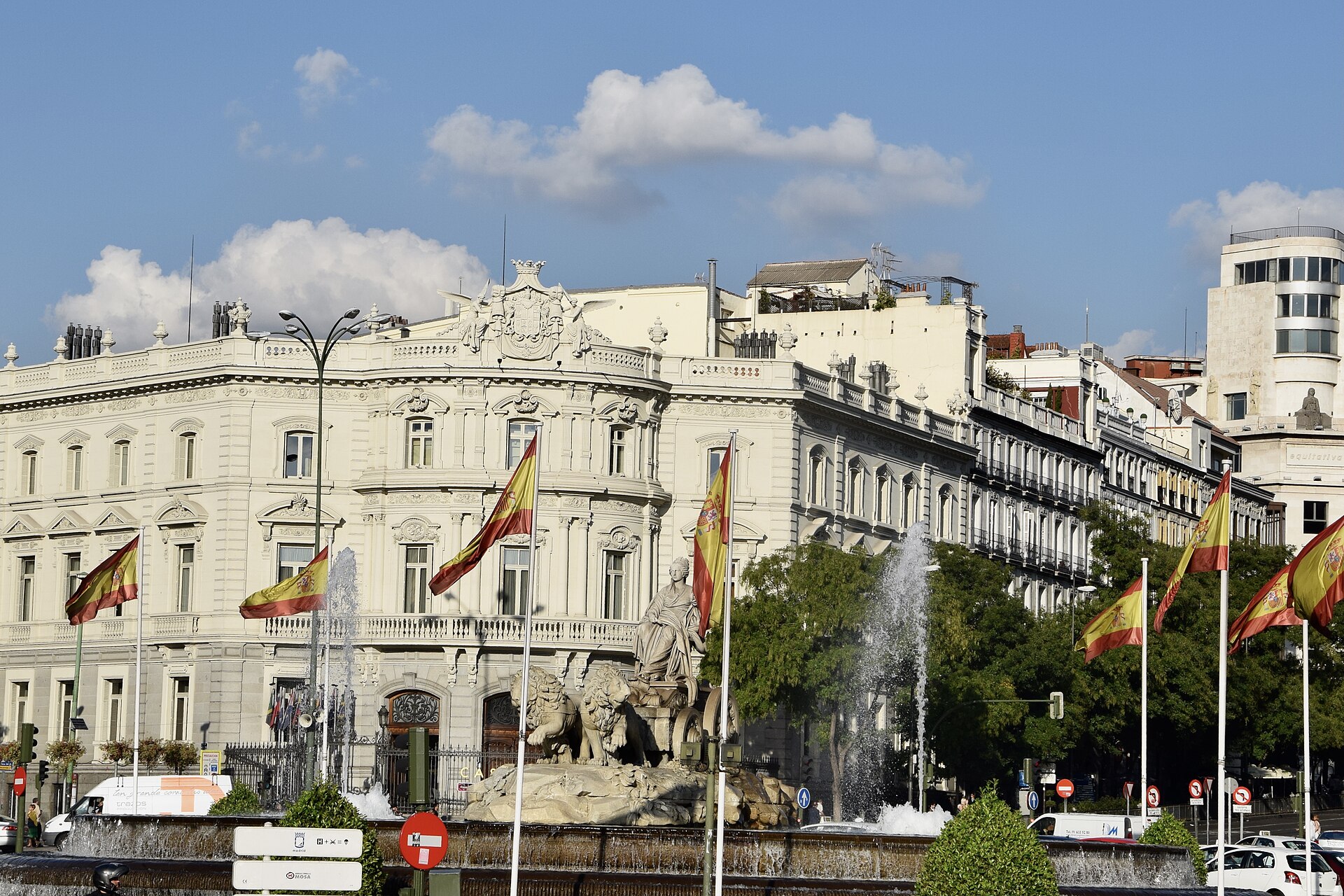
Plaza de Cibeles is a large traffic roundabout and public square at the meeting point of Paseo del Prado, Paseo de Recoletos, and Calle de Alcalá, marking the border between the Retiro, Salamanca, and Centro districts. At its centre stands an 18th-century marble fountain; behind it rises a large early 20th-century palace that now serves as Madrid’s city hall.
What is Plaza de Cibeles exactly?
It is one of the busiest intersections in central Madrid, where several of the city’s grand boulevards converge. The square sits roughly midway along the axis that runs from the Paseo del Prado museum district up through Paseo de Recoletos toward Plaza de Colón, and it also marks the eastern end of Calle de Alcalá, which continues toward the Puerta de Alcalá and on into the Retiro district.
Four large buildings occupy the four corners of the square: the Palacio de Cibeles itself, the Banco de España, the Palacio de Linares, and the Palacio de Buenavista. Together they give Plaza de Cibeles a scale and formality closer to a monumental civic set-piece than an ordinary street junction.
What is the fountain, and who built it?
The Fuente de Cibeles depicts the goddess Cybele — a fertility and nature deity of Phrygian and later Roman worship — riding a chariot pulled by two lions. It was designed by the architect Ventura Rodríguez, with the sculptural group carried out by Francisco Gutiérrez and Roberto Michel, and installed in the 1780s as part of a wider scheme of fountains commissioned under King Carlos III to mark the improved water supply and urban embellishment of the Paseo del Prado corridor.
The same building programme produced the nearby Fuente de Neptuno further down the Paseo del Prado, and the two fountains are often discussed together as a pair of Enlightenment-era public monuments rather than as decorative afterthoughts — they were part of a deliberate remodelling of Madrid’s principal avenue under Carlos III.
Over time, the fountain has become one of the most widely used visual shorthand images for Madrid itself, appearing on municipal material and functioning as an informal emblem of the city, independent of any single institution’s branding.
What is the building behind the fountain?
The building directly behind the fountain, facing it across the square, is the Palacio de Cibeles. It was built between 1907 and 1919 to a design by the architects Antonio Palacios and Joaquín Otamendi, in a stone-and-granite style that mixes Gothic, Plateresque, and early 20th-century monumental influences — a style sometimes labelled, loosely, as Madrid’s own take on Beaux-Arts eclecticism.
For most of the 20th century the building was known as the Palacio de Comunicaciones, and it served as the headquarters of Spain’s national postal and telegraph service, Correos. Its scale was intentional: the postal service was a major state institution, and the building was conceived as a visible statement of that institution’s importance, not simply a functional sorting office.
Correos vacated the building in the early 2000s, and Madrid’s city council acquired it. Since 2007 the Palacio de Cibeles has functioned as the Ayuntamiento de Madrid — the seat of the city government, including the mayor’s offices and the full council chamber — a considerably more prominent civic role than its original postal function.
_10.jpg)
What happens inside the Palacio de Cibeles today?
Beyond its administrative function, most of the ground floor and part of the building operate as CentroCentro, a public cultural centre run by the city council. It hosts temporary exhibitions, talks, and a public reading room, and admission to these areas is generally free, though the council periodically changes the programme.
The building also has a rooftop viewpoint, the Mirador Madrid, reached by lift, which is one of the few paid attractions inside an otherwise free civic building — access is ticketed and capacity-limited, so current hours and prices should be confirmed on the CentroCentro website directly rather than assumed from any printed guide.
Because the Palacio de Cibeles is a working seat of government as well as a cultural venue, some areas are closed to the public on days of official events, and visiting hours for the mirador and exhibition spaces do not always match each other.
What are the other buildings around the square?
The Banco de España occupies another corner of the plaza and is the headquarters of Spain’s central bank, a distinct institution from the Bank of Spain’s museum holdings, which are not generally open to casual visitors. The Palacio de Linares, a 19th-century aristocratic mansion, now houses Casa de América, a cultural institution focused on relations with Latin America, and its interior can sometimes be visited as part of organised cultural visits arranged through that institution. The Palacio de Buenavista, on the fourth corner, is a former ducal residence that has served as the headquarters of the Spanish Army’s Estado Mayor — it is not a public visitor site.
None of these four buildings should be confused with the Royal Palace itself, which sits well to the west near the cathedral; readers looking for the monarchy’s ceremonial residence should see the separate article on the Royal Palace of Madrid. Plaza de Cibeles is a civic and institutional square, not a royal one.
Why do crowds sometimes gather at Cibeles?
The fountain has become the traditional gathering point for Real Madrid supporters celebrating major trophies, a pattern that has developed over decades and is widely reported by Spanish and international media rather than being an official arrangement with the club or the city. Barcelona-based celebrations, by contrast, are traditionally centred elsewhere, which is part of why Cibeles’ association with Real Madrid specifically has become so entrenched in public memory.
Because these gatherings can draw very large crowds at short notice, tied to unpredictable sporting results, the square’s normal traffic and pedestrian patterns can be disrupted with little warning during a title run — a detail relevant to residents and visitors alike who might otherwise plan to pass through the junction.
How does Plaza de Cibeles fit into the wider museum district?
The square sits at the northern end of the Paseo del Prado corridor, close to the concentration of major museums sometimes referred to as Madrid’s Golden Triangle of Art. It is also a short walk from smaller specialist collections such as the Museo Naval, making the plaza a natural orientation point for anyone moving on foot between the Retiro park area and the museum district further south.
For a broader sense of how repurposed historic buildings function as cultural venues elsewhere in the city — a pattern the Palacio de Cibeles itself exemplifies, moving from postal headquarters to city hall and gallery — see the explanation of CaixaForum Madrid and the building it occupies.
How do you get to Plaza de Cibeles?
The square is served directly by its own metro station, Banco de España, on Madrid’s metro network, operated by Metro de Madrid. Multiple bus routes run through or near the plaza as part of the EMT Madrid network. As with all transport details in this city, current lines, fares, and any service changes should be checked on the operator’s own site rather than assumed from a guidebook.
On foot, the square connects directly to Paseo del Prado heading south toward the museum district, and to Calle de Alcalá heading east toward the Puerta de Alcalá and Retiro park — both walks of a few minutes across level, well-signed streets.
Readers assembling a wider itinerary around the city’s monuments and squares may find it useful to browse the site’s Landmarks & Sights archive, which covers the other major public spaces and gates that structure central Madrid, including Plaza Mayor and Puerta del Sol, both a short distance to the west.
Access Madrid is an independent guide written from published, checkable sources. We have not visited the places described here and we do not publish personal recommendations or invented ‘local favourites’ — where something is singled out as notable, we say who says so. Opening times, fares, closures and prices change at short notice, so treat everything here as a starting point and confirm with the museum, operator or venue directly before building a day around it. We give no advice on visas, insurance, health or safety; use your own government’s official guidance for those.