What is CaixaForum Madrid?
CaixaForum Madrid is a cultural centre run by Fundación “la Caixa,” the philanthropic and cultural foundation linked to the Spanish bank CaixaBank. It has no permanent collection of its own on display. Instead it hosts temporary exhibitions, concerts, talks and workshops, in a building on Paseo del Prado that was originally an electricity substation.
It sits in the stretch of Paseo del Prado that also holds the Museo del Prado, the Thyssen-Bornemisza and the Real Jardín Botánico — the area often called Madrid’s Golden Triangle of Art, though CaixaForum is a later addition to that cluster and functions differently from the three big collecting museums nearby.
What was the building before it became CaixaForum?
The building was the Central Eléctrica del Mediodía, a power station built at the turn of the twentieth century to generate electricity for Madrid’s southern tramline network. Construction dates to around 1899–1901, in the exposed-brick industrial style typical of the period’s utility architecture.
By the late twentieth century the station was disused. Fundación “la Caixa” acquired the site and commissioned a conversion rather than a demolition, which is why the exterior brick shell — a recognisable piece of Madrid’s industrial past — still stands largely as it did, even though almost everything behind and beneath it is new.
Who converted the building, and when did it open?
The conversion was designed by the Swiss architectural firm Herzog & de Meuron, known internationally for adaptive reuse projects including the Tate Modern in London, itself a converted power station. CaixaForum Madrid opened in 2008 after several years of construction.
The architects kept the original brick structure but removed its stone base entirely, along with the ground beneath part of the site, to create an underground level. Above ground, new cast-iron sections were added to the top of the building, extending its silhouette without disguising where old brick ends and new material begins.
Why does the building appear to float above the plaza?
The most-noted feature of CaixaForum is that its brick mass appears to hang in the air, detached from the ground, with an open plaza underneath it. This was achieved by excavating the base of the old power station and supporting the remaining structure on a reduced number of points, rather than a continuous foundation.
The effect creates a covered public space at street level, open to Paseo del Prado, before visitors reach the entrance. It is one of the more discussed pieces of contemporary architecture on this stretch of the paseo, precisely because it is a nineteenth-century industrial structure altered to behave like a modern one.
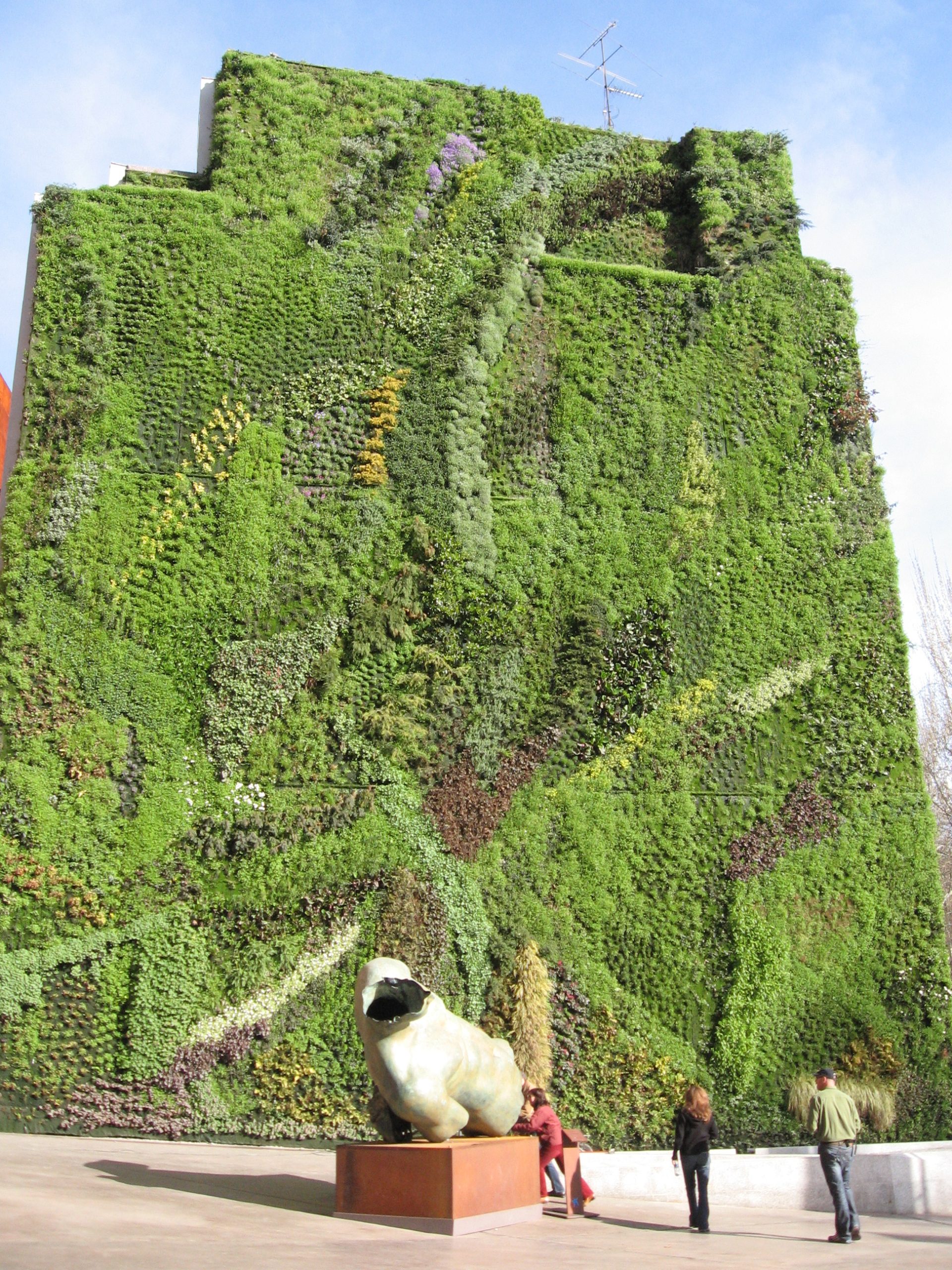
What is the vertical garden next to CaixaForum?
Attached to the building, on a party wall facing the plaza, is a large vertical garden — a wall of live planting rather than a mural or cladding. It was designed by the French botanist Patrick Blanc, who developed the technique of growing plants directly on a vertical felt-and-irrigation system rather than in soil beds.
The wall is planted with a mix of species chosen for the conditions and requires ongoing irrigation and maintenance, which Fundación “la Caixa” is responsible for as part of the site. It has become one of the more photographed features of this part of Madrid, largely because it sits directly beside a much older brick facade and reads as a deliberate contrast rather than decoration.
What does CaixaForum show, if it has no permanent collection?
CaixaForum Madrid’s programme is built around temporary exhibitions, typically drawing on loans from major international museums, private collections, and the foundation’s own holdings, including the Colección “la Caixa” de Arte Contemporáneo. Exhibitions rotate over the course of a year and can range from historical painting to photography, design and contemporary art.
Beyond exhibitions, the centre runs a regular schedule of concerts, lectures, film screenings and family or educational workshops, reflecting its role as a cultural centre rather than a museum in the traditional sense. Because none of this holds a fixed collection on view year-round, the specific exhibition on at any given time has to be checked directly rather than assumed from what the building has shown before.
Readers wanting a sense of how CaixaForum’s model compares with the collecting institutions nearby can look at what is actually on permanent display at the Museo del Prado or the Thyssen-Bornemisza collection, both of which hold fixed bodies of work rather than a rotating programme.
Where is CaixaForum, and how does it fit into the museum district?
CaixaForum Madrid stands on Paseo del Prado, within walking distance of the Prado, the Thyssen-Bornemisza, the Real Jardín Botánico and, a little further south, the Reina Sofía and its Guernica collection. It is one of the reasons this stretch of the paseo functions as a continuous cultural corridor rather than a series of separate stops.
Unlike the Prado or Reina Sofía, CaixaForum is not a national museum and is not part of any government-run free-entry scheme. Readers checking how national museum access windows work can see the separate explanation of Madrid’s national museum free-entry windows, which does not apply to CaixaForum since it operates under its own foundation rather than the state.
Is CaixaForum free, and how are tickets structured?
Access to CaixaForum’s building and its ground-floor spaces is generally open, but entry to specific exhibitions is usually ticketed, sometimes with a fee and sometimes free depending on the show and the foundation’s own policy at the time. Fundación “la Caixa” periodically runs promotions or free days that are not fixed year to year.
Because pricing, opening hours and any current promotions change and are set entirely by the foundation, the only reliable source is CaixaForum’s own site, caixaforum.org, which should be checked directly before planning a visit rather than relying on a fixed figure here.
Does CaixaForum close on Mondays like other Madrid museums?
Unlike many of Madrid’s national museums, CaixaForum has historically kept longer opening hours across the week, including days when institutions such as the Prado or Reina Sofía are shut. The general pattern of Monday closures across Madrid’s major museums is explained separately in why so many Madrid museums close on Mondays, and CaixaForum’s own current schedule should be checked on its site rather than assumed to follow the same rule.
Is CaixaForum Madrid part of a larger network?
CaixaForum Madrid is one of several centres under the same name run by Fundación “la Caixa” across Spain, including CaixaForum Barcelona, Zaragoza, Sevilla, Palma, Girona, Lleida and Valencia. Each occupies a distinct building — several of them, like Madrid’s, repurposed from earlier industrial use — and each runs its own exhibition programme, though some touring shows move between locations.
This means an exhibition seen at CaixaForum Madrid may have shown, or may later show, at another CaixaForum in Spain, which is worth knowing for anyone tracking a specific touring show rather than the building itself.
Why does the building matter beyond its current use?
CaixaForum Madrid is one of the clearer examples in the city of an industrial structure being kept rather than cleared, with its original brick shell doing double duty as both a historical object and a working exhibition space. The decision to expose that history — leaving old brick visibly distinct from new steel and cast iron — is part of what makes the building a reference point in discussions of adaptive reuse in Spanish architecture.
For visitors and residents building a wider sense of how Madrid’s museums differ in structure, collection and funding, the Museums & Galleries section covers the national, civic and private institutions that make up the city’s broader museum landscape, of which CaixaForum — privately run, collection-free, and housed in a former power station — is a distinctive outlier.
Access Madrid is an independent guide written from published, checkable sources. We have not visited the places described here and we do not publish personal recommendations or invented ‘local favourites’ — where something is singled out as notable, we say who says so. Opening times, fares, closures and prices change at short notice, so treat everything here as a starting point and confirm with the museum, operator or venue directly before building a day around it. We give no advice on visas, insurance, health or safety; use your own government’s official guidance for those.
Featured image: Photo by Draceane, source, CC BY-SA 4.0
