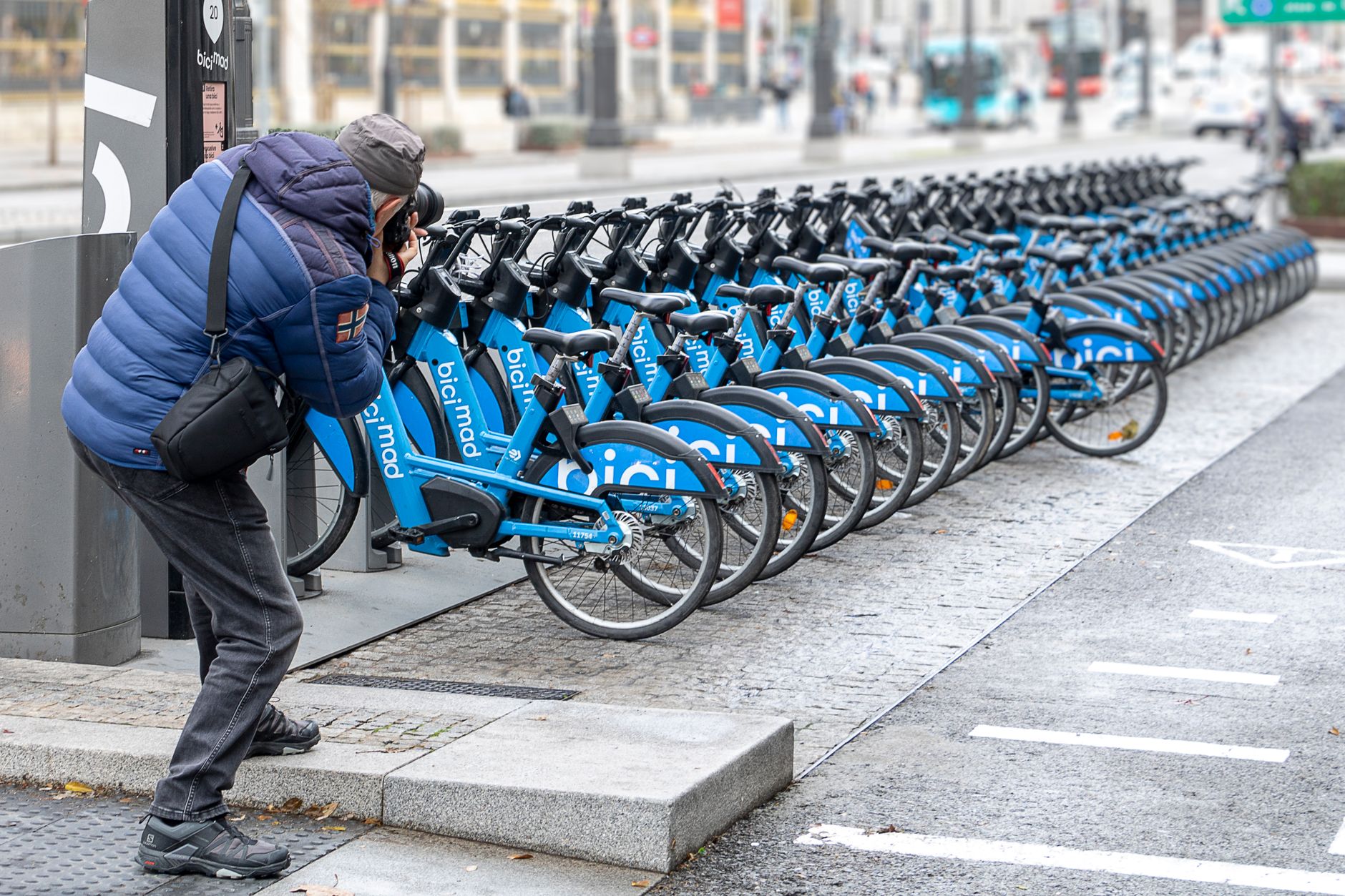
BiciMAD is Madrid’s public bike-sharing system: a network of docking stations holding electric-assist bicycles, spread across the city and operated by EMT, the same public company that runs Madrid’s bus network. Users unlock a bike through an app or a physical card, ride it, and return it to any station with a free space.
What Is BiciMAD, Exactly?
BiciMAD is a station-based, electric bicycle-sharing scheme owned by the Ayuntamiento de Madrid (Madrid City Council) and operated by EMT — Empresa Municipal de Transportes, the municipal transport company better known for running the city’s bus fleet. It launched in 2014, initially covering the central districts inside the M-30 ring road, and has since been extended in phases into outer districts.
The bikes themselves are pedelecs — pedal-assist electric bicycles that add power as the rider pedals, rather than throttle-controlled scooters. Each station is a self-contained unit with a row of docks, a control terminal, and, in most cases, solar panels that help charge the bikes while they wait.
Who Operates BiciMAD, and Is It a City Service?
BiciMAD is municipal infrastructure, not a private rental company. EMT runs it under the same public remit as the bus network, which is why the two systems share branding conventions and, in places, planning logic. The system is not, however, folded into the Consorcio Regional de Transportes fare structure used by the Madrid Metro or the Tarjeta Transporte Público abono. BiciMAD has its own registration, its own app, and its own separate fare system, managed directly through EMT.
How Do the Bikes Work?
Each bike is checked out from a station terminal or through the BiciMAD app, using either a registered account or an occasional-use ticket bought on the spot. The bike must be returned to a docking station — BiciMAD is not a free-floating, park-anywhere system. If the nearest station is full, the app and station terminals show real-time availability at nearby stations so a rider can plan the return.
EMT operates two main ways to use the system: an annual subscription (abono anual), aimed at people who ride regularly and pay a set yearly fee for cheaper per-trip rates, and an occasional-use registration for one-off or short-term riders, typically billed per minute or per short block of time. Both routes are managed through the same app and the same station network.
How Do You Register and Pay?
Registration is done through the BiciMAD app or the EMT’s BiciMAD website, using a debit or credit card. Because fare tiers, included minutes, and per-minute surcharges are adjusted periodically by EMT, this is exactly the kind of detail that goes stale fast — the operator’s own BiciMAD site is the only reliable source for current pricing, and it should be checked before planning a longer trip on the network.
What stays constant is the shape of the fare: a base charge or subscription fee covers a set period of continuous use, after which per-minute charges apply, with an additional surcharge if a bike is kept out for an extended period or not docked correctly at the end of a ride.
Where Are the BiciMAD Stations?
Coverage began with the central almendra — the area inside the M-30 — taking in districts such as Centro, Chamberí, Arganzuela and parts of Salamanca and Retiro. EMT has since extended the network in stages into districts further out, including areas of Carabanchel, Latina, Vallecas and Villaverde, though coverage remains denser in the centre than at the city’s edges. Station locations and live bike availability are shown on the BiciMAD app and on EMT’s own site, which is the only source that stays current as the network keeps expanding.
Because station density varies so much by area, BiciMAD works differently depending on which part of the city a rider is in — a point worth checking against the pattern of any specific district or barrio before relying on it for a regular commute.
Is BiciMAD Useful for a Short Visit?
For a visitor spending a few days in the centre, BiciMAD can cover ground that is awkward on foot but too short for the metro — crossing from one side of Retiro to Gran Vía, for instance, or linking two museums that sit at opposite ends of the Golden Triangle of Art. It is worth weighing against how compact the historic centre actually is: the piece on how walkable central Madrid really is sets out the real distances between major landmarks, and for many routes walking or the metro will be simpler than managing a docking station.
Occasional-use registration is built for exactly this kind of short-term visitor need, without requiring a long-term commitment or an annual account. Even so, EMT’s app and terminals are primarily in Spanish (with some English support), and station docking in a busy central area can be unpredictable at peak times, which matters more to a visitor working around a tight schedule than to someone who lives here.
How Does BiciMAD Fit With the Rest of Madrid’s Transport?
BiciMAD sits alongside, rather than inside, Madrid’s main public transport network. The EMT bus network and the metro run on the regional Tarjeta Transporte Público system described in the piece on the Madrid Metro fare system; BiciMAD does not use that card or that zone structure. A traveller arriving via Barajas Airport or connecting through Cercanías will still need a separate BiciMAD registration if they want to use the bikes once in the centre.
Cycling infrastructure in Madrid itself is uneven. Some stretches — notably along Madrid Río, the park corridor that follows the Manzanares through Arganzuela — have dedicated, segregated paths well suited to cycling. Elsewhere, particularly in the older street grid of the centre, bikes share road space with traffic on narrower streets, and the dedicated bike-lane network is more limited than the pedestrian and transit infrastructure covering the same ground.
What Are the Basic Rules of Using BiciMAD?
Riders are expected to follow ordinary Spanish traffic rules for cyclists, and to dock bikes correctly at the end of a trip — failing to do so typically triggers an additional charge under BiciMAD’s fare terms. Details on helmet expectations, permitted routes and specific local traffic rules for cyclists are set by Spanish and Madrid municipal regulations directly; EMT’s own BiciMAD terms and the city council’s cycling guidance are the sources to check rather than general summaries.
Is BiciMAD Worth It for Residents?
For someone living in Madrid, BiciMAD’s annual subscription is aimed squarely at routine, short urban trips — the kind of journey too short to justify a metro fare but long enough to be tiring in midsummer heat or a winter downpour. Its usefulness depends heavily on where in the city someone lives, since station density thins out considerably beyond the central districts and into areas like Vallecas or Carabanchel, even where EMT has extended coverage.
Residents weighing BiciMAD against a full transport pass are really comparing two different kinds of trip: BiciMAD for short, point-to-point hops within reach of stations, and the metro or bus network for anything longer or less predictable. The two are not designed to replace each other, and EMT’s own site is the place to check current subscription costs before deciding which combination makes sense for a given commute.
For a wider view of how the various pieces of Madrid’s transport system connect — buses, metro, Cercanías and bike-share among them — the Getting Around section sets out how each part of the network functions on its own terms.
Access Madrid is an independent guide written from published, checkable sources. We have not visited the places described here and we do not publish personal recommendations or invented ‘local favourites’ — where something is singled out as notable, we say who says so. Opening times, fares, closures and prices change at short notice, so treat everything here as a starting point and confirm with the museum, operator or venue directly before building a day around it. We give no advice on visas, insurance, health or safety; use your own government’s official guidance for those.
Featured image: Photo by Javier Perez Montes, source, CC BY-SA 4.0
