Tetuán is one of Madrid’s 21 administrative districts, sitting north of Chamberí and south of Fuencarral-El Pardo, roughly between Paseo de la Castellana and the old road out to Fuencarral. It began as a separate settlement outside the city, was folded into Madrid in 1948, and today is a dense, largely residential and commercial district known for Cuatro Caminos and for the diversity of its population.
Where Is Tetuán Located?
Tetuán occupies a wedge of north-central Madrid. It borders Chamberí to the south, Chamartín to the east across Paseo de la Castellana, Fuencarral-El Pardo to the north, and Moncloa-Aravaca to the west. It is Madrid’s district number 6 in the city council’s own numbering.
The district’s spine is Calle Bravo Murillo, which runs roughly north–south and functions as its main commercial street, much as other Madrid districts organise around a single artery. Its eastern edge follows Paseo de la Castellana, which carries traffic north past the Nuevos Ministerios complex toward Plaza de Castilla, where Tetuán meets the Chamartín and Fuencarral-El Pardo boundaries and the Castellana continues on toward the Cuatro Torres skyscrapers.
Where Does the Name Tetuán Come From?
The name commemorates the Battle of Tetuán, fought in February 1860 during Spain’s war with Morocco (the Guerra de África), and won by Spanish forces under General Leopoldo O’Donnell. O’Donnell was subsequently given the title Duke of Tetuán.
In the years after the victory, a new settlement grew up on the road leading north out of Madrid, and its residents named it Tetuán de las Victorias in commemoration of the battle. That settlement is the origin of today’s district. The naming pattern — a place named after an event or a person rather than a physical feature — is not unusual in Madrid; the origin of Malasaña’s name, for instance, comes from a similar act of commemoration rather than geography.
How Did Tetuán Become Part of Madrid?
Tetuán de las Victorias was originally its own municipality, distinct from Madrid and separated from it by open ground. It developed through the late nineteenth and early twentieth centuries as a working settlement on Madrid’s edge, housing labourers and small industry that the growing capital needed but had no room for within its own boundary.
In 1948, Madrid annexed a group of surrounding municipalities in a major administrative expansion that also absorbed places such as Chamartín de la Rosa, Carabanchel, Vallecas and Fuencarral. Tetuán de las Victorias was one of them. The annexation is why several of Madrid’s districts — Tetuán among them — retain a street pattern and character distinct from the planned grid of a district like the Barrio de Salamanca, which was designed from the outset as an extension of the capital rather than absorbed as an existing town.
What Are Tetuán’s Neighbourhoods (Barrios)?
Madrid’s districts are subdivided into official barrios, and Tetuán has six, each with its own character within the wider district:
- Bellas Vistas
- Cuatro Caminos
- Castillejos
- Almenara
- Valdeacederas
- Berruguete
Of these, Cuatro Caminos is the best known outside the district itself, largely because of the transport hub that shares its name.
What Is Cuatro Caminos, and Why Does It Matter?
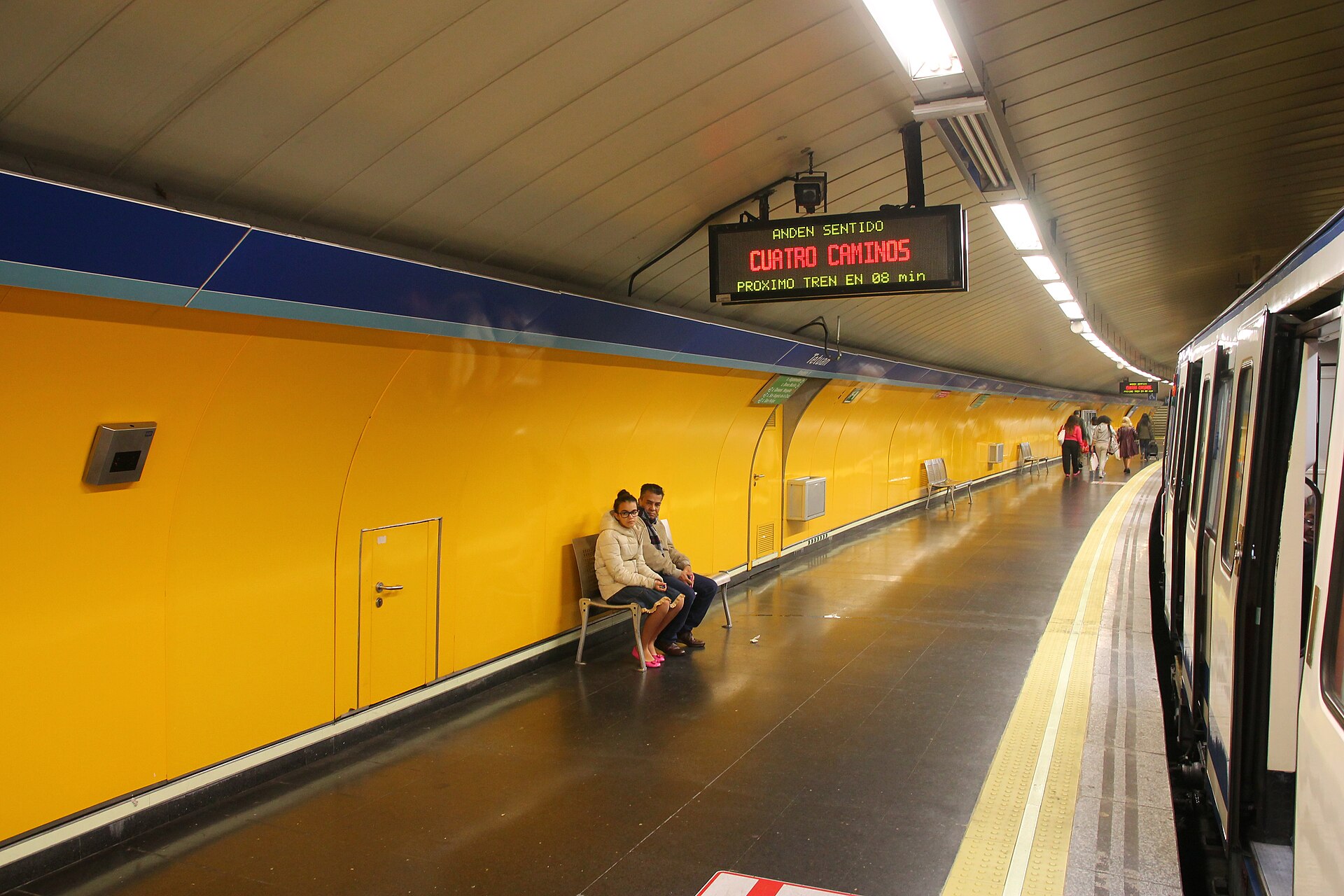
Cuatro Caminos — literally “four roads” — is the historic crossroads where routes toward Fuencarral, Chamartín, the old town of Tetuán and central Madrid once met. It gave its name to both the barrio and the metro station beneath it.
The station is one of Madrid’s oldest. It opened in 1919 as part of the original Madrid Metro line running between Cuatro Caminos and Sol — the city’s very first underground line. That history connects Tetuán to the story told at Chamberí’s disused ghost station, which sat on the same early network and now survives as a preserved relic of it. Cuatro Caminos itself is still very much in service, functioning today as an interchange between several metro lines and a genuinely busy commuter node rather than a curiosity.

What Is Tetuán Like Today?
Tetuán is one of Madrid’s more densely populated districts, built up largely with mid-rise apartment blocks along a compact street grid rather than the wide boulevards of neighbouring Chamberí. It functions primarily as a residential and commercial district: workshops, wholesalers and small retail along Bravo Murillo, offices further east toward the Castellana, and housing filling in between.
It is also one of the city’s more demographically diverse districts. Madrid City Council’s own municipal register data consistently show a higher-than-average share of foreign-born residents in Tetuán compared with the city as a whole, with communities from Latin America and, more recently, from China represented in significant numbers. The clustering of Chinese-run wholesale and retail businesses around Bravo Murillo has been widely reported in Spanish press coverage of the district, though readers wanting current, sourced detail should look to the council’s own published demographic data rather than anecdote.
Unlike districts built around a single monument or square, Tetuán has no equivalent centrepiece — it reads more as a working cross-section of ordinary Madrid than as a destination in its own right, which is itself informative about how much of the city outside the historic centre actually functions day to day.
How Do You Get To and Around Tetuán?
Cuatro Caminos is the district’s main transport anchor, with several Madrid Metro lines meeting there. Nuevos Ministerios, just across the district’s eastern boundary along the Castellana, adds a major Cercanías (regional rail) interchange within easy reach. Bus routes run the length of Bravo Murillo and along the Castellana corridor.
For current line numbers, interchange details and service maps, Madrid’s metro operator publishes its own network information and should be treated as the reference source over any third-party description, since lines and interchanges are occasionally reorganised.
What Else Is Near Tetuán?
Tetuán sits close to several landmarks that fall administratively in neighbouring districts but are easily reached from it. The Santiago Bernabéu stadium lies just across the Castellana in Chamartín. Further north, past Plaza de Castilla, the Castellana corridor runs on toward the Cuatro Torres business towers. To the south, Chamberí offers the ghost station and the older, more architecturally uniform streets that predate Tetuán’s own incorporation into Madrid.
Readers building a wider picture of how Madrid’s districts fit together can compare Tetuán’s working, annexed character against the planned grid described in the piece on the Barrio de Salamanca, or browse the fuller picture of the city’s neighbourhoods in the Access Madrid neighbourhoods archive. For landmarks near the district’s edges, the landmarks and sights archive covers the Castellana’s major buildings in more detail.
Access Madrid is an independent guide written from published, checkable sources. We have not visited the places described here and we do not publish personal recommendations or invented ‘local favourites’ — where something is singled out as notable, we say who says so. Opening times, fares, closures and prices change at short notice, so treat everything here as a starting point and confirm with the museum, operator or venue directly before building a day around it. We give no advice on visas, insurance, health or safety; use your own government’s official guidance for those.
Featured image: Photo by Draceane, source, CC BY-SA 4.0
