The Santiago Bernabéu is Real Madrid’s home football stadium, standing on Paseo de la Castellana in the Chamartín district. It opened in 1947 and has been rebuilt and expanded repeatedly since, most recently in a renovation finished in the 2020s that added a retractable roof, a movable pitch, and a fully reclad exterior — turning a football ground into a year-round events venue.
What is the Santiago Bernabéu, exactly?
It is the stadium of Real Madrid Club de Fútbol, one of the two clubs (with Atlético Madrid) that play in Spain’s top division from the capital. It has hosted European Cup and Champions League finals, Spain national team matches, and — since its most recent renovation — concerts and other large ticketed events, none of which is unusual for a stadium of this size but which the ground was not previously built to accommodate.
Structurally it is a multi-tiered bowl set into a dense city block, hemmed in by Paseo de la Castellana on one side and residential streets on the others. That constraint — a major stadium with almost no surrounding land to expand into — has shaped nearly every rebuild since its opening, because growth had to go up and out rather than sideways.
Why is it called the Santiago Bernabéu?
The stadium is named after Santiago Bernabéu de Yeste, a Real Madrid player, manager and later club president who oversaw its construction. The ground opened under the name Estadio Chamartín, referencing the district, and was renamed in his honour in 1955 while he was still president, a decision the club has always credited to his role in commissioning and financing the original build.
Bernabéu remained club president until his death in 1978, and the stadium has carried his name for most of its existence — longer, in fact, than it carried its original one.
Where is it located, and how do you get there?
The stadium sits on Paseo de la Castellana, Madrid’s principal north–south avenue, in the Chamartín district north of the city centre. It has its own metro station, Santiago Bernabéu, on Line 10, putting it within a short ride of central Madrid and of Nuevos Ministerios, a major interchange station. Bus routes along the Castellana also stop close by. Details of routes and any match-day service changes are best confirmed through Madrid’s metro operator, Metro de Madrid, rather than assumed in advance.
How has the stadium changed since 1947?
The Bernabéu has never really stood still. Its history is one of near-continuous alteration rather than a single fixed design:
- 1947 — opened as Estadio Chamartín with an initial capacity in the low tens of thousands, small by the ground’s later standards.
- 1954 and 1955 — expanded and renamed Santiago Bernabéu, roughly doubling capacity as Real Madrid’s success in the early European Cup era drew larger crowds.
- 1982 — remodelled ahead of the FIFA World Cup, which Spain hosted, with the stadium as one of the host venues.
- Late 1990s and 2000s — a third tier added and facilities modernised, including new corporate and media infrastructure as the ground was brought closer to modern stadium standards.
- 2019 onward — the most extensive rebuild in the stadium’s history, carried out in phases while the ground stayed largely in use for matches.
Each phase responded to a different pressure: crowd growth in the 1950s, a World Cup deadline in the 1980s, and — most recently — the demands of European club competition and a broadcasting-driven need for year-round revenue beyond match days.
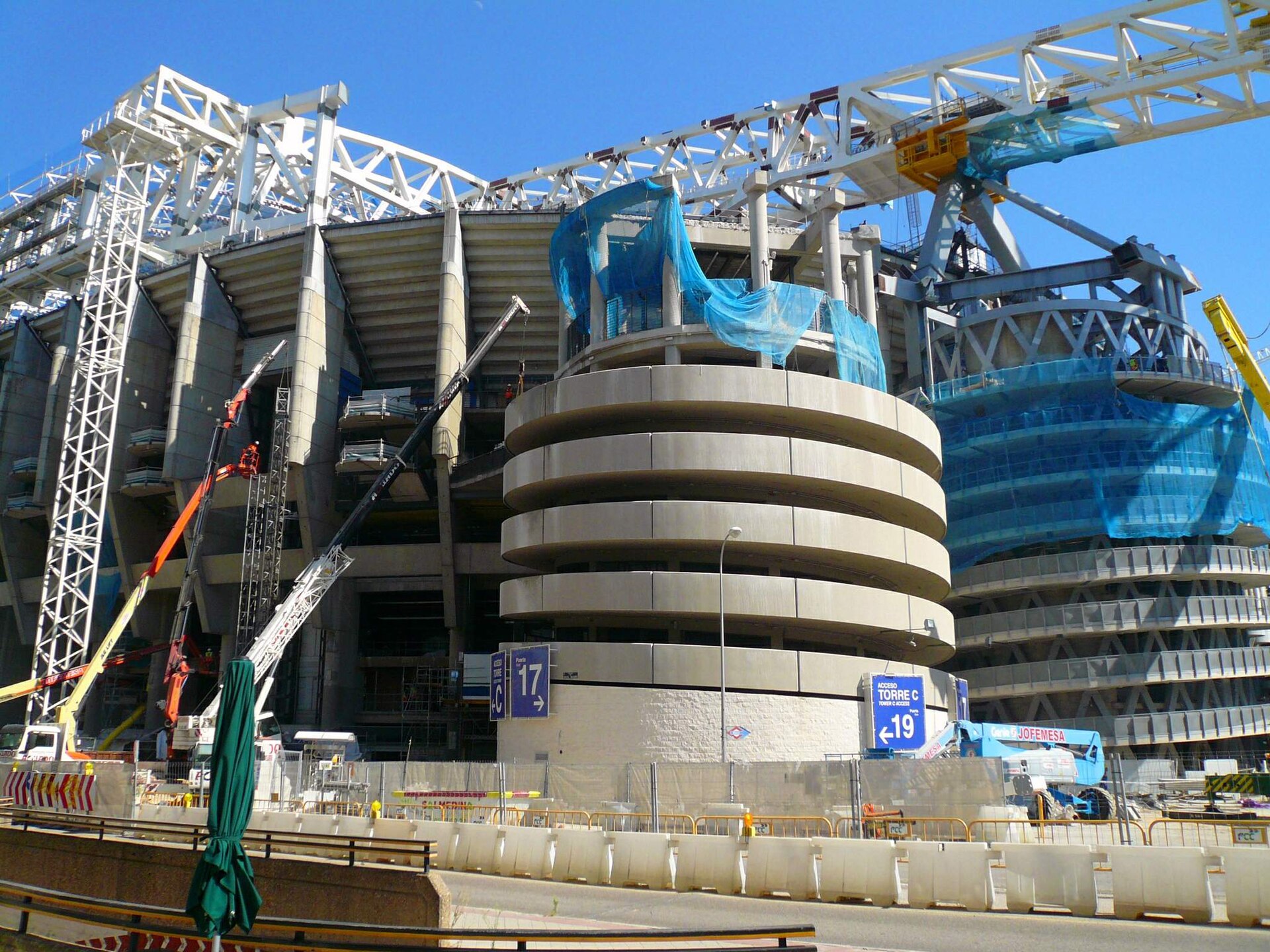
What did the most recent renovation actually change?
The renovation completed in the 2020s reworked the stadium almost completely while a full rebuild elsewhere was never an option, given the site’s location in a built-up part of the city. According to Real Madrid’s own statements on the project, the work included:
- A retractable roof, allowing the stadium to close and be used regardless of weather.
- A retractable natural-grass pitch, which can be rolled out of the stadium on trays to let the space beneath be used for other events without damaging the playing surface.
- A new external skin of steel and polycarbonate panels, replacing the stadium’s previous concrete facade and giving it the layered, metallic exterior it now has along the Castellana.
- A 360-degree screen running around the inside of the upper tier, among the largest continuous stadium screens described in the club’s own materials.
- Expanded retail, museum and hospitality space built into the base of the stadium, effectively wrapping a shopping and leisure concourse around the ground at street level.
The project was financed substantially through a long-term loan arranged by the club, and its total cost has been widely reported in the Spanish and international press to have run well over the original estimate. For specific figures, timelines, or claims about cost, the club’s own site and its financing disclosures are the primary source; press estimates have varied and should be read as reporting rather than confirmed totals.
The practical effect is that the Bernabéu changed from a stadium used mainly on match days into a venue the club markets for concerts, NFL games staged in Europe, and other large events — something the closed roof and retractable pitch make possible in a way the older open-air ground never could.
Can the stadium be visited outside match days?
Real Madrid runs a paid stadium tour, the Bernabéu Tour, which includes areas such as the trophy room, changing rooms and pitch-side sections, subject to match-day and event closures. Because tour routes, prices and closure dates change and are set entirely by the club, they should be checked directly on Real Madrid’s official site before planning a visit rather than assumed from any third-party listing.
The stadium also houses the club’s museum, displaying trophies and historical material relating to Real Madrid, distinct from Madrid’s national museums but functioning in a broadly similar way — a collection built around a single institution’s own history. Readers interested in how Madrid’s museums are generally organised, including free-entry windows and closure patterns at the state-run collections, can find that covered separately in the Museums & Galleries archive.
How does the Bernabéu compare with Madrid’s other major arena?
Madrid has a second large-capacity venue built for spectacle rather than football: Las Ventas, the city’s bullring, a Neo-Mudéjar building from the 1920s with a fixed brick-and-tile structure very different from the Bernabéu’s steel-and-glass rebuild. Where the Bernabéu has been continuously remodelled to keep pace with modern stadium standards, Las Ventas has kept its original architecture largely intact, making the two useful points of comparison for how differently Madrid’s twentieth-century arenas have aged.
Real Madrid title celebrations, when they happen, traditionally end not at the stadium but in the city centre — most often at Plaza de Cibeles, where the fountain and the building behind it have become the fixed point for the club’s public celebrations, a pattern distinct from the stadium itself but closely tied to it in the city’s sporting life.
Why does the renovation matter beyond football?
The rebuild sits within a broader pattern of large Madrid institutions being reworked for uses beyond their original purpose — a theme that also runs through the city’s converted industrial and exhibition buildings. The Bernabéu’s retail concourse and events capacity place it, functionally, closer to a mixed-use venue than a stadium in the older sense, even though football remains its primary purpose.
For anyone mapping how Madrid’s landmark buildings have been altered, added to, or repurposed over time, the Bernabéu is a useful case: a single site rebuilt in place, in stages, over more than seventy years, without ever fully closing. That pattern of continuous adaptation, rather than a single moment of construction, is arguably the more accurate way to understand the stadium as it stands today. Other examples of Madrid buildings reshaped for new uses are covered in the site’s Landmarks & Sights archive.
The avenue it sits on, Paseo de la Castellana, is itself part of a wider nineteenth- and twentieth-century pattern of Madrid cutting and extending major arteries through the city, a theme also visible in the history of Gran Vía, cut through the older centre in the early twentieth century for very different reasons but with a similar effect on how the city grew around a single new street.
Access Madrid is an independent guide written from published, checkable sources. We have not visited the places described here and we do not publish personal recommendations or invented ‘local favourites’ — where something is singled out as notable, we say who says so. Opening times, fares, closures and prices change at short notice, so treat everything here as a starting point and confirm with the museum, operator or venue directly before building a day around it. We give no advice on visas, insurance, health or safety; use your own government’s official guidance for those.