Las Ventas is Madrid’s principal bullring, formally the Plaza de Toros Monumental de Las Ventas, and one of the largest bullfighting venues in the world. What makes it architecturally unusual is its neo-Mudéjar style — a brick-and-ceramic revival of medieval Islamic-influenced building traditions, applied at a scale almost nowhere else in the city.
What exactly is Las Ventas?
Las Ventas is a purpose-built bullring in eastern Madrid, home ground of the city’s bullfighting calendar and the venue most closely associated with the sport in Spain. It also houses a bullfighting museum, the Museo Taurino, built into its structure. The ring is privately operated but functions as a public landmark, listed among Madrid’s protected heritage buildings.
It is not the oldest bullring in the city — an earlier one stood closer to what is now Puerta de Alcalá — but it is the one that replaced it and has functioned as Madrid’s main ring since the interwar period. Its scale, both in seating capacity and in the ambition of its decoration, set it apart from bullrings elsewhere in Spain.
Where is it, and how do you reach it?
Las Ventas sits on Calle de Alcalá, in the Ventas district of the Salamanca area, well east of the historic centre along the same street that runs from Puerta del Sol out through the Puerta de Alcalá. The Madrid Metro station Ventas, served by lines 2 and 5, sits directly outside it, which is the standard way of reaching the building without a car.
Because Calle de Alcalá is one of Madrid’s longest and most continuous streets, Las Ventas can be understood as a kind of eastern bookend to a route that starts near the centre’s classic squares and monuments. For general orientation among the city’s major landmarks, the site’s own Landmarks & Sights archive covers the buildings that anchor that route.
Why does the building look the way it does?
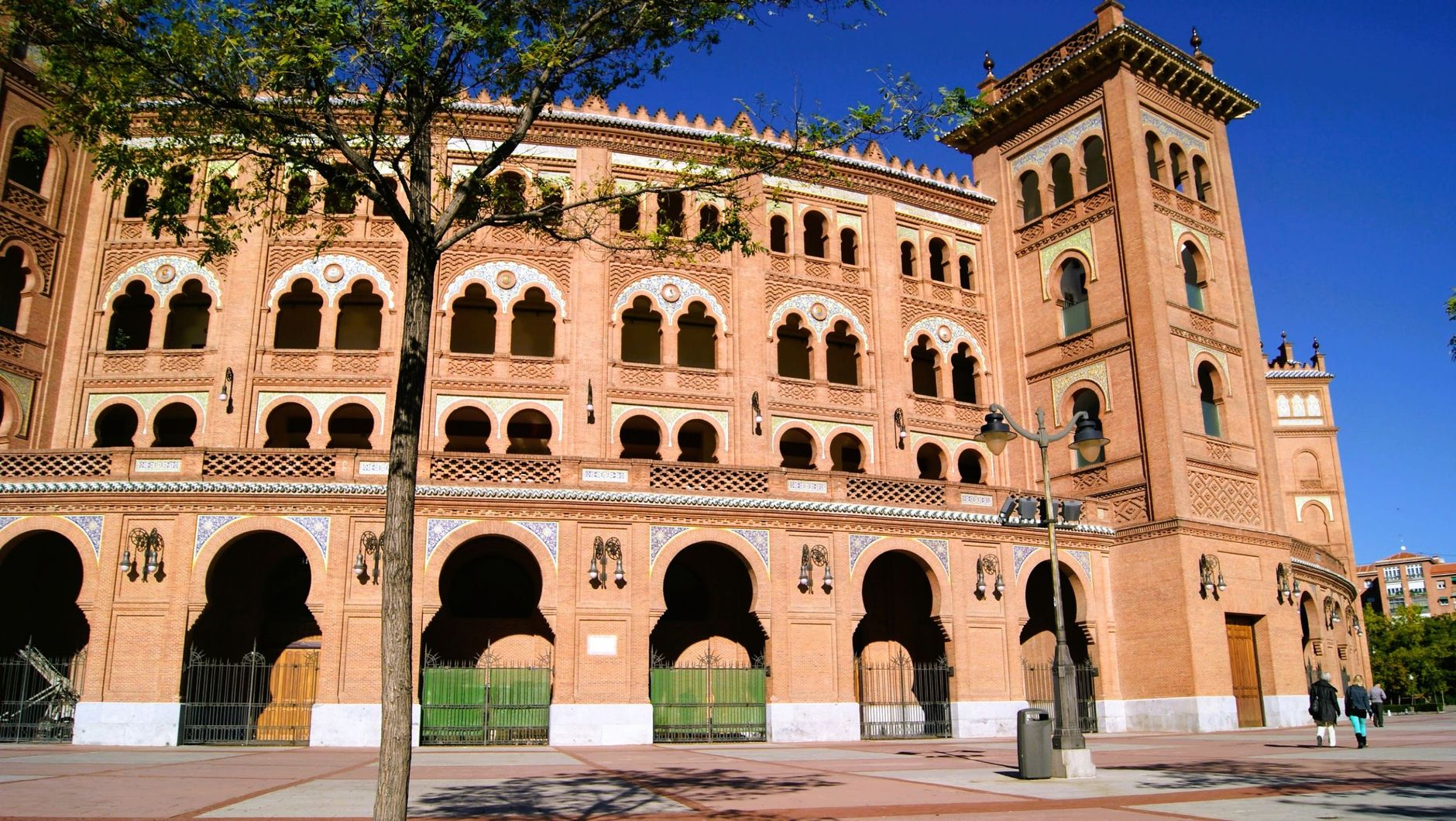
Las Ventas is built almost entirely in neo-Mudéjar style — a late-19th and early-20th-century revival movement that borrowed decorative brickwork, ceramic tilework, and horseshoe or lobed arches from Mudéjar architecture, the building tradition developed by Muslim craftsmen working under Christian rule in medieval Iberia, particularly strong in Aragón and Castile.
The result is a facade of patterned exposed brick interspersed with glazed ceramic tile panels, horseshoe-arched openings, and towers with a distinctly non-classical silhouette. This is unusual for Madrid, where major public buildings of the same period more often reached for French-influenced eclecticism or the heavy classicism seen around Plaza de Cibeles. Las Ventas instead drew on a regional, historicist vocabulary rarely deployed at this scale in the capital, which is part of why architectural surveys single it out.
The ring’s plan is polygonal rather than a simple circle, built up from a series of straight-walled bays that together approximate a curve — a structural choice that also shapes the decorative rhythm of the exterior, since each facet carries its own arch and tile panel rather than a continuous unbroken wall.
Who designed and built it, and when?
The bullring was designed by architects José Espeliú and Manuel Muñoz Monasterio, with construction proceeding through the 1920s and the venue opening in 1929, replacing Madrid’s older bullring, which by then could no longer meet demand from a growing city. The building went up during the same broad era of urban expansion that produced the widening of Gran Vía, though the two projects answer to entirely different architectural instincts — one modern and commercial, the other historicist and regionally rooted.
Engineering additions and restorations followed across the 20th century as the venue’s capacity and facilities were adapted, but the neo-Mudéjar exterior and the polygonal ring plan have remained the building’s defining and unaltered features.
How big is it, and what happens inside?
Las Ventas is regularly described, including by Spanish cultural authorities, as one of the largest bullrings in the world by seating capacity, with figures commonly cited in the low tens of thousands; readers wanting an exact current seating figure should confirm it with the venue’s own site rather than rely on a fixed number here, since renovations have altered capacity over time.
Its primary use remains bullfighting, staged through a formal season that runs roughly from spring through autumn, with the calendar’s single busiest stretch tied to Madrid’s San Isidro festival in May, when a concentrated run of fights takes over the ring for several weeks. Outside the bullfighting calendar, the venue is also used for concerts and other large public events, a secondary use common to bullrings of this size across Spain.
What is the Museo Taurino, and is it separate from the ring?
The Museo Taurino, or bullfighting museum, is built into the Las Ventas complex and holds costumes, weapons, portraits, and other memorabilia connected to the history of Spanish bullfighting and to specific matadors. It functions as a distinct museum space rather than simply an anteroom to the ring, and like most Madrid museums it keeps its own opening pattern, including closure days that may not match the bullring’s own event calendar — a pattern discussed in general terms in the site’s explainer on why so many Madrid museums close on Mondays. Readers planning around the museum specifically should check its current hours directly rather than assume they mirror bullfight dates.
For readers approaching Las Ventas primarily as a museum stop rather than an event venue, the site’s Museums & Galleries archive gives a wider sense of how specialist, single-subject museums like this one sit alongside Madrid’s larger national collections.
Is Las Ventas formally protected as a heritage building?
Las Ventas is recognised within Spain’s heritage protection framework as a building of cultural interest, a designation that restricts alteration to its historic fabric and formally acknowledges its architectural significance beyond its functional use as a working bullring. This protected status covers the building’s structure and decorative brickwork rather than its operations, meaning the ring continues to function as an active venue even as its fabric is legally safeguarded.
That dual identity — an actively used, commercially operated venue that is simultaneously a protected historic monument — is not unusual in Madrid; several of the city’s landmark buildings combine an ongoing public function with formal heritage listing, a pattern also visible at civic buildings such as the one behind Plaza de Cibeles.
How does the bullfighting calendar shape a visit to the area?
The area around Las Ventas changes noticeably depending on whether a fight is scheduled. On event days, the Ventas metro exit and the streets immediately around the ring see markedly heavier pedestrian traffic, concentrated in the hours before an evening start. Outside the bullfighting season, or on non-event days, the immediate surroundings function as an ordinary stretch of the Salamanca district’s outer edge.
The San Isidro period in May is the clearest seasonal marker: it concentrates the year’s densest run of fights into a compact window and draws the largest crowds to the immediate area, a pattern comparable to how other Madrid institutions see sharp seasonal peaks tied to a specific festival or free-entry window, discussed generally in the site’s piece on how Madrid’s national museum free-entry windows work. As with any date-specific detail, current fixture lists and San Isidro dates should be confirmed directly with the ring’s own operator rather than assumed from year to year.
Access Madrid is an independent guide written from published, checkable sources. We have not visited the places described here and we do not publish personal recommendations or invented ‘local favourites’ — where something is singled out as notable, we say who says so. Opening times, fares, closures and prices change at short notice, so treat everything here as a starting point and confirm with the museum, operator or venue directly before building a day around it. We give no advice on visas, insurance, health or safety; use your own government’s official guidance for those.
Featured image: Photo by Luis García (Zaqarbal), source, CC BY-SA 3.0
_05.jpg)