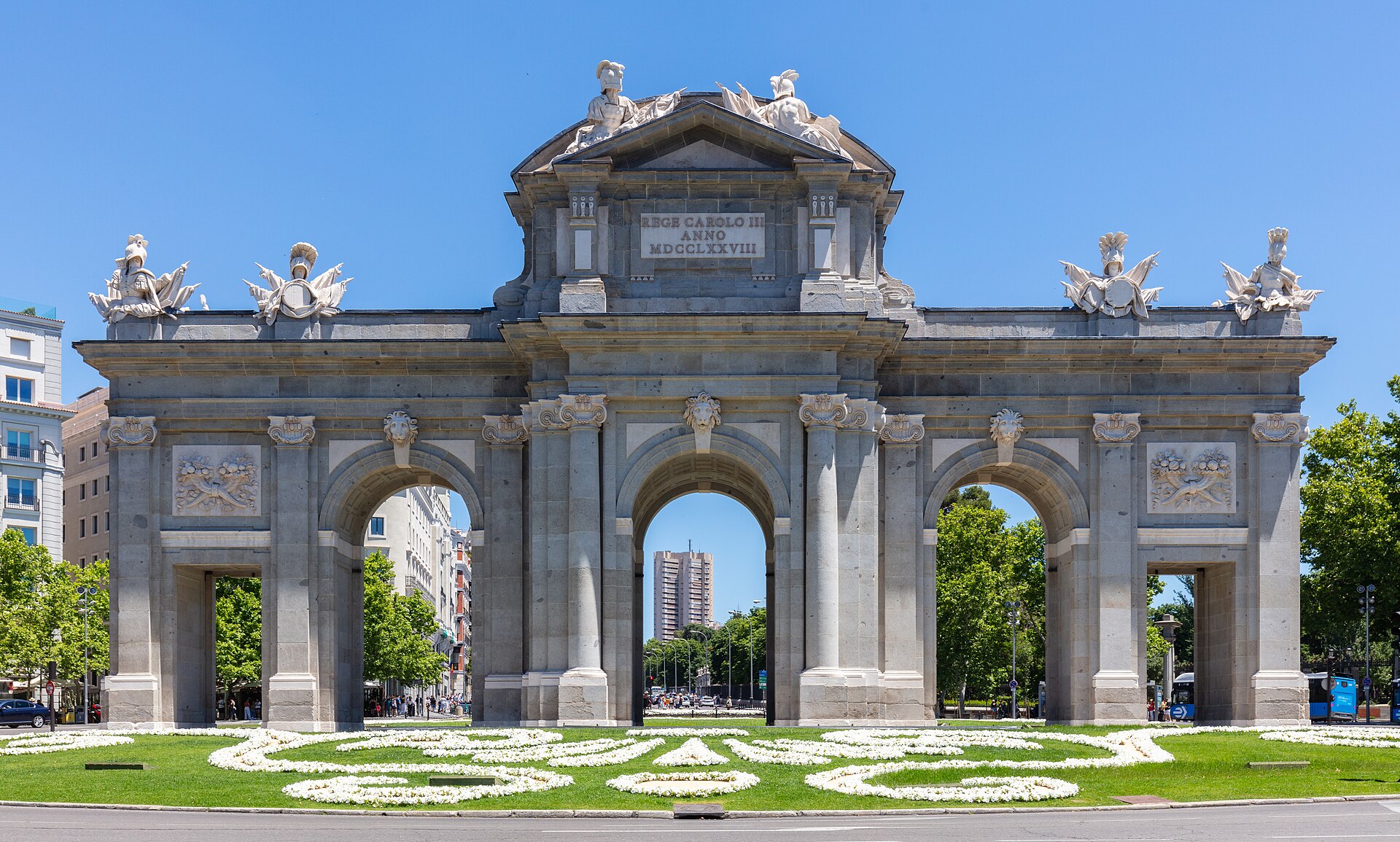
The Puerta de Alcalá is a freestanding stone gate at Plaza de la Independencia, on the eastern edge of Madrid’s centre, next to Retiro Park. It was completed in 1778 as a ceremonial entrance to the city, commissioned by King Carlos III and designed by the Italian architect Francesco Sabatini. It no longer functions as a gate — the city grew past it long ago — but it still stands, on its own traffic island, as one of Madrid’s fixed points of reference.
What is the Puerta de Alcalá exactly?
It is a monumental granite gateway with five openings — three arches for wheeled traffic and two smaller rectangular passages for pedestrians — built in a neoclassical style with Doric columns, attached pilasters and carved decoration above the cornice. It was never a house, a church or a fortification. It is a single freestanding structure, designed purely to be passed through, or under, and to be looked at while doing so.
Why was it built, and by whom?
Carlos III commissioned it to replace an older, smaller Baroque gate that had stood on the same road since 1599, built for the entry into Madrid of Margaret of Austria. By the mid-18th century, Carlos III was remaking Madrid’s public spaces on a grander scale — the same reign that reshaped the Royal Palace and laid out much of the city’s classical infrastructure. Sabatini, who also worked on the palace itself, was given the commission for a new gate that would mark this stretch of the Calle de Alcalá with something more permanent and more imposing than what it replaced.
Construction ran through the 1770s and the gate was finished in 1778. The decorative sculpture — military trophies, coats of arms, and allegorical figures set into the stonework — is generally attributed to the sculptors Francisco Gutiérrez and Roberto Michel, both working under Sabatini’s direction.
Where exactly does it stand?
The Puerta de Alcalá sits at Plaza de la Independencia, at the point where Calle de Alcalá meets the western edge of Retiro Park. It marks the boundary between the historic centre and the Salamanca and Retiro districts to the east. Today the plaza around it functions as a large traffic roundabout, so the gate is seen from the surrounding pavements rather than approached directly on foot in the way a church or a palace would be.
Why is it called the Puerta de Alcalá?
The name refers to the road it once controlled: the route east out of Madrid towards Alcalá de Henares, the university town roughly 30 kilometres away. Like most of Madrid’s historic gates, it is named for its destination rather than for a person or an event, in the same way the Puerta de Toledo, Madrid’s other surviving gate, is named for the road to Toledo.
Was it part of Madrid’s old city wall?
It marked an entrance into the city rather than forming part of a defensive wall in the medieval sense. Madrid’s 16th- and 17th-century boundary was a lower, largely administrative fence used to control trade and collect duties on goods entering the city, punctuated by a series of named gates. Most of those gates were demolished as the city expanded outward in the 19th and 20th centuries. The Puerta de Alcalá and the Puerta de Toledo are the two that survived, both rebuilt in more monumental form in the 18th century rather than left as simple checkpoints.
Is it Madrid’s answer to a triumphal arch?
Its form — a stone gateway with multiple arched openings, decorated with military and heraldic motifs — sits in the same architectural tradition as Roman and later European triumphal arches, and it is sometimes described in general accounts of Madrid’s monuments as one of the earlier post-Roman examples of the form built for civic rather than purely religious purposes. That framing is a matter of art-historical interpretation rather than settled fact, and readers researching the point further should treat it as a claim made in secondary sources, not as an official designation.

Can visitors go inside it?
No. The Puerta de Alcalá is not an interior space with rooms, stairs or an entrance fee — it is a solid stone structure pierced by its five archways, and there is nothing inside to visit in the way there is at, for example, the Royal Palace of Madrid. It is viewed from outside, from the pavements and crossings around Plaza de la Independencia, at any hour, without a ticket.
How does it compare to Madrid’s other “puertas”?
Madrid has several landmarks with “puerta” (gate) in the name, and they are not the same kind of thing. Puerta del Sol is a square, not a physical gate — its name survives from a gate that stood there centuries ago but was demolished long before the current plaza took shape. The Puerta de Alcalá, by contrast, is the actual 18th-century structure, still standing on its original site. It belongs to the same royal building programme that produced the layout of Plaza Mayor in an earlier era, part of a long pattern of Spanish monarchs using major public architecture to mark their reigns.
What is around the Puerta de Alcalá?
Retiro Park runs immediately to the east of the gate, and the Plaza de Cibeles, with its own fountain and the Palacio de Cibeles, sits a short distance west along Calle de Alcalá. The area is also within reach of Madrid’s so-called Golden Triangle of art museums, and of smaller specialist institutions such as the Real Fábrica de Tapices, the royal tapestry works founded to supply the crown with textiles for its palaces. Anyone planning a day around this stretch of the city is effectively planning a day between a monument, a park and a cluster of museums, and it is worth reading the Golden Triangle of Art explainer alongside this one, and the broader Museums & Galleries archive, before deciding what else to fit in.
Why does the gate turn up in Madrid’s culture beyond architecture?
The gate gave its name to a well-known 1986 song, “Puerta de Alcalá,” performed by the singers Víctor Manuel and Ana Belén, which became closely associated with the city in the years leading up to Madrid’s bid for the 1992 Olympic Games. That association is a matter of popular culture rather than architectural history, but it explains why the gate’s name is recognisable to Spaniards well beyond Madrid, independent of anyone’s familiarity with Sabatini or Carlos III’s building programme.
Is the Puerta de Alcalá managed by a museum or heritage body?
It is a listed monument under Spanish heritage protection and is maintained as public urban infrastructure by Madrid’s city authorities, in the same category as the city’s other protected outdoor monuments rather than as a museum with its own visiting arrangements. There is no ticketed access, no opening hours to check, and no operator’s website governing entry, which sets it apart from most of the sights covered elsewhere on this site, including the Landmarks & Sights archive’s entries on buildings that do have interiors to plan a visit around, such as the Almudena Cathedral.
What should a reader take from this?
The Puerta de Alcalá is best understood as a fixed point in Madrid’s 18th-century remaking of itself: a royal commission, built to a single architect’s design, that has outlasted the road system it was built to control and the city wall it was once attached to. It survives now as a monument on a roundabout, at the hinge between the historic centre and Retiro Park, still legible as the thing it was built to be.
Access Madrid is an independent guide written from published, checkable sources. We have not visited the places described here and we do not publish personal recommendations or invented ‘local favourites’ — where something is singled out as notable, we say who says so. Opening times, fares, closures and prices change at short notice, so treat everything here as a starting point and confirm with the museum, operator or venue directly before building a day around it. We give no advice on visas, insurance, health or safety; use your own government’s official guidance for those.