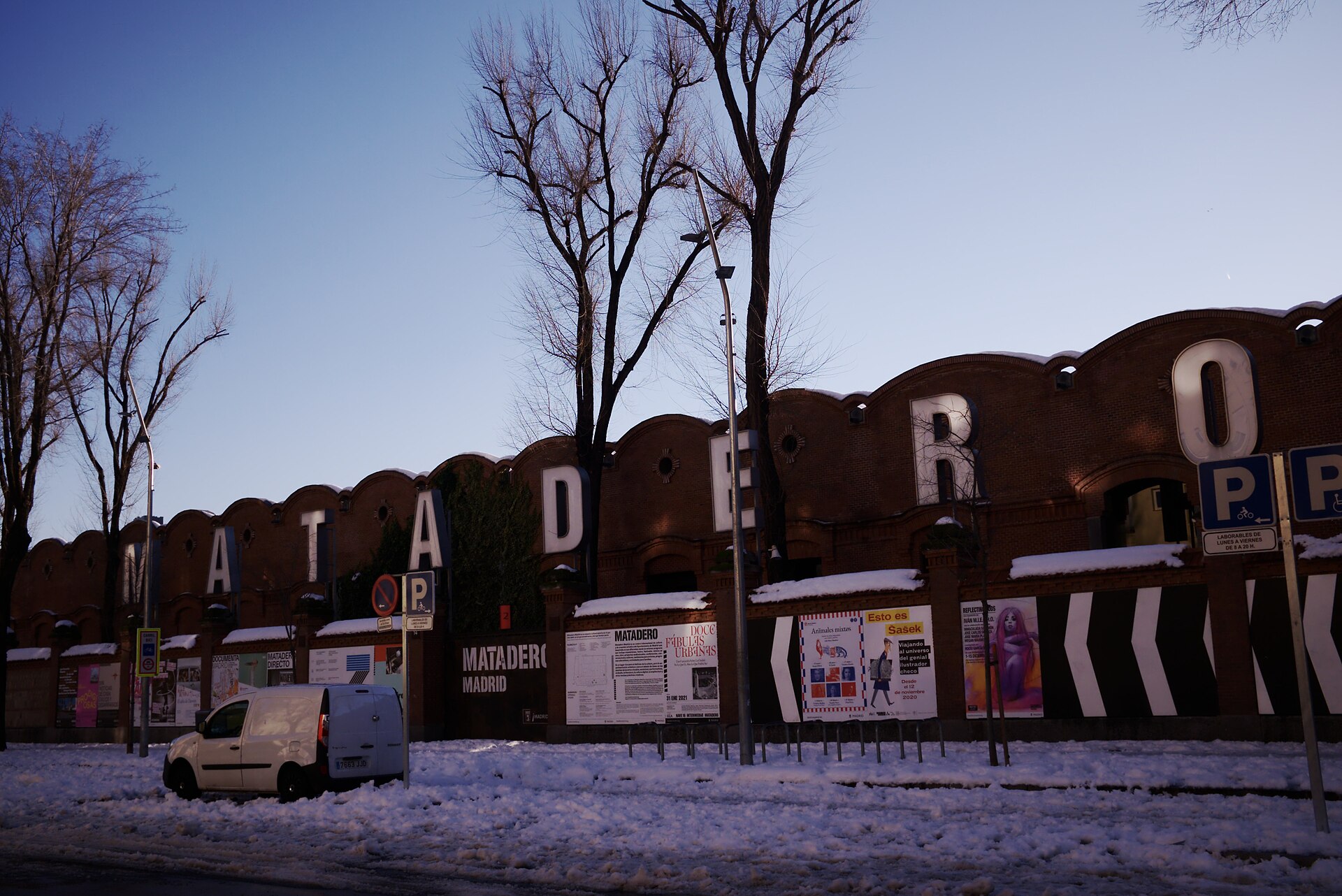
Matadero Madrid is a cultural centre in the Arganzuela district, built on the site of the city’s former municipal slaughterhouse and livestock market. The complex was constructed in the early twentieth century to process the meat supply for a growing capital, functioned as an abattoir into the late twentieth century, and was converted by Madrid’s city council into a public arts venue in the 2000s.
What was the building originally for?
It was built as the Matadero y Mercado de Ganados de Madrid — the municipal slaughterhouse and livestock market. The city needed a modern, centralised facility to slaughter animals and distribute meat to a population that had expanded rapidly after the demolition of the old city walls in the mid-1800s. Rather than scattered small-scale butchery across the centre, Madrid concentrated the whole operation on open land beside the Manzanares river, on the southern edge of the city.
The site combined several functions in one walled complex: pens for livestock arriving by rail and road, slaughter pavilions, a market for the sale of meat, and administrative buildings. It was, in effect, industrial infrastructure for feeding the city, sited deliberately outside the residential core.
Who designed it, and what does the architecture look like?
The complex was designed chiefly by the municipal architect Luis Bellido y González, working with other city architects across a construction period that ran roughly from 1908 into the 1920s. The result is a series of low brick pavilions in a Neo-Mudéjar style — patterned brickwork, exposed structural ironwork, and decorative details drawn from Islamic-influenced Spanish architecture, a style municipal architects favoured for civic buildings in Madrid at the time.
The pavilions were built individually, connected by streets and courtyards rather than a single monolithic structure, which is why the site today reads less like one building and more like a small industrial district. That layout is largely unchanged; it is one of the reasons the site could be repurposed piece by piece rather than demolished and rebuilt.
When did it stop being a slaughterhouse?
The site’s livestock market closed in the 1960s as Madrid’s meat supply chain modernised, and slaughtering activity wound down over the following decades before ending in the 1990s. For a period afterward the buildings stood largely disused, an industrial complex left stranded as the city grew around it and the Manzanares riverbank was redeveloped.
The closure mirrors a pattern seen elsewhere in the city: industrial or utility buildings outgrown by their original function, later kept for their architectural and historical value rather than pulled down. CaixaForum Madrid followed a comparable path — the building explained on this site was originally an electrical power station before its conversion into a gallery.
How did it become a cultural centre?
Madrid’s city council took on the site’s conversion in the 2000s, with the first pavilions opening to the public later that decade. The council’s own description of the project frames it as an exercise in adaptive reuse: retaining the brick shells and industrial character of the pavilions while fitting them out for exhibitions, performance, film and design work. Restoration continued in phases across the following years as more of the original pavilions were brought into use.
This is a municipal project rather than a national one — a distinction worth noting for anyone used to Madrid’s state-run museums. Matadero Madrid sits outside the free-entry schemes that apply to national institutions like the Prado or Reina Sofía; how those free-entry windows work is a separate system tied to national museum status, and it does not automatically extend to a city-run arts centre.
What is inside Matadero Madrid today?
The complex now houses a cluster of distinct organisations and programmes under one site, rather than a single collection. Notable components include:
- Cineteca Madrid — a public cinema focused on documentary and non-fiction film, run within one of the former pavilions.
- Naves del Español en Matadero — performance spaces used by Madrid’s municipal theatre company for contemporary drama.
- Central de Diseño — a space dedicated to design exhibitions and related programming.
- Intermediae — a programme centred on experimental and participatory art projects.
- Plaza Matadero and open pavilions — event and exhibition spaces used for temporary shows, fairs and public programming that changes through the year.
Because the site is organised around rotating programmes rather than a fixed permanent collection, what is on show at any given time varies considerably. This makes it a different kind of visit from a traditional museum: there is no single core exhibition to plan around, and the calendar of the site’s own listings is the only reliable guide to current activity.
Where is it, and how does it fit into the city?
Matadero Madrid sits in the Arganzuela district, on the bank of the Manzanares, close to Madrid Río — the linear park created when the M-30 ring road was rerouted underground along the riverbank in the late 2000s. The centre is reachable by Madrid Metro, with Legazpi generally cited as the nearest station; confirming the current route is worth doing on the Madrid Metro’s own site, since specific service details can change.
Its riverside setting places it apart from the museum cluster in the city centre. Where the so-called Golden Triangle of Art concentrates the Prado, the Thyssen-Bornemisza and the Reina Sofía within walking distance of Paseo del Prado, Matadero Madrid sits several kilometres south, tied instead to the riverbank redevelopment and to Arganzuela’s own transformation from an industrial and working-class district into a mixed residential and cultural one.
Is entry free, and does it close on Mondays like other museums?
Matadero Madrid is a municipal cultural centre rather than a ticketed national museum, and much of its exhibition space has historically operated on free or low-cost access, though individual programmes — screenings, performances or specific exhibitions — can carry their own charges set by the organisation running them. Current terms should be confirmed on the centre’s own listings before visiting.
The pattern of closure days also differs from the national museums covered elsewhere on this site. Why so many Madrid museums close on Mondays is a convention tied largely to state-run institutions; a municipal arts centre built around cinema and live performance schedules does not necessarily follow the same weekly rhythm, and specific opening days for each space within the complex are best checked directly.
How does it fit into Madrid’s wider museum landscape?
Matadero Madrid is not a museum in the conventional sense of a fixed collection with a catalogue. It functions more as infrastructure for contemporary culture — cinema, theatre, design and experimental art — housed in a preserved piece of the city’s industrial past. Readers building a broader sense of what Madrid holds in its museums and galleries can find the full range, from national collections to smaller house-museums, on this site’s museums and galleries hub, alongside explainers on institutions such as the Reina Sofía’s own contemporary collection, which sits closer to the centre and operates under the different rules that apply to national museums.
The through-line across all of them, Matadero included, is that the building itself is usually as informative as whatever is inside it — in this case, a municipal slaughterhouse that outlived its original purpose by exactly the margin the city needed to find it a new one.
Access Madrid is an independent guide written from published, checkable sources. We have not visited the places described here and we do not publish personal recommendations or invented ‘local favourites’ — where something is singled out as notable, we say who says so. Opening times, fares, closures and prices change at short notice, so treat everything here as a starting point and confirm with the museum, operator or venue directly before building a day around it. We give no advice on visas, insurance, health or safety; use your own government’s official guidance for those.