Parque del Retiro is a 125-hectare former royal park in central Madrid holding a lake with rowing boats, a glass exhibition pavilion, a rose garden, a monument to a Spanish king, a 19th-century statue of a fallen angel, and a memorial grove to the victims of the 2004 Madrid train bombings. It sits east of the Paseo del Prado and is free to enter.
How did the park come to exist?
Retiro began as the grounds of the Palacio del Buen Retiro, a royal residence built for Felipe IV in the 1630s. Most of the palace itself was destroyed in the early 19th century, during the Peninsular War and later conflicts, but the gardens survived and expanded around it. The park passed into public ownership under Alfonso XII in 1868 and has been municipal parkland ever since, managed today by Madrid’s city council. The Retiro district that takes its name from the park extends well beyond its walls, and covers residential streets that have nothing to do with the green space itself.
What is the Palacio de Cristal?
The Palacio de Cristal is a glass-and-iron pavilion built in 1887 to house a display of plants and flora from the Philippines, then a Spanish colony, as part of an exhibition. Its structure is often compared to London’s Crystal Palace, though smaller and purpose-built for a single event rather than permanent trade fairs. Today it is used by the Museo Reina Sofía as an exhibition space for contemporary art, standing at the edge of an artificial lake that mirrors its glass walls. A separate, smaller building nearby, the Palacio de Velázquez, serves the same institution for further temporary shows. Details on the current pavilion, its architecture and how it is used now are covered separately in the site’s explainer on the Palacio de Cristal.
What is the Estanque, and what happens on it?
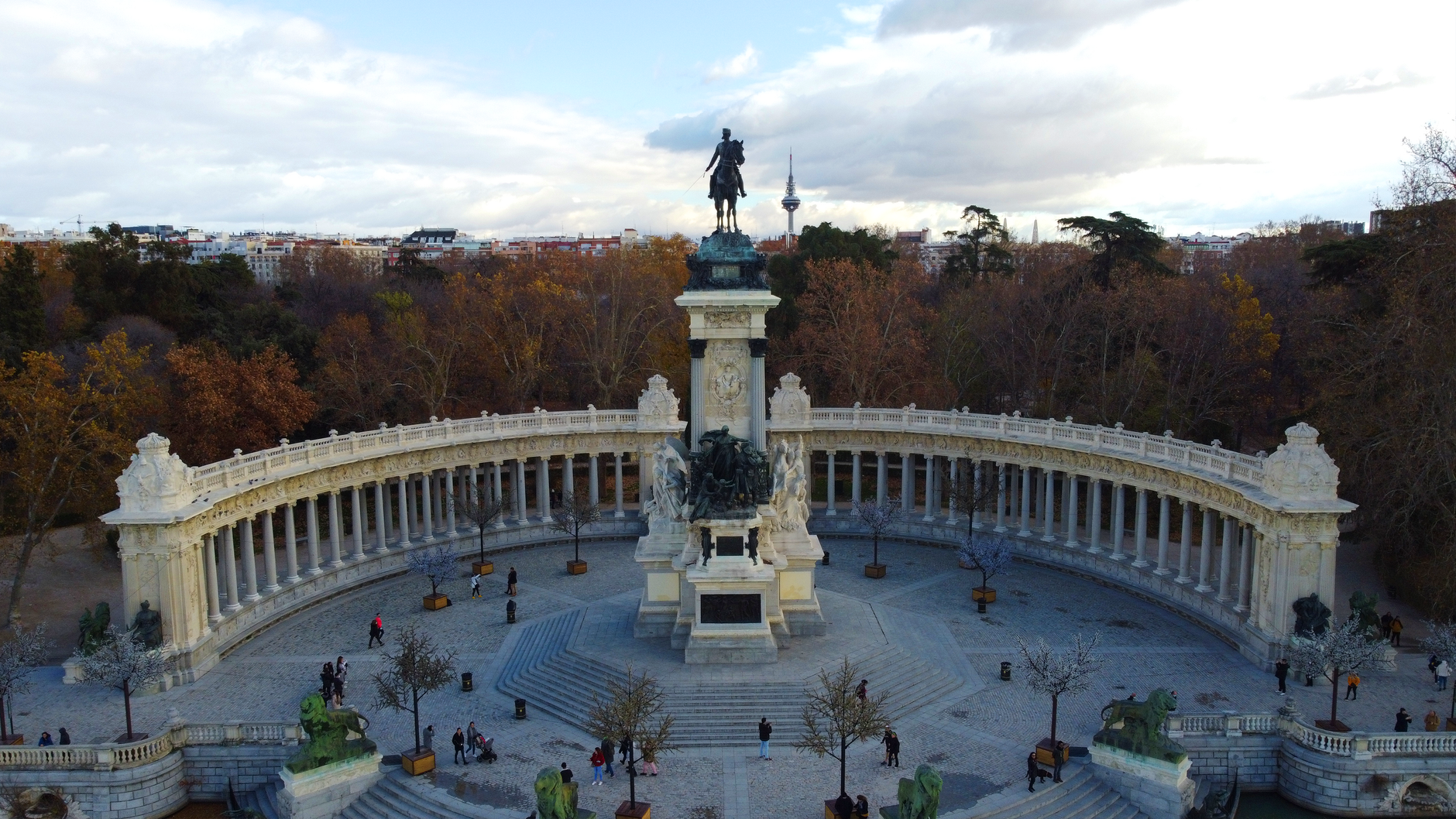
The Estanque Grande is the park’s main lake, built in the 17th century as part of the original palace grounds and later opened for public boating. Rowing boats can be hired on site, a tradition documented in city records going back well over a century. At its eastern end stands the Monument to Alfonso XII, a semicircular colonnade completed in 1922 with an equestrian statue of the king at its centre, faced across the water by the boating dock and one of the park’s most photographed sightlines.
What other monuments and buildings are inside the park?
Retiro holds several structures that are notable in their own right rather than as generic park furniture.
- The Ángel Caído (Fallen Angel): a bronze statue by Ricardo Bellver, unveiled in 1877, depicting Lucifer’s fall. Madrid’s own tourism materials describe it as one of very few public monuments anywhere dedicated specifically to this subject.
- La Rosaleda: a formal rose garden opened in 1915, redesigned along French garden lines, holding several thousand rose bushes across dozens of varieties.
- The Bosque del Recuerdo: a memorial grove of cypress and olive trees planted for each of the 191 people killed in the Madrid train bombings of 11 March 2004, laid out along a straight path rather than as a monument in the conventional sense.
- Casa de Vacas: a former dairy building converted into a municipal exhibition space, run by the city council.
- La Rosaleda’s neighbouring puertas: the park has multiple historic gates, including the Puerta de la Independencia, which faces the Puerta de Alcalá just outside the park.
Is Retiro part of a UNESCO World Heritage site?
Yes. In 2021, UNESCO inscribed “Paseo del Prado and Buen Retiro, a Landscape of Arts and Sciences” as a World Heritage Site, covering the axis running from the Prado museum down to Atocha and including the Retiro park grounds themselves. UNESCO’s listing frames the park and the boulevard together as a single 18th-and-19th-century project of urban planning built around science, art and public leisure, rather than treating the park as separate green space. The adjoining stretch of boulevard is covered in the site’s own walking route along the Paseo del Prado.
What happens in the park through the year?
Retiro hosts the Feria del Libro de Madrid, an annual book fair with rows of publisher and bookshop stalls set up along one of the park’s central avenues, typically running for around two to three weeks in late spring. Exact dates shift year to year and should be confirmed against the fair’s own announcements rather than assumed from a previous year’s calendar. Outside that fair, the park functions as ordinary public space: joggers, chess players at fixed outdoor tables, buskers around the lake, and, on Sundays, informal gatherings of drummers near the Fallen Angel statue that have gone on for decades without any official programme behind them.
Is the park useful for a hot day or a day with children?
Retiro’s mature tree cover and lake make it one of the more workable options in central Madrid during the hottest months, and it is often cited alongside other options in the site’s guide to how Madrid handles summer heat. The boating lake, open lawns and space to run make it a reasonable stop on a day in Madrid built around children, without needing to enter a single museum.
How do you get to Parque del Retiro?
The park has several metro stations on its edges, including Retiro and Ibiza on Line 2, and Príncipe de Vergara on Line 9 to the east. It also sits within easy walking distance of Atocha station and the Paseo del Prado museums, making it a natural stop on foot rather than a separate outing requiring its own transport plan. General questions about navigating the city’s transport are addressed in the site’s Getting Around archive.
What is immediately outside the park?
The Puerta de Alcalá, an 18th-century triumphal arch commissioned under Carlos III, stands at the park’s northwest corner and functions as a landmark in its own right, covered separately in the site’s explainer on the Puerta de Alcalá. To the west, the park backs onto the Paseo del Prado corridor and its three major museums. To the south, it borders residential streets belonging to the wider Retiro district, whose own character — quiet, largely residential, unrelated to the tourist volume inside the park gates — is addressed in the site’s piece on Retiro district beyond the park. For a broader sense of where the park fits among Madrid’s central landmarks, see the Landmarks & Sights archive, and for wider planning across a visit, the Madrid guide hub.
Access Madrid is an independent guide written from published, checkable sources. We have not visited the places described here and we do not publish personal recommendations or invented ‘local favourites’ — where something is singled out as notable, we say who says so. Opening times, fares, closures and prices change at short notice, so treat everything here as a starting point and confirm with the museum, operator or venue directly before building a day around it. We give no advice on visas, insurance, health or safety; use your own government’s official guidance for those.
Related reading
Living in Madrid, Madrid, Practically.
Featured image: Photo by Carlos Delgado, source, CC BY-SA 4.0
