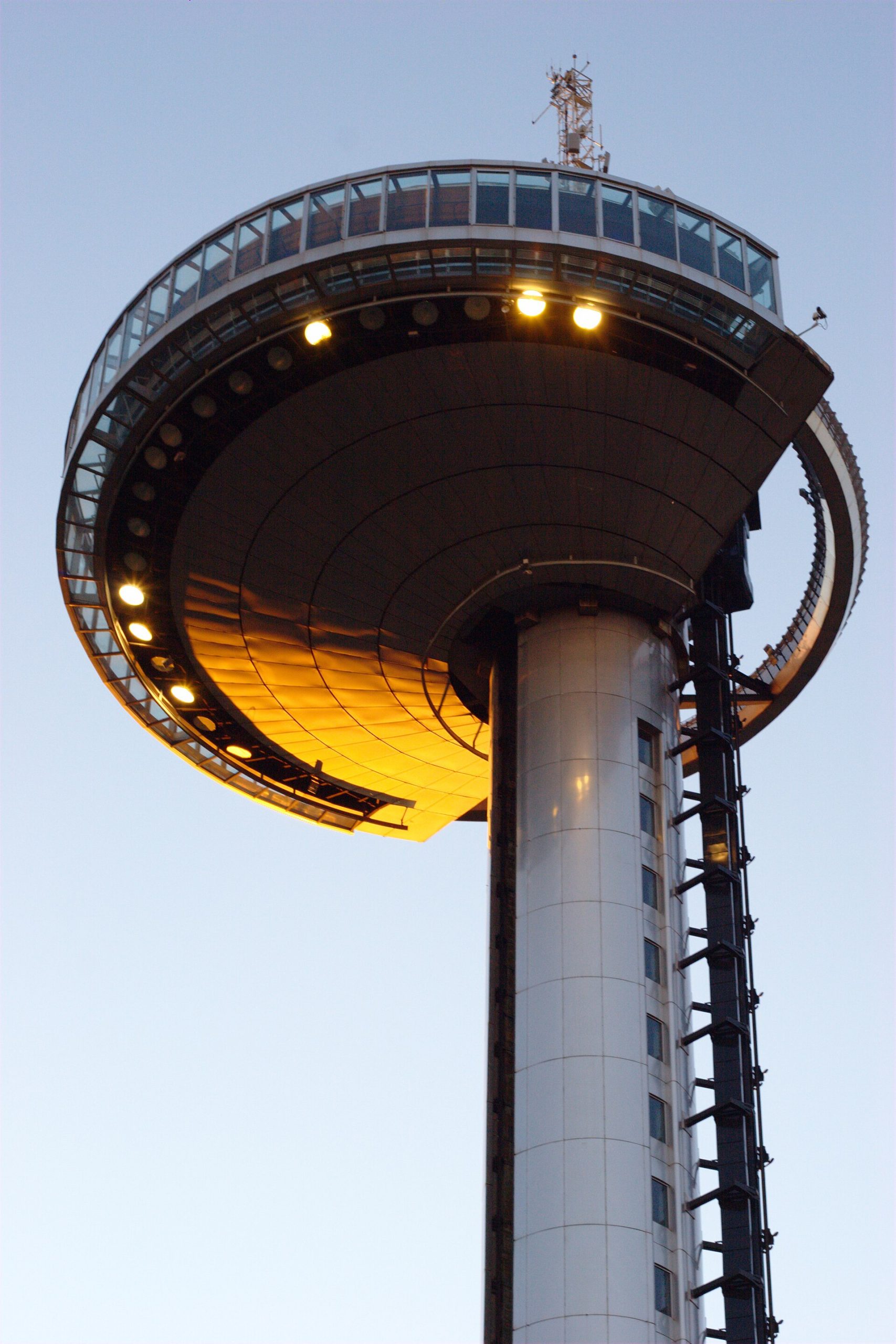
The Faro de Moncloa is a purpose-built observation tower on the edge of central Madrid, next to the Moncloa transport interchange. A lift carries visitors up to a glassed platform roughly 90 metres above street level, from which the city spreads out in every direction, with the Sierra de Guadarrama visible on clear days to the northwest.
Where exactly is it, and how do you reach it?
The tower stands in the Moncloa-Aravaca district, on the plaza in front of the Museo de América, at the point where Avenida de la Memoria meets the wider Moncloa transport hub. It sits just north of the Parque del Oeste and the edge of Ciudad Universitaria, Madrid’s university campus.
The nearest metro station is Moncloa, served by lines 3 and 6 and by the intercambiador that handles buses to the northwest of the region. The station opens directly onto the plaza where the tower stands, so the walk from public transport is short.
Who built the Faro de Moncloa, and why?
The tower was designed by the engineer Salvador Pérez Arroyo and completed in 1992, a year in which Madrid held the title of European Capital of Culture and the city built or renovated a number of public structures to mark it. It was conceived from the outset as a public viewing tower rather than a repurposed telecommunications mast, which distinguishes it from similar-looking structures elsewhere in Spain.
Structurally it is a slender concrete and steel shaft topped by a wider observation ring, a common form for towers of this kind but built here specifically to give the public an elevated view of a city that has very few tall buildings in its historic centre.
What can you actually see from the top?
The platform gives a 360-degree view. To the east and southeast, the skyline of the historic centre spreads out with the domes and rooftops of buildings such as the Royal Palace visible among the lower blocks that make up most of central Madrid. To the north, the Cuatro Torres business district is identifiable by its four towers on the far side of the Castellana, and the Santiago Bernabéu stadium sits closer, along the same axis.
To the west and southwest the view opens onto Casa de Campo, the Manzanares valley, and, on a clear day, the outline of the Sierra de Guadarrama on the horizon. Immediately below, the Parque del Oeste and the university buildings of Ciudad Universitaria give a sense of how much green space sits inside Madrid’s western edge, close to the centre but rarely visible from ground level.
_08.jpg)
Why did the Faro de Moncloa close, and is it open now?
The tower closed to the public for a long period after structural inspections raised safety concerns, and it underwent renovation work before reopening. Because closures, refurbishment schedules and reopening dates for a single municipal structure like this can change without much notice, this is exactly the kind of detail the site treats as perishable rather than fixed.
The tower is operated as a public facility connected to Madrid’s municipal tourism structure. Anyone planning a visit should confirm current opening days, ticket arrangements and any access restrictions directly through the official Madrid tourism site, esmadrid.com, before travelling out to Moncloa specifically for it.
Is the Faro de Moncloa the same as other Madrid viewpoints?
No. Madrid has several elevated points open to the public, and they work differently. The rooftop terrace at the Círculo de Bellas Artes is a paid viewpoint inside a cultural institution in the centre of the city, closer to Gran Vía, and gives a much lower, closer-in view over the rooftops of the Barrio de las Letras. The Faro de Moncloa is a dedicated tower on the western edge of the centre, built purely as an observation deck, with a longer sightline out toward the mountains rather than a rooftop panorama of the old town.
Both are part of the same broader pattern in Madrid, where the historic centre’s low roofline means that any building or tower with public access to height becomes a notable viewpoint by default, rather than through any deliberate “skyline” of tall buildings as seen in other capitals.
What else is in the immediate area?
The Faro shares its plaza with the Museo de América, a national museum devoted to the archaeology, ethnography and history of the Americas, built in the same postwar period as much of the surrounding Moncloa campus. Neither the museum nor the tower is isolated: Moncloa functions as one of Madrid’s main transport gateways to the northwest, and the area around it mixes university buildings, ministries and green space rather than typical visitor infrastructure.
- The Templo de Debod, an Egyptian temple gifted to Spain and re-erected in Parque del Oeste, is a walkable distance southeast of the tower and is itself known for panoramic sunset views over the park, though from ground level rather than a platform.
- The Parque del Oeste separates Moncloa from the Argüelles neighbourhood and the area around Plaza de España, both connected to Moncloa by metro and bus.
- Looking north from the platform, the Cuatro Torres and the Santiago Bernabéu stadium mark the modern axis of the Castellana, well beyond walking distance but clearly visible as fixed points on the skyline.
Does the Faro de Moncloa fit into a museum-focused visit?
It can, though it is a landmark in its own right rather than a gallery. Visitors building a day around Madrid’s museum districts more typically concentrate on the Golden Triangle of Art along the Paseo del Prado, well to the east. Moncloa sits outside that cluster entirely, so a visit here is generally a separate trip built around the tower, the Museo de América, and the western parks, rather than an add-on to a Prado or Reina Sofía itinerary.
Readers researching Madrid’s other elevated and architecturally distinct landmarks can find more on the site’s Landmarks & Sights hub, and readers interested in how the city’s museum network is organised, including national institutions near Moncloa such as the Museo de América, can start from the Museums & Galleries hub.
What should a resident know that a first-time visitor might not?
For anyone living in Madrid, the Faro de Moncloa is more useful as a landmark for orientation than as a repeat destination: because the platform gives a genuinely wide view of the city’s geography, it is one of the few places to see how the historic centre, the Castellana business corridor, the university campus and the Casa de Campo relate to each other spatially, something that is hard to grasp from street level in a city with so few tall buildings.
It is also a useful marker for the Moncloa interchange itself, which handles a significant share of bus traffic toward Madrid’s northwestern suburbs and university halls. Residents using that interchange regularly will already know the tower as a visual reference point above the plaza, whether or not they have been up it.
Access Madrid is an independent guide written from published, checkable sources. We have not visited the places described here and we do not publish personal recommendations or invented ‘local favourites’ — where something is singled out as notable, we say who says so. Opening times, fares, closures and prices change at short notice, so treat everything here as a starting point and confirm with the museum, operator or venue directly before building a day around it. We give no advice on visas, insurance, health or safety; use your own government’s official guidance for those.
Featured image: Photo by Draceane, source, CC BY-SA 4.0
.jpg)
Related reading
Where Can You See Madrid From Above? A Clear Guide.
Featured image: Photo by Carlos Delgado, source, CC BY-SA 4.0
