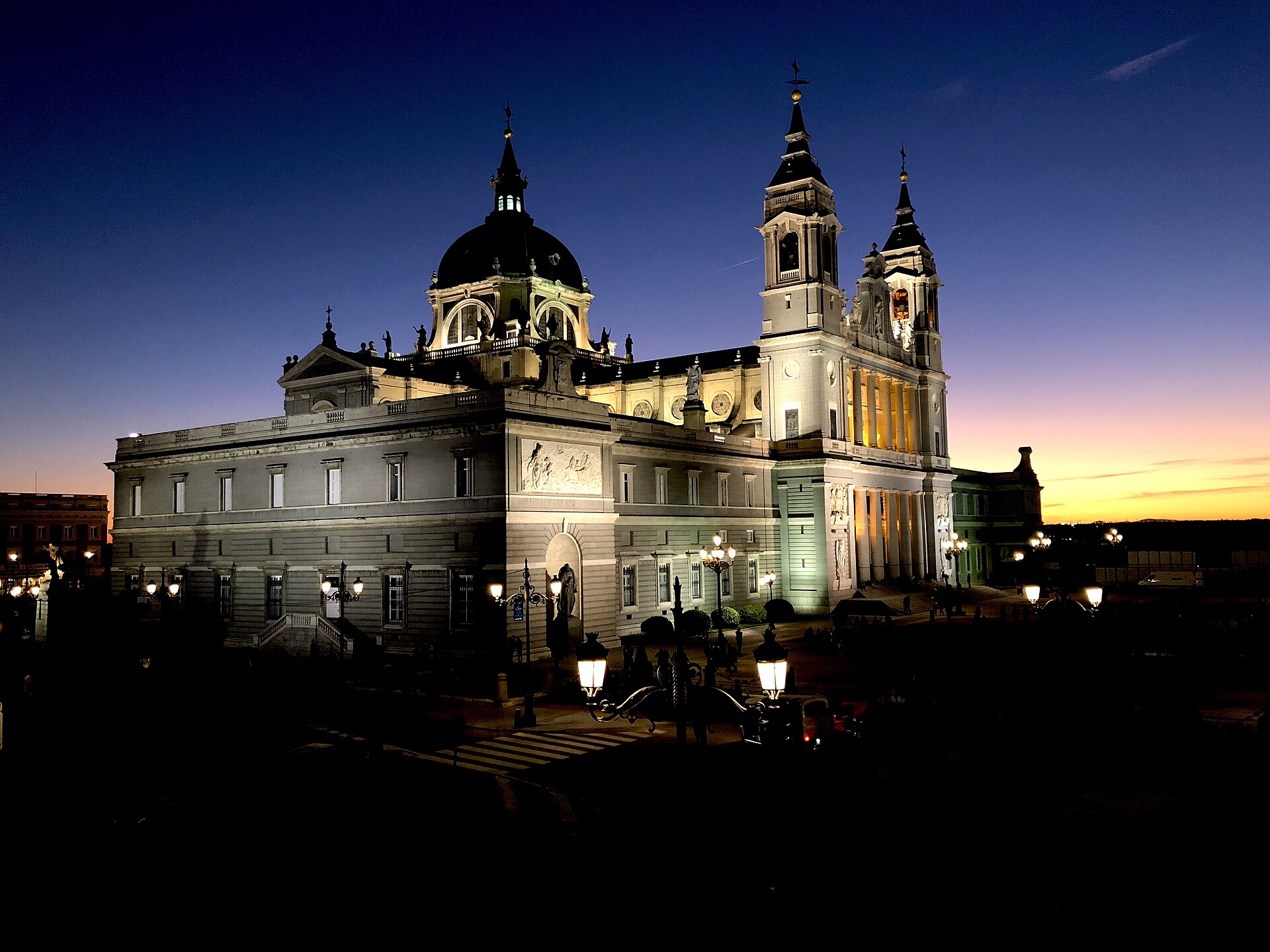
The Almudena Cathedral (Catedral de Santa María la Real de la Almudena) is Madrid’s Catholic cathedral, standing opposite the Royal Palace. It looks modern because it largely is: construction ran from 1883 to 1993, more than a century, so most of what a visitor sees dates from the 20th century rather than the medieval or Baroque periods typical of Spanish cathedrals.
What is the Almudena Cathedral?
It is the seat of the Archdiocese of Madrid, dedicated to the Virgen de la Almudena, the city’s patron saint. It sits on Calle Mayor, directly facing the Royal Palace of Madrid across the Plaza de la Armería, and functions as an active parish and cathedral church rather than a museum piece.
The name “Almudena” comes from an Arabic term for a granary or citadel storehouse (al-mudayna), reflecting a tradition that an image of the Virgin was found near the old city walls during the Christian reconquest of Madrid in 1085. That legend explains the dedication; it does not explain the building’s age, which is a separate and much more recent story.
Why does it look so modern compared to other Spanish cathedrals?
Because it was designed and built almost entirely within living memory of the 20th century, using styles chosen to harmonise with the neighbouring Royal Palace rather than to replicate a medieval cathedral. Its stone is clean, its proportions are regular, and its decoration is comparatively recent — all visible signs of a young building.
Madrid did not have a proper cathedral for most of its history. Unlike Toledo, Burgos or Seville, it was not a bishopric of major standing before the 19th century, and the city’s main churches remained parish churches, not cathedrals. When Madrid became the permanent royal capital, the absence of a cathedral next to the palace was an obvious civic gap, but filling it took generations.
When was it actually built?
Work began in 1883, following a design initially led by the architect Francisco de Cubas, and continued in phases interrupted by funding shortages, changes of architect, the Spanish Civil War, and shifting tastes in ecclesiastical architecture. The cathedral was not consecrated until 1993, when Pope John Paul II dedicated it — making it, by that measure, one of the newest cathedrals in Europe to hold the title.
- 1883 — foundation stone laid, on a Neo-Gothic design by Francisco de Cubas.
- Early-to-mid 20th century — construction slows and stalls repeatedly; the exterior is largely completed with a Baroque-Neoclassical style intended to match the Royal Palace’s facade.
- 1993 — consecration by Pope John Paul II, formally establishing it as Madrid’s cathedral.
That gap between foundation and consecration — over a century — is the direct reason the building reads as modern. Most of its stonework, decoration and structural completion date from the 20th century, even where the original design intent was Neo-Gothic.
.jpg)
Why does the outside look Neoclassical and the inside look Gothic?
The exterior was deliberately adapted to match the 18th-century Royal Palace it faces, using a Baroque-Neoclassical stone facade, while the interior retained more of the original Neo-Gothic structural plan from Cubas’s 1883 design. The result is a building with two different visual languages depending on which side is being looked at.
This was not an accident of poor planning so much as a practical response to context. Civic and religious authorities overseeing the later phases of construction wanted the cathedral’s principal facade to sit comfortably beside the palace rather than clash with it, so later architects revised the exterior toward a style that echoes the palace’s own Neoclassical lines. Inside, the pointed arches, ribbed vaulting and verticality are closer to the cathedral’s original Gothic-revival intent, though the decorative scheme — including brightly coloured ceiling paintings completed in the late 20th century — is unmistakably contemporary rather than historic.
What can be seen inside?
The cathedral holds a Neo-Gothic nave and vaulting, a crypt with older origins than the church above it, chapels dedicated to Spanish saints and royal connections, and a museum covering the cathedral’s history and treasury. Its scale and layout are conventional for a major cathedral; its decoration is not, being far newer than the architecture might first suggest.
The crypt, dedicated to the Virgen de la Almudena, is structurally older than the cathedral above it and was built in a Neo-Romanesque style in the earlier phase of construction — it functioned, and was used for worship, well before the main church above was finished. The cathedral museum, where it exists as a distinct visitable space, covers ecclesiastical items, vestments and the building’s own long construction history; opening arrangements for the museum and crypt are set by the cathedral itself and should be confirmed on its own site before visiting.
Is it linked to the Royal Palace?
Physically and symbolically, yes: the cathedral stands directly opposite the palace and has hosted state occasions connected to the Spanish royal family, including a royal wedding in 2004. It is not part of the palace administratively, but the two buildings were designed across different centuries to visually complete the same royal precinct.
Readers researching the palace itself, its state rooms, and what is open to visitors can find that covered separately in the guide to the Royal Palace of Madrid. The cathedral and palace are typically visited together given their shared square, but they operate under entirely separate management, ticketing and opening hours.
How does it fit into the wider Habsburg-era streets around it?
The cathedral sits at the edge of Madrid’s historic centre, close to the streets that also hold Plaza Mayor and Puerta del Sol, both of which predate the cathedral by centuries. Its relative newness is easiest to grasp by contrast: Plaza Mayor was largely built out in the 17th century, while the cathedral facing the palace was still an active construction site into the 1990s.
That contrast is a useful way to understand central Madrid generally: much of what looks continuous and historic in the old centre is in fact a patchwork of periods, with 20th-century civic ambitions — the cathedral among them — inserted into a street plan shaped centuries earlier.
Where does it sit for someone planning museum time in central Madrid?
The cathedral is free-standing and not part of any museum pass or free-entry-window system used by Madrid’s national museums, since it is a working church rather than a state museum. Readers planning a day around the Royal Palace and central Madrid’s museum cluster should treat the cathedral as a separate stop with its own hours, distinct from the scheduling patterns covered in the guide to how Madrid’s national museum free-entry windows work or the explanation of why so many Madrid museums close on Mondays.
For a broader sense of what else counts as a landmark in this part of the city, the Landmarks & Sights archive covers the major public buildings and monuments of central Madrid, while the Museums & Galleries archive covers the collections nearby, including those that sit within Madrid’s wider gallery district described in the guide to the Golden Triangle of Art.
What should a reader confirm before visiting?
Opening hours, access to the crypt and museum, and any restrictions during religious services are set by the cathedral itself and change without much public notice, so they should be checked directly with the cathedral rather than assumed from general guidebook information. As with any working place of worship, dress expectations and quiet-hours during Mass are the cathedral’s own to set, not a matter of tourist custom.
Because the building continues to function as an active cathedral with a regular liturgical calendar, visiting hours for tourists are typically more limited than for a state museum, and can be suspended during Mass or specific ceremonies. Confirming current times on the cathedral’s own published information — rather than assuming standard museum hours — avoids arriving during a closed window.
Access Madrid is an independent guide written from published, checkable sources. We have not visited the places described here and we do not publish personal recommendations or invented ‘local favourites’ — where something is singled out as notable, we say who says so. Opening times, fares, closures and prices change at short notice, so treat everything here as a starting point and confirm with the museum, operator or venue directly before building a day around it. We give no advice on visas, insurance, health or safety; use your own government’s official guidance for those.