Puerta del Sol is the square at the geographic and symbolic centre of Madrid, where ten streets converge in front of a former post office building. Kilometre Zero is the marker set into the pavement outside that building, the fixed point from which distances on Spain’s national road network are officially measured.
What is Puerta del Sol?
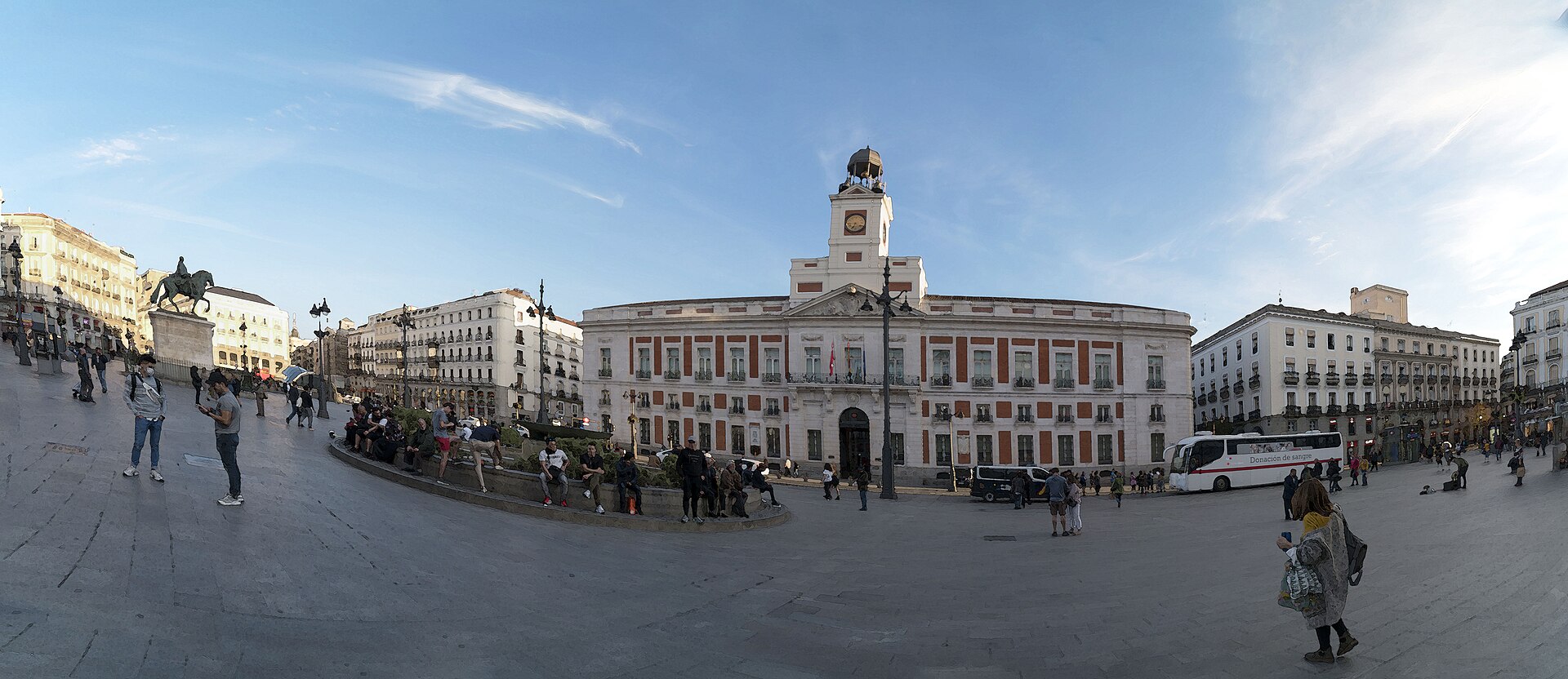
Puerta del Sol is a semicircular open square in the historic centre of Madrid, bounded on its curved side by the Real Casa de Correos and opening onto ten converging streets, among them Calle Mayor, Calle de Alcalá and Calle del Carmen. It functions less as a monument in itself and more as a junction — the point where the old walled city, the shopping streets of Preciados and Carmen, and the routes toward Alcalá and the Retiro all meet.
The square has occupied this role since at least the sixteenth century, though its current paved, largely traffic-restricted form dates from a series of twentieth- and twenty-first-century remodellings, the most recent completed in 2009 when Madrid City Council enlarged the underground transport interchange beneath it. Above ground, the square today is a pedestrian-priority space; the through traffic that once crossed it has been progressively removed over several decades of redesign.
Where does the name come from?
The name means “Gate of the Sun”. It refers to a medieval gate that once stood at this location as part of Madrid’s city wall, facing east, reportedly decorated with a carved or painted sun on its façade. The gate was demolished in the sixteenth century as the city expanded beyond its old perimeter, but the name attached to the open space that replaced it has persisted ever since. No trace of the original gate survives above ground.
What is Kilometre Zero, exactly?
Kilometre Zero — Kilómetro Cero in Spanish — is a stone marker embedded in the paving directly in front of the Real Casa de Correos. It designates the reference point from which the distances of Spain’s original network of national roads are calculated, a role assigned to this exact spot by the state body responsible for the road network, today part of the Ministerio de Transportes, Movilidad y Agenda Urbana.
Six historic national roads, numbered N-I through N-VI, radiate outward from Madrid toward the coasts and the French and Portuguese borders, and their distance markers along the way are counted from this single point in the square. The plaque visitors see today is not the original marker; it has been replaced and repositioned more than once as the square itself has been rebuilt, most recently as part of the 2009 works. Details of the current marker’s design are best confirmed on the website of the Instituto Geográfico Nacional, the state mapping agency that maintains the country’s geodesic reference points.
What is the Real Casa de Correos?
The Real Casa de Correos is the building that forms the curved backdrop to Puerta del Sol and is the fixed reference point for Kilometre Zero. It was built in the second half of the eighteenth century to house Spain’s postal service and later served as the Ministry of the Interior. Today it is the seat of the Presidencia de la Comunidad de Madrid, the regional government of Madrid, a role documented on the Comunidad de Madrid’s own institutional website.
Its most recognisable feature is the clock tower above the main entrance, whose bells are broadcast nationally every 31 December as the reference for the tradition of eating twelve grapes, one on each chime of midnight — a custom often traced back to 1909, when a surplus grape harvest in the east of the country was marketed as a New Year good-luck ritual. The building itself is not generally open to public visits, since it functions as a working seat of government rather than a museum.

What else is there to see in the square?
Two sculptures anchor the square’s public identity. At its eastern end stands a bronze statue of a bear reaching into a strawberry tree — El Oso y el Madroño — installed in 1967 and long used as the official emblem of the city of Madrid, appearing on municipal seals and street furniture across the capital. Toward the centre of the square is an equestrian statue of King Carlos III, erected in the 1990s, recalling the Bourbon monarch credited with much of Madrid’s eighteenth-century urban development.
The square carries no museum or gallery of its own; its significance is civic and historical rather than curatorial. Readers looking for the institutions that hold Madrid’s collections — from the paintings of the Golden Triangle to smaller specialist museums — are better served by the city’s dedicated museum sector nearby, covered in the site’s Museums & Galleries archive.
Why does Puerta del Sol matter on New Year’s Eve?
Puerta del Sol is the fixed location of Spain’s principal New Year’s Eve broadcast, when crowds gather in the square and the clock atop the Real Casa de Correos strikes midnight on national television. The custom of eating twelve grapes to the chimes, one per stroke, is followed simultaneously by households across the country watching the same broadcast, which makes this specific square — rather than any equivalent space in another Spanish city — the fixed reference point for how the whole country marks the turn of the year. This is a broadcast tradition rather than an official state ceremony, and details of any given year’s event are set by Madrid City Council and the national broadcaster, not by any fixed programme worth listing here.
How does Puerta del Sol work as a transport hub?
Beneath the square sits Sol station, one of the busiest interchanges on the Madrid Metro network, connecting several metro lines with the Cercanías commuter rail network that links central Madrid to its wider metropolitan area. The 2009 remodelling of the square was driven largely by the need to expand this underground interchange, which explains why the surface square feels comparatively compact relative to the volume of passengers moving through it below. Current line connections, accessibility information and any service changes are best checked directly on Metro de Madrid’s own website before a journey.
How does Puerta del Sol connect to the rest of central Madrid?
Puerta del Sol sits within a few minutes’ walk of several of the sites that define Madrid’s historic centre. Plaza Mayor, the arcaded square built under Habsburg rule, lies just southwest along Calle Mayor; the site’s own explainer on what Plaza Mayor is and why it was built covers how that square’s history differs from Sol’s role as a road and rail junction. For the deeper civic history of the city that grew up around both squares, the Museo de Historia de Madrid holds material tracing Madrid’s development from a minor Habsburg town to national capital.
Further east, the cluster of institutions that make up Madrid’s Golden Triangle of art museums — the Prado, the Thyssen-Bornemisza and the Reina Sofía — sits within comfortable walking or short metro range of Sol, making the square a practical, if unglamorous, starting point for a day oriented around the city’s major collections. The full run of Madrid’s landmark buildings and public monuments is catalogued in the site’s Landmarks & Sights archive.
What should someone know before visiting?
Puerta del Sol is an open public square with no admission charge and no fixed opening hours, since it is a street-level civic space rather than a monument or a museum. It is one of the most heavily used pedestrian junctions in Madrid at almost any hour, which is worth factoring into any plan that involves crossing it during commuting periods or around major public gatherings such as New Year’s Eve. Anyone planning a museum-heavy day starting from the square may find it useful to check the site’s guides on how Madrid’s national museum free-entry windows work and why so many Madrid museums close on Mondays, since both affect how a day beginning at Kilometre Zero is best structured.
Readers travelling from abroad should confirm any entry requirements and current travel guidance through their own government’s official foreign travel advice service before planning a visit, rather than relying on third-party summaries.
Access Madrid is an independent guide written from published, checkable sources. We have not visited the places described here and we do not publish personal recommendations or invented ‘local favourites’ — where something is singled out as notable, we say who says so. Opening times, fares, closures and prices change at short notice, so treat everything here as a starting point and confirm with the museum, operator or venue directly before building a day around it. We give no advice on visas, insurance, health or safety; use your own government’s official guidance for those.
Featured image: Photo by Javier Perez Montes, source, CC BY-SA 4.0
