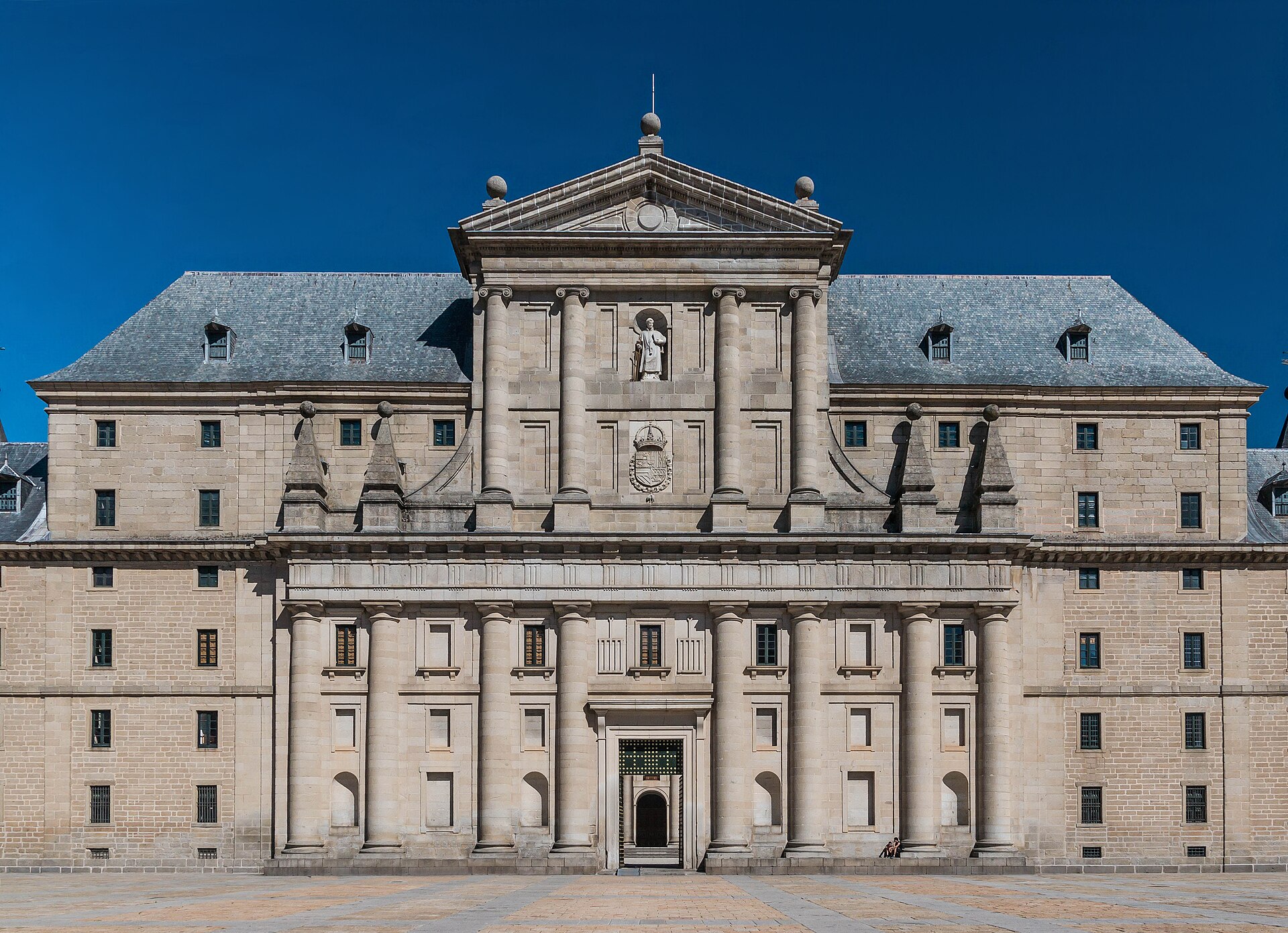
El Escorial is a vast granite monastery-palace built for King Philip II in the second half of the 16th century, about 45 kilometres northwest of Madrid. It combines a working Augustinian monastery, a royal palace, a basilica, a library and a mausoleum where most Spanish monarchs since Charles I are buried. UNESCO lists it as a World Heritage Site.
Where is El Escorial and what does the name mean?
The site sits at the foot of the Sierra de Guadarrama, in the town of San Lorenzo de El Escorial. The name comes from the old Spanish word for the slag heaps left by iron-ore mining once carried out there. The full formal name of the building is the Real Monasterio de San Lorenzo de El Escorial, “escorial” describing the site rather than the monastery itself.
The town has grown up around the monastery and is now a functioning municipality of the Community of Madrid, not a purpose-built visitor site. Its elevation, roughly 1,000 metres, makes it noticeably cooler than central Madrid, which is one reason the Spanish court used it as a retreat from summer heat. The broader mountain range it sits against is covered in more detail in the guide to the Sierra de Guadarrama.
Who built it, and why?
Philip II commissioned the monastery in 1563 to fulfil a vow made after the Battle of Saint Quentin and to serve as a burial place for his father, Charles I (Charles V as Holy Roman Emperor), and for the Spanish royal line that followed. Construction ran until 1584.
The first architect was Juan Bautista de Toledo, who had worked in Rome and Naples. After his death in 1567, Juan de Herrera took over and gave the building its severe, almost unornamented style, later known in Spanish architecture as “herreriano”. The result is one long, unbroken statement in grey granite rather than the layered decoration typical of the period elsewhere in Europe.
What is actually inside the complex?
El Escorial is not a single museum but a set of distinct institutions housed under one roof and organised around a grid plan said to reference the gridiron of Saint Lawrence, the monastery’s patron.
- The basilica — a domed church at the centre of the complex, with an altarpiece and choir used for the monastery’s continuing religious life.
- The Royal Pantheon (Panteón de los Reyes) — a crypt beneath the basilica holding the marble sarcophagi of most Spanish monarchs from Charles I onward.
- The Royal Library — one of the most significant historic library collections in Spain, with a frescoed ceiling and manuscripts dating back centuries.
- The royal apartments — the private rooms used by Philip II and later monarchs, including the austere quarters from which Philip II is said to have followed work on the basilica.
- The monastery proper — cloisters and chapter rooms still associated with the Order of Saint Augustine, which has maintained a community there since the 19th century.
- Museums of art and architecture — galleries within the complex holding paintings and tapestries from the royal collections, alongside models and documents relating to the building’s construction.
Patrimonio Nacional, the Spanish state body responsible for royal heritage sites, manages the monastery and publishes current details of what is open to visitors on its own site.
Why does UNESCO list it as World Heritage?
UNESCO inscribed the Monastery and Site of the Escorial, Madrid, in 1984, citing it as an outstanding example of the architectural response to the Catholic Reformation and its influence on Spanish architecture that followed. The listing covers the monastery, the palace, and the surrounding gardens and site as a single ensemble rather than isolated buildings.
This is a different kind of recognition from a museum ranking or a guidebook star: it reflects the site’s documented historical and architectural significance, assessed by an international body, rather than a curatorial or culinary judgement.
How do you get there from Madrid?
The standard route is Cercanías line C-3, Madrid’s suburban rail network, from Madrid’s central stations to the San Lorenzo de El Escorial station, with a journey of a little over an hour. From the station, the monastery is a walk uphill into the town.
Renfe, the Spanish national rail operator, publishes current timetables and fares for the C-3 line on its own site, and these should be checked directly rather than assumed, since suburban schedules change. For a wider view of how Madrid’s Cercanías network fits alongside the metro, see the explainer on Cercanías versus metro. Coach services also run from Madrid to the town and are a common alternative for visitors without a rail pass.
Because El Escorial sits outside the city, it is generally treated as a half-day or full-day excursion rather than an add-on to a central Madrid itinerary. The Madrid guide hub sets out where a trip like this fits alongside the city’s core sights, and the day trips archive covers other excursions from Madrid on a similar basis.
Is it worth combining with anything else nearby?
El Escorial is sometimes paired with the Valley of Cuelgamuros (formerly known as Valle de los Caídos), a separate and more contested monument a short distance away, though the two require separate admission and separate planning. Readers researching either site should treat them as distinct visits with their own current access rules, published by Patrimonio Nacional.
For travellers weighing El Escorial against Madrid’s other classic day trips, the guide to Segovia and its aqueduct and the guide to Toledo as a day trip cover the two most commonly compared options, both reachable by direct rail from Madrid and both offering a different period of Spanish history than the 16th-century court world of El Escorial.
What should a visitor know before planning a visit?
El Escorial keeps its own opening calendar, sets its own closed days, and — like most major Spanish monuments — often closes on Mondays. Ticket prices and any timed-entry requirements are set and revised by Patrimonio Nacional, not by any third party, and should be confirmed on its official site before travelling.
The building’s scale means a visit covers a genuine walking distance across galleries, cloisters and the basilica, so comfortable footwear and a realistic sense of the time required — commonly cited as at least two to three hours for the main rooms — are worth building into a day’s plan. Broader guidance on how Madrid’s major sites now handle entry queues and timed slots is covered in the guide to timed entry at Madrid’s major sites, much of which applies to state-run monuments outside the city as well.
Because El Escorial sits at altitude in the Sierra de Guadarrama foothills, its climate runs noticeably cooler and windier than central Madrid across the year, a point worth weighing for visits either in high summer or winter. The planning and practicalities archive covers how Madrid’s seasonal weather generally shapes a visit, and the same patterns apply, in a sharper form, once outside the city itself.
Access Madrid is an independent guide written from published, checkable sources. We have not visited the places described here and we do not publish personal recommendations or invented ‘local favourites’ — where something is singled out as notable, we say who says so. Opening times, fares, closures and prices change at short notice, so treat everything here as a starting point and confirm with the museum, operator or venue directly before building a day around it. We give no advice on visas, insurance, health or safety; use your own government’s official guidance for those.
Featured image: Photo by Rodelar, source, CC BY-SA 4.0
