Segovia is a city of around 50,000 people in the Castilian plateau, roughly 90 minutes north-west of Madrid by road or under 30 minutes by high-speed train. Its landmark is a Roman aqueduct: a raised stone channel, built without mortar, that still stands more than 800 metres through the middle of the old town.
What is Segovia?
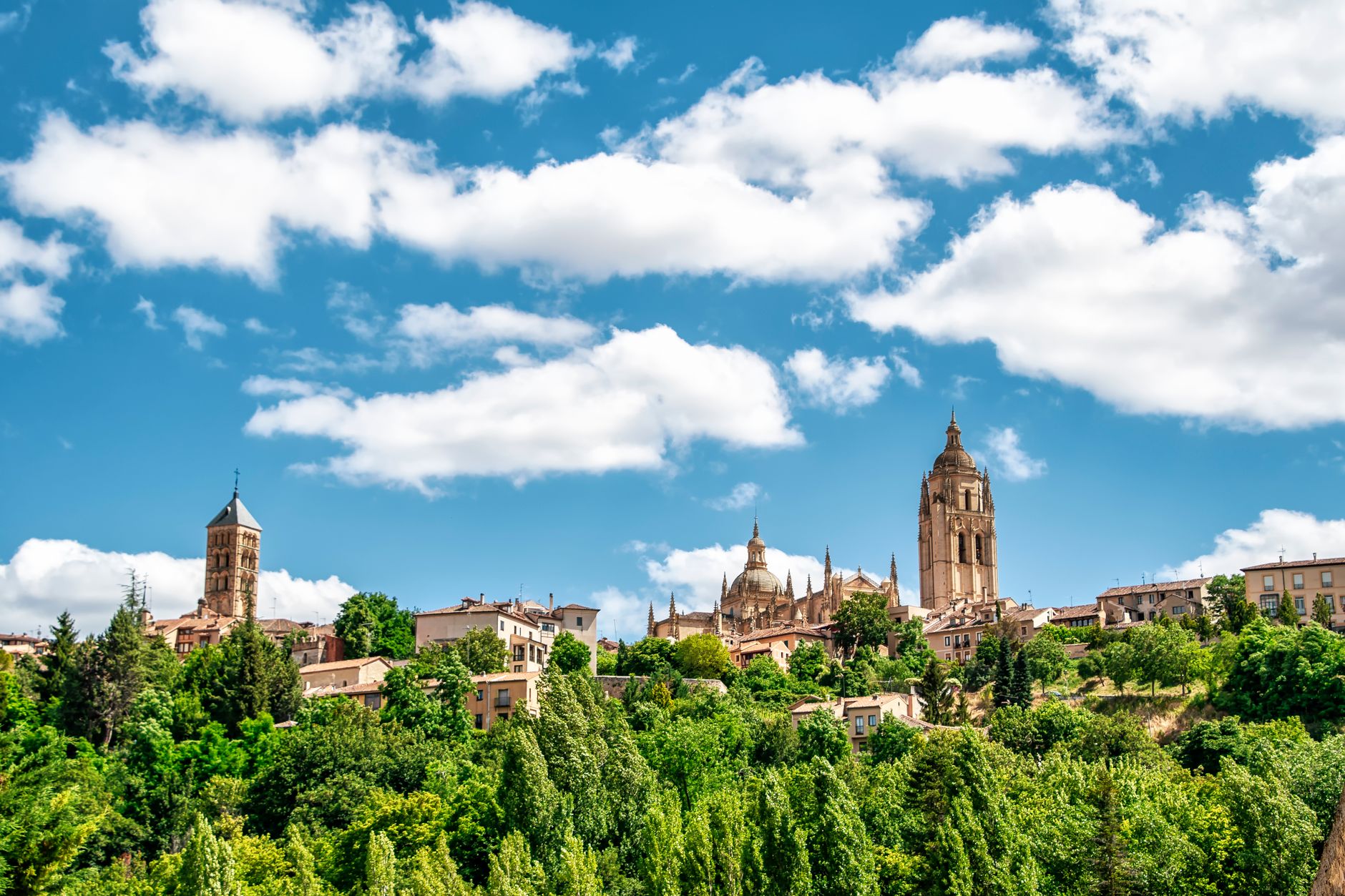
Segovia is the capital of Segovia Province, in the autonomous community of Castile and León. It sits on a rocky spur where two rivers meet, north of the Sierra de Guadarrama that separates it from Madrid. The old town — cathedral, alcázar, aqueduct and a dense grid of medieval streets — occupies the high ground of that spur, with newer parts of the city spreading below.
UNESCO inscribed the “Old Town of Segovia and its Aqueduct” as a World Heritage Site in 1985, citing the density of Roman, Romanesque, Gothic and Renaissance building fabric preserved within a small area. That inscription is the reason the city is treated, in guidebooks and by Spain’s own tourism bodies, as a single protected historic unit rather than a scattering of individual monuments.
What is the aqueduct, exactly?
The Acueducto de Segovia is a Roman-era structure that carried water roughly 17 kilometres from the Río Frío into the city, ending in a distribution system that fed the upper town. The visible, famous section runs through the Plaza del Azoguejo: a double tier of granite arches reaching about 28 metres at its tallest point, built from unmortared, dry-fitted stone blocks held together by precise cutting and their own weight.
It functioned as a working piece of civic infrastructure into the modern era. Segovia’s municipal authorities used it to supply the town with water until the late 19th century, which is a long working life for a structure with no binding agent at all.
How old is it, and who built it?
Historians and archaeologists generally date the aqueduct to the late 1st century or early 2nd century AD, under the Roman emperors of the Flavian or early Trajanic period, though no inscription survives to confirm an exact year or patron. Spain’s Instituto del Patrimonio Cultural and academic studies of the monument treat this as the best-supported window rather than a fixed date, since the dedicatory plaque that once sat on the structure — its bronze lettering long gone — is known only from the holes left for its fixing lugs.
What is not in dispute is the engineering. The aqueduct’s channel maintains a controlled gradient across uneven terrain using arcading rather than a continuous embankment, a standard Roman solution to carrying water across a valley without losing the fall needed for it to flow.
Why does the aqueduct matter today?
It matters as one of the most complete elevated Roman aqueducts left standing anywhere, and the best preserved in Spain. UNESCO’s listing and Spain’s own heritage protections (it is a Bien de Interés Cultural, the country’s top individual heritage designation) both rest on that completeness — the fact that a working Roman engineering structure survives in a modern city centre, still crossing a functioning public square.
It also anchors how the old town reads as a whole. Visitors and Segovia’s municipal tourism office both describe the aqueduct as the natural starting point for a walk through the upper town, since it sits at the boundary between the newer lower city and the walled historic core.
What else is in Segovia besides the aqueduct?
The aqueduct is the reason most people first hear of the city, but the old town holds two other major monuments that Spain’s national and regional heritage bodies list independently:
- The Alcázar de Segovia — a royal fortress-palace on the western tip of the old town’s rocky spur, rebuilt and altered over centuries, and widely cited (including by the Alcázar’s own visitor materials) as one of the buildings associated with the popular image of a fairy-tale castle.
- Segovia Cathedral — a Gothic cathedral completed in the 16th and 17th centuries, one of the last major Gothic cathedrals built in Spain, standing in the main square of the old town.
Beyond these, the old town’s UNESCO citation covers the wider fabric: Romanesque parish churches, the medieval street plan, and the city walls, all within walking distance of each other inside a compact historic centre.
How do you get from Madrid to Segovia?
The fastest option is a high-speed rail service run by Renfe, Spain’s national rail operator, which connects Madrid’s Chamartín station to Segovia-Guiomar in well under an hour; the operator’s own site carries current timetables and fares, which change and should be checked directly rather than assumed. Segovia-Guiomar station sits outside the old town, and a local bus service connects it to the centre.
Regular coach services also run from Madrid, taking longer but dropping closer to the historic centre in some cases. Readers planning the journey from Madrid’s stations more broadly may find it useful to see how Madrid’s main railway stations are organised, and how trains from Madrid to other Spanish cities are generally booked and timed.
Segovia is often mentioned alongside Toledo as a natural counterpart for a day trip from the capital — the two are frequently compared because both are UNESCO-listed historic cities within easy rail reach of Madrid. Readers weighing the two may want to compare with what Toledo is and what makes it a day trip from Madrid, since the cities differ in character: Toledo built around its Islamic, Jewish and Christian layers, Segovia around its Roman engineering and its Alcázar.
Is Segovia worth a day trip, or does it need longer?
The core sites — aqueduct, cathedral, alcázar and the old town streets between them — are compact enough that a single day from Madrid covers the essentials for most visitors, particularly using the high-speed train. Those with more time sometimes extend it with the surrounding province, including smaller towns and countryside in the same region, though that moves beyond what a single day trip usually covers.
Because Segovia sits just north of the Sierra de Guadarrama, readers curious about that mountain range as a separate excursion from Madrid — walking country rather than historic-city sightseeing — may find what the Sierra de Guadarrama is and how close it sits to Madrid a useful comparison, since the two make very different day trips despite being near neighbours.
What should someone living in Madrid know about visiting Segovia?
For Madrid residents, Segovia functions less as a tourist checklist and more as a genuinely reachable weekend or half-day option, given the train time. The practical planning questions are the same ones that apply to any day trip out of the capital: how to time the outward and return journeys around a station rather than a city-centre stop, and how opening hours at the cathedral and Alcázar shift with the season and with religious or public holidays.
General guidance on how public holidays affect opening hours across the region is worth checking before travelling, since holiday closures in Castile and León do not always align with Madrid’s own calendar. For those building the trip into a broader itinerary, Access Madrid’s wider guides to day trips from Madrid and to itineraries and day plans cover how a Segovia excursion typically fits alongside time spent in the capital itself.
Anyone planning official travel arrangements, entry requirements or safety guidance for the wider region should consult their own government’s official travel advice rather than tourism sites, since that detail sits outside what any guide, including this one, can responsibly confirm.
Related reading
what the city is like to actually live in, Madrid, Practically, The Madrid Guide
Access Madrid is an independent guide written from published, checkable sources. We have not visited the places described here and we do not publish personal recommendations or invented ‘local favourites’ — where something is singled out as notable, we say who says so. Opening times, fares, closures and prices change at short notice, so treat everything here as a starting point and confirm with the museum, operator or venue directly before building a day around it. We give no advice on visas, insurance, health or safety; use your own government’s official guidance for those.
Featured image: Photo by Diego Delso, source, CC BY-SA 4.0
