A day in Madrid with no museums at all is entirely possible, and it does not mean a thin day. The central district is compact enough to cover on foot alone, and the walk itself passes through squares, a produce market, a working-class barrio, and a park that were built to be looked at, not queued for. The route below runs roughly six to eight kilometres depending on detours, and needs nothing but shoes and, in summer, a plan for the middle of the afternoon.
What does a museum-free day in Madrid actually cover?
It covers the historic core — Sol, Plaza Mayor, the Austrias district, La Latina — then a stretch through or around Retiro park, with Gran Vía or Cibeles as a way back. None of this requires a ticket, a timed entry slot, or an opening-hours check, which is the point: the day is built around things that are simply there, all the time, for free.
Where does a walking day like this start?
It starts at Puerta del Sol, the square marked as Kilómetro Cero, the notional zero point for Spain’s radial road network. Sol is also where several metro lines converge, so it works as a start point regardless of where a visitor is staying, and it sits at the edge of Madrid de los Austrias, the tangle of narrow streets laid out under the Habsburg kings before the city was significantly replanned.
From Sol, the walk to Plaza Mayor takes a few minutes down Calle Mayor or through the Arco de Cuchilleros. The square itself is a 17th-century arcaded rectangle, closed to traffic, that has served over its history as a market, a site for royal ceremony, and — for a period — a venue for bullfights and public executions. None of that requires interpretation from a guide standing in front of a painting; it is legible from the architecture and the plaques on the walls.
How far is the Austrias district, and is it worth the detour?
The Austrias district is not a detour — Sol and Plaza Mayor sit inside it. It is the oldest surviving street layout in central Madrid, and a dedicated walking route through it is covered in detail elsewhere on this site, but the short version is that the streets are narrow because they predate cars, and the churches and convents scattered through them — several still functioning — predate the Bourbon rebuilding of the city in the 18th century.
The Mercado de San Miguel, an early 20th-century iron-framed market hall just off Plaza Mayor, is a fixed point on most versions of this walk. It is worth noting for what it is architecturally — a rare surviving iron-and-glass market structure in the city centre — rather than for any particular stall inside it, which changes over time.
What does La Latina add that the Austrias core doesn’t?
La Latina is the district immediately south and west of the Austrias core, built on steeper ground, and it is where the working city — as opposed to the ceremonial one — is easier to see. The streets here slope down toward what was once the bank of the Manzanares, and the district takes its name from a royal hospital, La Latina, founded in the late 15th century on the site.
The Basílica de San Francisco el Grande sits at the western edge of La Latina, notable for one of the largest church domes in Spain by diameter. Continuing downhill leads to Puerta de Toledo, a triumphal gate completed in the early 19th century, which marks the traditional southern edge of the old city and the start of Arganzuela.

Does the day change if it falls on a Sunday?
Yes — Sunday mornings in this part of the city are dominated by El Rastro, Madrid’s long-running open-air market that runs down the streets between La Latina and Embajadores. It is not a single fixed site but a market that occupies public streets on a weekly pattern, which changes the crowd density and the practical route through the area considerably. Anyone planning a walk for a Sunday specifically should read how the rest of the city’s rhythm shifts on that day, since many shops and some sights close entirely.
On any other day, the same streets are markedly quieter, and the walk can continue east through Lavapiés — one of the most ethnically mixed districts in central Madrid, with a street layout and building stock largely unchanged since the 19th century — before turning north back toward the centre.
Is it worth walking to Retiro if the plan is to stay outside?
Retiro is a public park, not a museum, so nothing about it requires going indoors — the Palacio de Cristal and the Palacio de Velázquez inside it are exhibition buildings, but the park itself, its lake, and its formal avenues are open and free. The park was originally laid out as the grounds of a 17th-century royal retreat and was opened fully to the public in the late 19th century; UNESCO included Retiro, together with the Paseo del Prado, in a World Heritage inscription recognising the area as an axis of art and science tied to the Spanish Enlightenment.
A walk through Retiro from its western Puerta de Alcalá side to the lake and back out through one of the northern gates adds roughly forty minutes to an hour without ever approaching a ticket desk. The park sits inside Retiro district, which is described in more detail elsewhere on this site, including what the district is beyond the park boundary.
How does the walk get back to the centre?
The most direct return from Retiro’s western gates is along Calle de Alcalá to Plaza de Cibeles, then either up Gran Vía or back through Sol. Cibeles is a good point to note rather than linger at length: the fountain at its centre and the building behind it, the former post-office palace now used as Madrid’s city hall, are both frequently photographed, but their significance is a matter of record rather than atmosphere. Puerta de Alcalá, the freestanding neoclassical gate at the square’s eastern side, was commissioned by Carlos III in the 1770s as one of the ceremonial gates into the city.
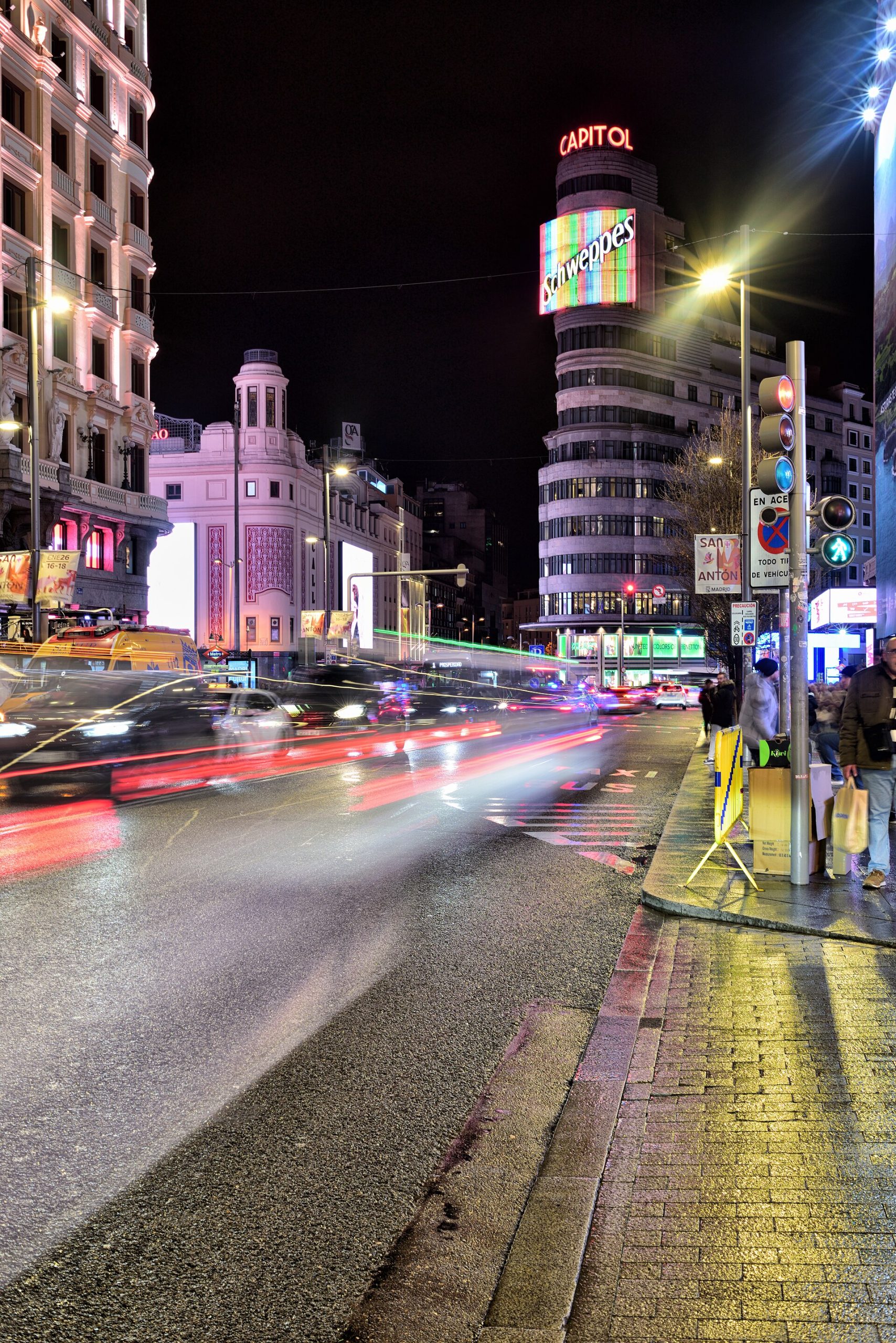
Gran Vía itself, if the day still has legs, is a 20th-century commercial avenue cut through the older street grid between 1910 and 1929, and its building line — cinemas, department stores, hotels from the period — is itself a kind of open-air record of that decade’s architecture, viewable without entering anything.
How does the heat or the season change this plan?
Central Madrid in July and August regularly sees afternoon temperatures that make continuous outdoor walking impractical between roughly 2pm and 6pm, so a day like this is better front-loaded into the morning, with a long paused lunch, and finished after the heat breaks. Spanish meal times run later than in much of northern Europe, which happens to suit this pattern well — a late lunch functions as a natural break in the middle of a walking day rather than an interruption to it. Winter removes the heat problem but shortens the usable daylight considerably, and rain is common enough in autumn and spring that an all-outdoor day should have a fallback in mind.
Does this route cost anything at all?
Every element described above — the squares, the streets, the park, the market as a building rather than its stalls — is free to walk through. The only genuine cost on a day like this is food, and possibly a metro or bus fare back to accommodation at the end of it, which runs on the same zone-based fare system as any other day in the city.
For anyone assembling this into a longer stay, the wider planning hub covers how a day like this sits alongside museum-heavy days, and the neighbourhoods archive goes into more depth on each district the route passes through.
- How walkable is central Madrid? The real distances
- How is Madrid divided into districts and barrios?
- Puerta del Sol and Kilómetro Cero explained
- A walking route through Madrid de los Austrias
- What is La Latina, Madrid’s district explained
- Retiro district, Madrid: beyond the park explained
- How do you plan around a Sunday in Madrid?
Related reading
what the city is like to actually live in.
Access Madrid is an independent guide written from published, checkable sources. We have not visited the places described here and we do not publish personal recommendations or invented ‘local favourites’ — where something is singled out as notable, we say who says so. Opening times, fares, closures and prices change at short notice, so treat everything here as a starting point and confirm with the museum, operator or venue directly before building a day around it. We give no advice on visas, insurance, health or safety; use your own government’s official guidance for those.
Featured image: Photo by Tim Adams, source, CC BY 3.0
