Madrid separates household waste into several colour-coded street containers — organic waste, packaging, paper and card, glass, and general “rest” waste — collected by the city council (Ayuntamiento de Madrid) and processed mainly at a large treatment complex on the city’s southeastern edge. Bulky items go through a separate, appointment-based system.
What do the different coloured containers mean?
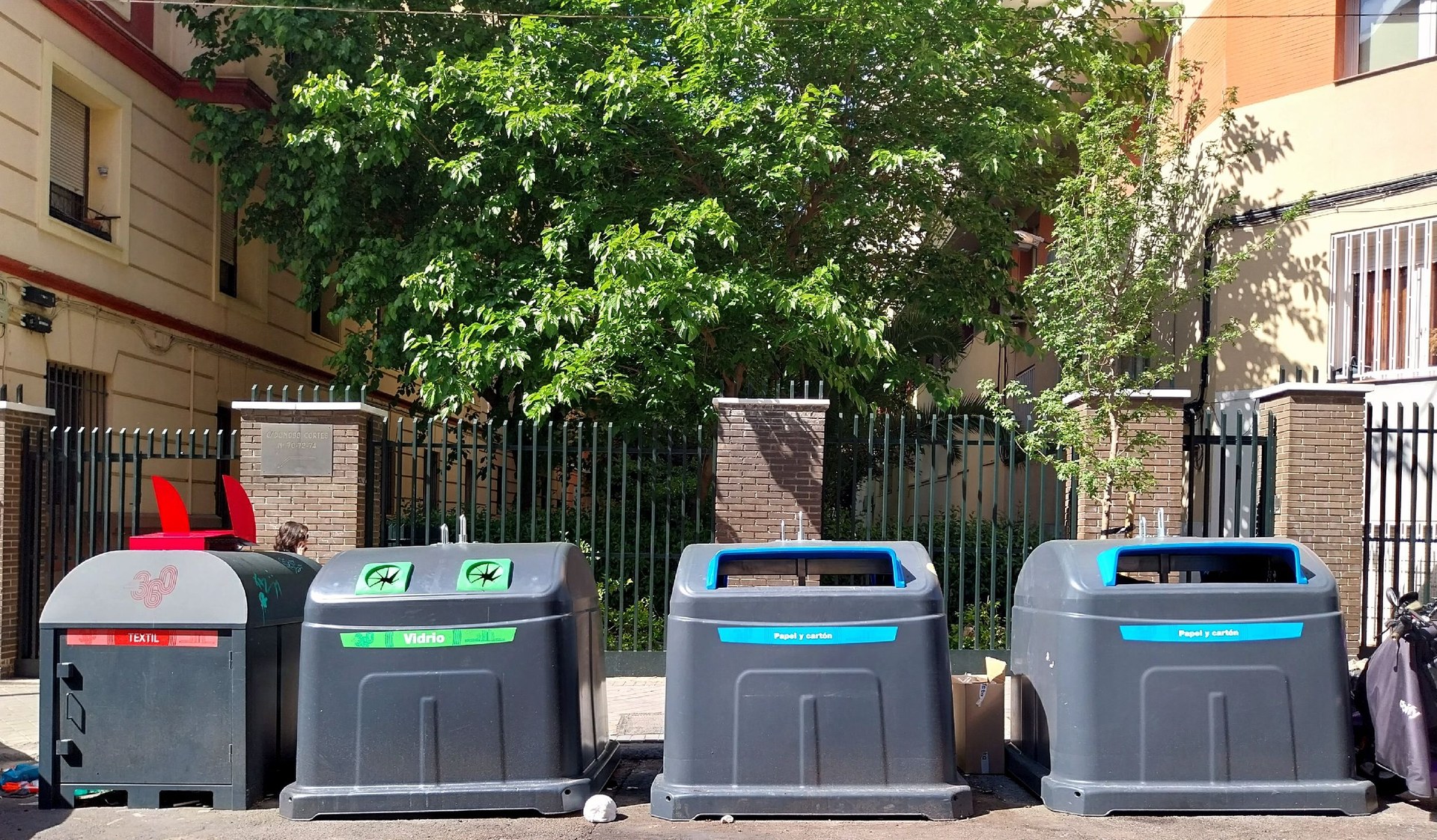
Most Madrid streets have a bank of containers rather than a single bin, and each colour is fixed by national convention as well as local practice.
- Yellow — light packaging: plastic bottles and tubs, cans, cartons (tetra-brik). Collected every day, including Sundays and public holidays.
- Blue — paper and cardboard.
- Green (bottle bank / “iglú”) — glass only, no lids or corks.
- Brown lid — organic waste in a compostable bag: food scraps, coffee grounds, tea bags, soiled kitchen paper and small garden trimmings. Collected every day, including Sundays and public holidays.
- Orange lid — the “rest” fraction: everything that does not fit the other categories, including sweepings, nappies, cigarette ends and cat litter. Collected Monday to Saturday, but not on public holidays.
The yellow and blue streams are run in coordination with Ecoembes, the national non-profit that organises packaging recycling on behalf of manufacturers across Spain, not just in Madrid. Glass collection nationally works through a comparable body, Ecovidrio. The city council manages the containers, routes and general “rest” fraction directly.
Is there a separate bin for organic waste?
Yes, across the whole city. Madrid added a fifth, brown-lidded container for organic waste district by district from the late 2010s, as part of a national push (driven by EU waste directives) to divert food and garden waste from landfill and incineration. It reached all 21 districts in September 2020, when Centro became the last to get it. According to the Ayuntamiento de Madrid, cooking oil, sweepings, hair, nappies and pet waste do not go in the brown bin. Oil goes to a clean point, and the rest goes in the orange-lidded bin.
Madrid trash bins: building bins or street containers?
It depends on the street. In much of the city each building has its own wheeled bins (cubos) with yellow, brown and orange lids. Residents fill these indoors, and the bins are put out for the collection round. Elsewhere, large street containers take the same three fractions. The council’s page on areas with two-wheeled bins covers only those three fractions, so paper and card always go to the blue street container and glass to the green bottle bank. Collection times vary by street. The council publishes them by area, and in a rented flat the building’s own routine (who puts the bins out, and when) is usually the thing to ask about first.
This matters for anyone settling into a flat rather than passing through. It’s one of several small systems — alongside how utilities work in a Madrid flat and how bins are actually placed on a given street — that a new resident has to learn locally rather than assume from elsewhere.
What happens with furniture, appliances and other bulky items?
Large items — furniture, mattresses, white goods — are not left beside the street containers. The council operates a scheduled collection service: residents request a pickup by phone or through the council’s app, and the items are left out on an agreed date rather than whenever convenient. Leaving bulky waste on the pavement outside this system is treated as an offence under the council’s own cleanliness ordinance.
Alongside scheduled pickup, Madrid runs a network of “puntos limpios” — clean points, both fixed sites and mobile units that rotate through neighbourhoods on a published schedule — for electronics, batteries, paint, oil, rubble and other items that should not go into any household container. Details of current locations, the collection request line and the app are kept on the council’s own site, which is the source to check rather than a fixed number printed here, since contact details and hours change.

Where does Madrid’s rubbish actually go?
The city’s principal waste treatment site is the Parque Tecnológico de Valdemingómez, a large municipal complex in the southeast of Madrid, in the district of Villa de Vallecas. It has operated in some form since the 1970s and today houses several plants: material recovery facilities that sort packaging and paper, composting and biomethanisation plants for organic waste, and an energy-from-waste plant that incinerates residual material that cannot be recycled or composted, generating electricity in the process. It is one of the largest facilities of its kind in Spain and is described in detail on the city council’s own environmental pages.
What arrives at Valdemingómez depends directly on how carefully waste was separated at street level. Contamination between streams — food waste in the packaging bin, glass mixed with general rubbish — reduces how much can actually be recovered, which is the practical argument the council makes for sorting correctly rather than treating it as a formality.
Is Madrid’s recycling rate good or bad?
Spain as a whole has historically recycled less of its municipal waste than the EU average, according to data compiled by Eurostat and reported on by Spain’s Ministry for Ecological Transition. Madrid, as the largest single municipality in the country, is a significant part of that national picture, though city-level figures are revised periodically and are best checked directly against the council’s own published waste statistics rather than repeated as a fixed number here.
The organic-waste rollout, the growing clean-point network and periodic separate-collection pilots in specific districts are the council’s stated response to that gap — again, something to verify on the council’s own site for the current state of any given neighbourhood.
Are collection points different in the historic centre?
Largely yes, in practice. Narrow streets in areas such as Madrid de los Austrias and parts of Malasaña cannot easily accommodate full container banks, so some central blocks rely on smaller underground or semi-buried units, tighter collection schedules, or door-to-door collection for specific fractions rather than street bins at all. This is a function of street width and building age, not a different policy — the same five-fraction logic applies, just delivered differently.
Newer, wider residential districts on the periphery generally have the full above-ground container set on most blocks, which is one of the smaller, unglamorous differences between how central and outer districts of Madrid function day to day.
Who actually runs this — the city or the region?
Refuse collection and street cleaning are a municipal competency in Spain, so this is entirely the Ayuntamiento de Madrid’s responsibility, not the Comunidad de Madrid (the regional government), which handles separate matters such as regional transport and healthcare planning. This split — municipal versus regional responsibility — recurs throughout how the city is administered, in the same way that healthcare access for residents or the school system involve different layers of government working on different things.
What should a resident actually do, practically?
For day-to-day use, the working version of the system is straightforward:
- Use the labelled street containers for packaging, paper, glass and organic waste where a brown bin exists; put anything else in the general “rest” container.
- Never leave furniture or appliances beside the containers — request a scheduled bulky-item collection instead.
- Take electronics, batteries, paint and similar hazardous items to a punto limpio rather than any street bin.
- Check the council’s own site for current collection days, the request line for bulky items, and the nearest fixed or mobile clean point, since these details are updated locally and change over time.
None of this is unusual by European standards, but it is a genuinely local system — container colours, organic rollout status and collection days vary by district — which makes it one of the small, practical things worth understanding properly rather than guessing at, alongside matters like registering on the padrón or how renting a flat in Madrid actually works. For the fuller picture of how the city functions beyond waste collection, the Living in Madrid hub and the wider Living in Madrid archive cover the surrounding practicalities in more depth.
Access Madrid is an independent guide written from published, checkable sources. We have not visited the places described here and we do not publish personal recommendations or invented ‘local favourites’ — where something is singled out as notable, we say who says so. Opening times, fares, closures and prices change at short notice, so treat everything here as a starting point and confirm with the museum, operator or venue directly before building a day around it. We give no advice on visas, insurance, health or safety; use your own government’s official guidance for those.