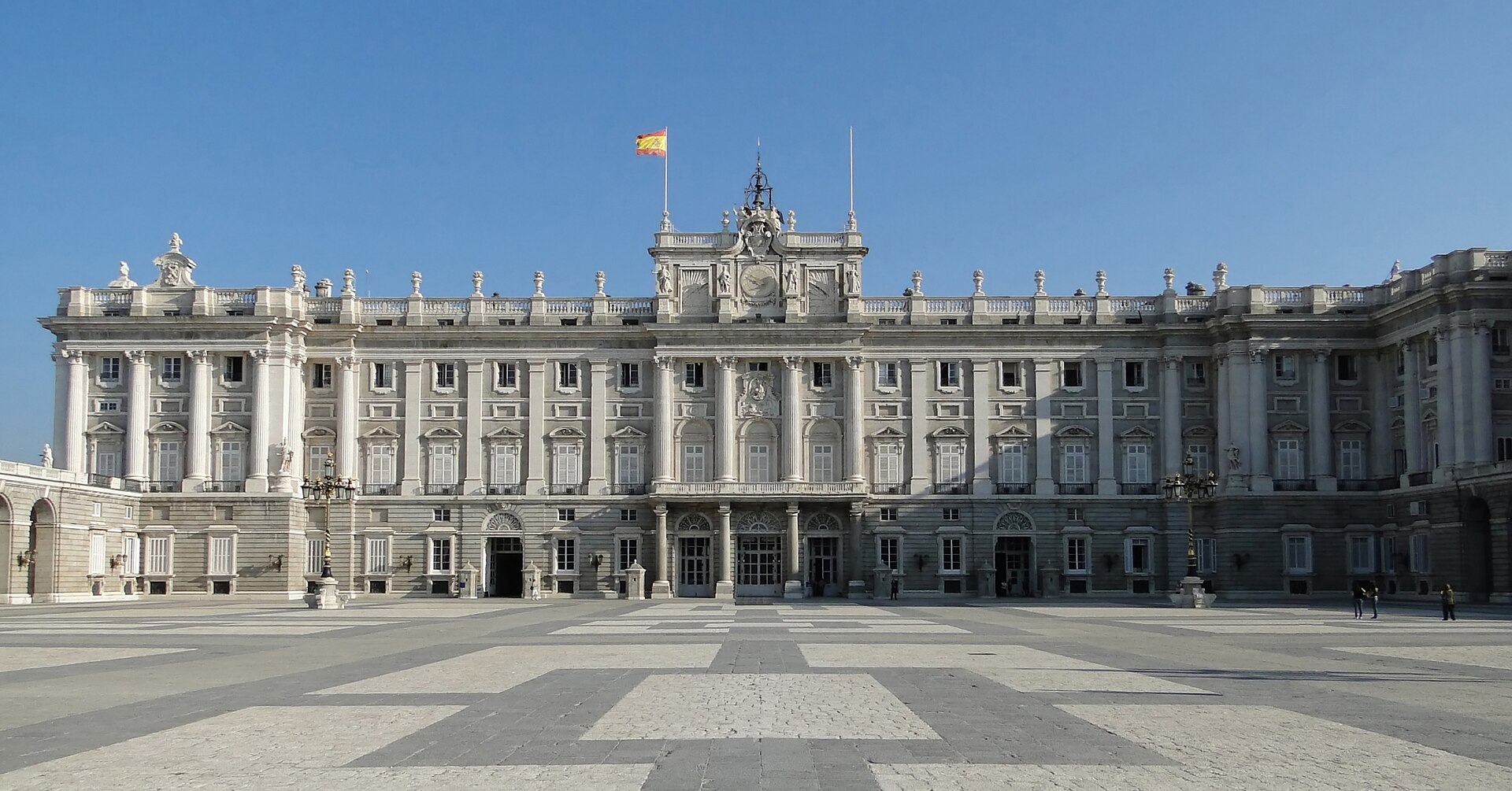
The Royal Palace of Madrid (Palacio Real de Madrid) is the official residence of the Spanish monarchy, built on the site of a former Muslim fortress and completed in the 18th century. It is not the King’s home — that is elsewhere — but a state building open to the public, holding the State Rooms, the Royal Armoury, the Royal Pharmacy and a working royal collection.
Where does the palace stand, and what did it replace?
The palace occupies the western edge of Madrid’s historic centre, on a rise above the Manzanares valley, at the site once held by the Alcázar of Madrid — a medieval Muslim fortress later used as a royal residence by the Habsburg kings. The Alcázar burned down in a fire in 1734, and the current palace was built on its footprint and foundations.
The location places it at the western end of a chain of central landmarks. From Puerta del Sol, the square marking Madrid’s kilometre zero, it is a walk of roughly fifteen to twenty minutes west through the old city, passing close to Plaza Mayor, the arcaded square built for markets, bullfights and royal ceremony under the Habsburgs.
Who designed it, and when was it built?
Construction began in 1738 under King Philip V, the first Bourbon monarch of Spain, who commissioned an Italian architect, Filippo Juvarra, to design a palace on a scale to rival Versailles. Juvarra died before work began in earnest, and the project passed to Giovanni Battista Sacchetti, who scaled down the original plan into the building that stands today. It was largely finished under Charles III, who moved in during the 1760s, and successive monarchs continued to shape its interiors well into the 19th century.
The result is a large, austere granite-and-stone block arranged around a central courtyard, closer in style to Italian Baroque civic architecture than to the ornamented French palaces it was meant to answer. The building’s scale — reportedly among the largest functioning royal palaces in Europe by floor area — owes more to Sacchetti’s revised plan than to Juvarra’s original ambition.
Is it still used by the royal family?
The Royal Palace is the official seat of the Spanish Crown and is used for state ceremonies, the reception of foreign heads of state, and formal royal functions, but it is not where the royal family lives day to day. The current monarch and his family reside at the Palacio de la Zarzuela, on the northwestern outskirts of the city, a considerably smaller residence.
This division — a working ceremonial palace open to visitors, and a private residence that is not — is why the Royal Palace can operate as a public monument for most of the year while remaining, on paper, an active seat of the Crown. Patrimonio Nacional, the state body that manages Spain’s royal heritage sites, administers the building and periodically closes rooms or the entire palace for state functions.
Which rooms can visitors actually enter?
The standard visit covers the State Rooms (Salones de Representación) — the sequence of reception and ceremonial halls used for official functions — along with the Royal Pharmacy, the Royal Kitchens in some visiting arrangements, and the Royal Armoury as a separate but adjoining collection. The private apartments used by earlier monarchs are shown as historic interiors, not as a residence in current use.
- The Throne Room, with its red velvet walls and ceiling fresco attributed to Giovanni Battista Tiepolo.
- The Gasparini Room, an 18th-century dressing room with elaborate stucco and silk decoration, one of the few interiors to survive largely unaltered since Charles III’s reign.
- The Porcelain Room, lined with porcelain plaques produced at the royal factory of the Buen Retiro.
- The Royal Chapel, used for religious ceremonies connected to the Crown.
- The Grand Staircase, built in marble and regarded as one of the architectural set-pieces of the visit.
Access to specific rooms varies by ticket type and by what Patrimonio Nacional has open on a given day; state functions can close individual rooms or the whole palace with little public notice, so any visit plan should be checked against the operator’s own site close to the date.

What does the palace’s collection actually hold?
Beyond the architecture, the Royal Palace functions as a museum of royal decorative arts, built up over three centuries rather than assembled for display. Its holdings include paintings by Diego Velázquez, Francisco de Goya and Caravaggio, alongside furniture, clocks, tapestries and silverware acquired or commissioned by successive Bourbon monarchs.
A number of the tapestries on display were produced at the Real Fábrica de Tapices, Madrid’s royal tapestry works, which still operates and which is explained separately on this site. The palace’s Stradivarius string instruments — a rare surviving set commissioned for the Spanish court — are also part of the collection, along with a working Royal Pharmacy that preserves 18th- and 19th-century apothecary equipment.
What is the Royal Armoury, and is it included?
The Real Armería is the Crown’s historic collection of arms and armour, housed in its own wing adjoining the main palace building. It holds ceremonial and battlefield armour belonging to Spanish monarchs from the 16th century onward, including pieces associated with Charles V and Philip II, along with swords, firearms and equestrian equipment.
It is typically covered by the same entry ticket as the State Rooms rather than requiring separate admission, though this has changed over time, so the current arrangement should be confirmed against Patrimonio Nacional’s own information before a visit.
Are the gardens and outdoor areas open too?
Yes. The Sabatini Gardens run along the palace’s northern side and are a public park managed independently of the palace ticket, generally open without charge during daylight hours. The Campo del Moro, a larger landscaped garden below the palace’s western facade, is also open to the public, though on separate hours from the palace itself and sometimes closed for maintenance.
Plaza de Oriente, the formal square on the palace’s eastern side, sits between the building and the Teatro Real, Madrid’s opera house, and is freely accessible at all times as a city square rather than a ticketed site.
How does the palace fit with the landmarks around it?
The Royal Palace anchors a cluster of monuments that together define Madrid’s old royal quarter. The Catedral de la Almudena stands immediately south of the palace and is generally the newest major building in the group, consecrated only in the 20th century despite the medieval site it occupies. The Teatro Real faces the palace across Plaza de Oriente. Further east, Plaza Mayor and Puerta del Sol mark the transition from royal Madrid into the dense commercial streets of the historic centre.
Readers assembling a fuller picture of the city’s monuments and museums can work outward from this cluster using the site’s Landmarks & Sights archive and Museums & Galleries archive, which cover the individual buildings and collections in the surrounding streets in more depth.
What should visitors know about hours, tickets and free entry?
The Royal Palace is managed by Patrimonio Nacional rather than by Spain’s national museum network, so it sits outside the free-entry schedules that apply to state museums such as the Prado or Reina Sofía — a system explained on this site’s page on how Madrid’s national museum free-entry windows work. Patrimonio Nacional does, however, publish its own reduced-price and free-admission conditions, including specific groups and periods, on its official site, and these should be checked there directly rather than assumed from other museums’ rules.
The palace’s closing pattern also differs from the citywide habit, discussed on this site’s page on why so many Madrid museums close on Mondays, of shutting national collections early in the week. The Royal Palace generally follows its own calendar, tied to the ceremonial functions it still performs, and can close for state visits with little advance warning. Current hours, prices and any closures should always be confirmed on Patrimonio Nacional’s own website before planning a visit, and travellers should also consult their own government’s official travel advice for Spain for anything beyond opening times.
Access Madrid is an independent guide written from published, checkable sources. We have not visited the places described here and we do not publish personal recommendations or invented ‘local favourites’ — where something is singled out as notable, we say who says so. Opening times, fares, closures and prices change at short notice, so treat everything here as a starting point and confirm with the museum, operator or venue directly before building a day around it. We give no advice on visas, insurance, health or safety; use your own government’s official guidance for those.
Featured image: Photo by kallerna, source, CC BY-SA 4.0
