The Museo del Prado holds Spain’s national collection of European painting from roughly the twelfth to the early twentieth century, built largely from the former royal collection. It contains around 7,600 paintings, plus sculpture, drawings, prints and decorative arts, arranged mainly by national school and period across two main floors of a nineteenth-century building on the Paseo del Prado.
What is actually in the Museo del Prado?
The core of the collection is Spanish, Italian and Flemish painting assembled by the Spanish Crown over three centuries, then nationalised and opened to the public in 1819. According to the museum’s own figures, published on its website, the holdings run to roughly 7,600 paintings — of which only a fraction, around 1,700, are on permanent display at any time — alongside about 1,000 sculptures, several thousand drawings and prints, and smaller groups of decorative art, coins and medals, and historical documents.
This is not a general encyclopaedic museum. It has almost no ancient art, very little from outside Europe, and nothing modern in the sense of twentieth-century abstraction — that material sits across the city at the Museo Nacional Centro de Arte Reina Sofía. The Prado’s boundary is, broadly, European painting up to around 1900, weighted heavily toward what the Spanish court owned or acquired.
How is the collection arranged inside the building?
The paintings are grouped by national school — Spanish, Italian, Flemish and Dutch, French, German — and then, within each school, roughly by century or by artist. This is the organising logic the museum itself uses in its floor plans and room-by-room catalogue, available on its official site.
The layout is not a single chronological walk from entrance to exit. The ground floor concentrates on Spanish painting from the medieval and early modern periods, Flemish and Netherlandish works including Bosch, and early Italian painting. The first floor holds the bulk of Spanish Golden Age painting — Velázquez, Zurbarán, Ribera — alongside the Prado’s large Titian and Venetian holdings, Rubens, and the museum’s extensive Goya rooms, which span his career from court portraiture to the late, darker work. Because rooms are added and reorganised periodically, the museum’s own current floor plan, updated online, is the only reliable guide to where a specific room sits at any given visit.
Which artists define the Prado’s reputation?
Three names anchor the collection in most published accounts of it: Diego Velázquez, Francisco de Goya, and the Prado’s Flemish and Italian holdings assembled by the Habsburg and Bourbon courts.
- Velázquez — the museum holds the largest single collection of his work, including Las Meninas, which the Prado’s own materials describe as the painting most consistently associated with the institution.
- Goya — the Prado holds the largest and most complete collection of his paintings anywhere, spanning royal portraits, the Majas, the war scenes including The Third of May 1808, and the so-called Black Paintings, transferred from the walls of his own house.
- Hieronymus Bosch — the museum holds several of his major panels, most notably The Garden of Earthly Delights, which entered the Spanish royal collection in the sixteenth century.
- Titian, Rubens and El Greco — the Italian and Flemish rooms, and the Prado’s El Greco holdings, reflect what the Spanish court specifically bought and commissioned, rather than a survey built for comprehensiveness.
This weighting — deep in a handful of artists the Crown patronised, thinner elsewhere — is a direct consequence of the collection’s origin, and it’s worth reading the museum’s own catalogue notes on provenance for any single work, since many pieces arrived through specific royal commissions or diplomatic gifts rather than open acquisition.
What else does the Prado hold besides paintings?
Beyond the paintings, the Prado’s stated holdings include sculpture — mostly classical and Renaissance pieces that entered the royal collection alongside paintings — a large works-on-paper collection of drawings and prints that is shown in rotating temporary displays rather than permanently hung, and a smaller decorative arts collection covering furniture, tapestries and precious objects tied to specific rooms or historical commissions.
There is also a dedicated space for the Cabinet of Drawings and Prints, and the museum periodically mounts temporary exhibitions drawing on loans from other institutions, which sit outside the permanent-collection numbering and change on their own schedule — current details are listed on the museum’s own site rather than reproduced here, since they change frequently.
How does the building itself shape what’s on view?
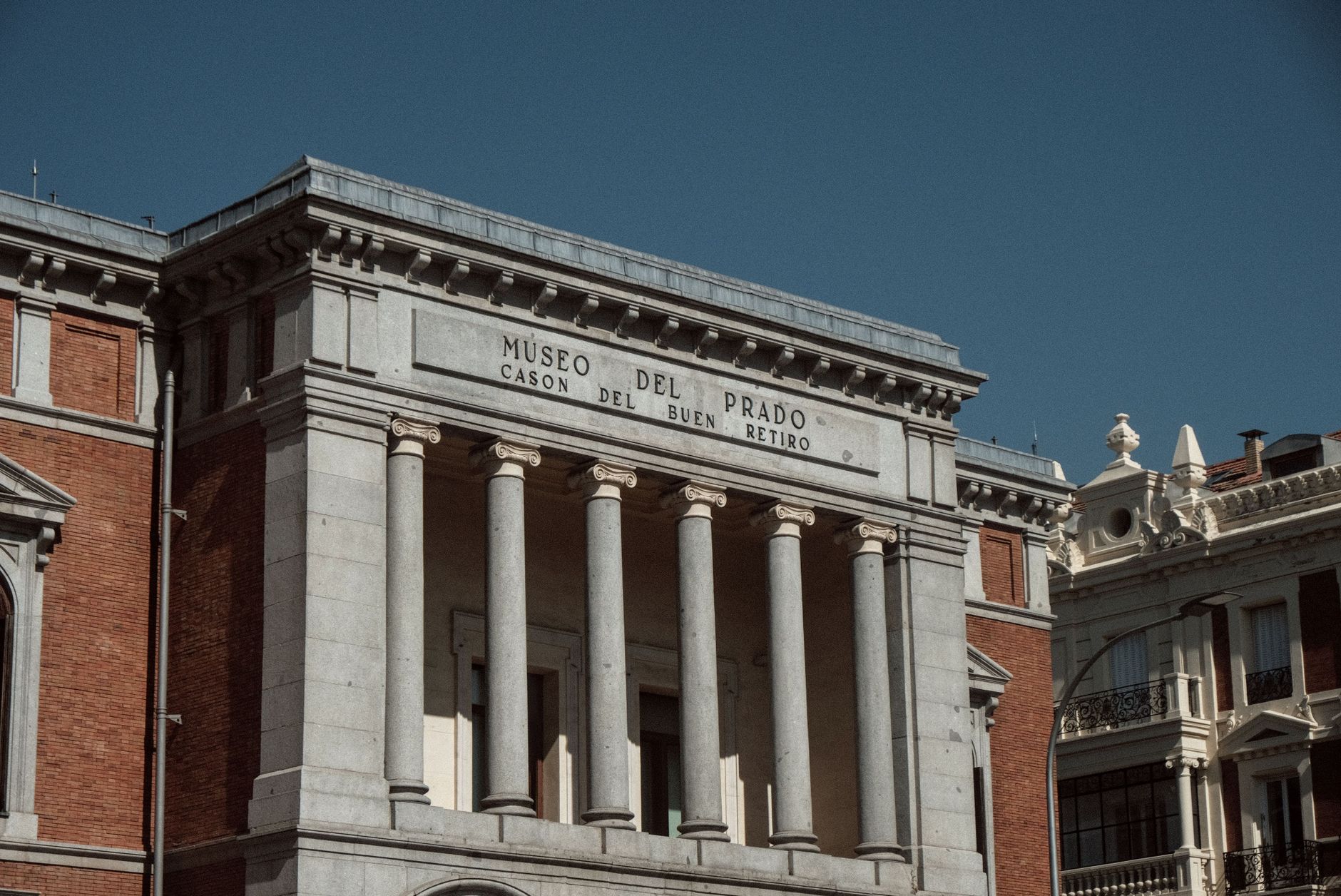
The main building was designed by the neoclassical architect Juan de Villanueva in the late eighteenth century, originally intended as a natural history cabinet, and repurposed as the Royal Museum of Paintings and Sculptures when it opened to the public in 1819. Its long, relatively narrow floor plan — a central block with two wings — still shapes how the collection is routed today, with the schools distributed across those wings rather than in a single loop.
In 2007 the museum opened an extension designed by the architect Rafael Moneo, built around the cloister of the former Jerónimos monastery adjoining the site. This addition, generally referred to as the Moneo extension or the Jerónimos building, added exhibition space, conservation facilities and public areas without altering the historic Villanueva building itself, and it is where many of the Prado’s temporary exhibitions are now held.
Because the collection has outgrown the original nineteenth-century rooms several times over, some works rotate in and out of display, and specific room numbers shift periodically as curators reorganise a school or period. Anyone planning a visit around a specific painting should check the museum’s own online room finder rather than relying on an older printed plan.
Is the Prado free to enter, and when?
The Prado, like most Spanish state museums, offers a window of free general admission on certain days or hours, alongside paid entry at other times; the exact hours and any exceptions are set and changed by the museum itself. For current hours, prices and any free periods, the museum’s official website is the only source that should be treated as current, since museum pricing and free-admission windows are revised periodically.
The Prado is also included in some multi-museum passes covering several of Madrid’s major institutions; details of what such passes include, and their current cost, are set by the issuing body and are again best confirmed directly rather than assumed from older listings.
How does the Prado fit with Madrid’s other major museums?
The Prado sits at one point of what is informally known in Madrid as the Golden Triangle of Art, alongside the Museo Thyssen-Bornemisza and the Reina Sofía, all within easy walking distance of one another along or near the Paseo del Prado. The three collections are complementary rather than overlapping: the Thyssen-Bornemisza fills gaps the Prado’s royal-collection origins left open, including Impressionism and early modern movements, while the Reina Sofía covers twentieth-century Spanish art, including Picasso’s Guernica, which falls entirely outside the Prado’s historical range.
Understood together, the three museums roughly cover European painting from the medieval period to the present, with the Prado holding the deepest and oldest portion of that span. Anyone building a first visit to Madrid’s museum district benefits from treating them as one continuous story rather than three separate errands — a framing worth setting up before arrival, alongside wider practical planning notes for a first visit to Madrid.
For residents, the more useful fact is that the Prado’s collection is largely static in its major holdings but constantly rotating in its secondary rooms, drawings and temporary shows — meaning a museum visited once as a tourist and again a year later as a resident is genuinely not showing quite the same thing, a pattern worth checking against Access Madrid’s broader guide to how the city’s museum calendar works and against the museum’s own published exhibition schedule.
Those weighing the Prado against Madrid’s wider museum landscape — including smaller, specialist collections — may also find it useful to read Access Madrid’s overview of how the city’s major museums are organised, and to cross-check any visit against general notes on getting around central Madrid, since the Paseo del Arte cluster is served by several metro and bus lines rather than a single station.
Access Madrid is an independent guide written from published, checkable sources. We have not visited the places described here and we do not publish personal recommendations or invented ‘local favourites’ — where something is singled out as notable, we say who says so. Opening times, fares, closures and prices change at short notice, so treat everything here as a starting point and confirm with the museum, operator or venue directly before building a day around it. We give no advice on visas, insurance, health or safety; use your own government’s official guidance for those.
Related reading
Living in Madrid, Madrid, Practically, What Is the Museo del Romanticismo in Madrid?, What Is the Museo Nacional de Ciencias Naturales?, What Is the Museo Naval de Madrid? A Guide to the Navy’s Museum, Prado, Reina Sofia, Thyssen: Free Entry or the Paseo del Arte Card?