A Monday in Madrid means most municipal and several national museums are shut, but it does not mean the city closes. Palaces, churches, markets, parks and two of the three “golden triangle” galleries stay open. The day works best if it is built around monuments, districts and open-air Madrid rather than around a museum list.
What actually closes in Madrid on a Monday?
Monday closure is a long-standing convention among Spain’s state and municipal museums, and Madrid’s smaller and mid-sized collections mostly follow it. Museo Arqueológico Nacional, Museo Cerralbo, Museo del Romanticismo, Museo Sorolla, Museo del Traje, Museo Naval and Museo Lázaro Galdiano are all typically closed on Mondays. The city has written up the pattern and its history in more depth, including why it became standard practice, in an explainer on why Madrid museums close on Mondays.
The pattern is not universal, and this matters for the “golden triangle” of art museums along the Paseo del Prado. The Museo del Prado, by its own published calendar, opens every day of the year with only a handful of exceptions, so it does not close on Mondays at all. The Museo Reina Sofía, home to Picasso’s Guernica, closes instead on Tuesdays. The Thyssen-Bornemisza does close on Mondays. That means two-thirds of the golden triangle is reachable on a Monday — see the separate pieces on what the Prado’s collection actually holds and what the Reina Sofía collection is built around, plus the wider context in the golden triangle overview.
Always confirm on the institution’s own site before travelling, since holidays and seasonal calendars shift these patterns; the public holidays guide covers the dates that additionally close things across the city, and the opening hours guide sets out the general rhythm of the working week.
What can you see instead — landmarks that don’t run on museum hours?
Madrid’s major monuments largely operate on their own schedules, independent of the municipal museum calendar, because most are religious sites, royal property, or civic monuments rather than museums in the administrative sense.
- The Royal Palace is the official residence of the Spanish monarchy, used for state ceremonies, and it keeps a daily visiting schedule.
- The Almudena Cathedral, standing beside the palace, is a working cathedral with its own hours, largely unaffected by museum closures.
- The Templo de Debod, a 2nd-century BC Egyptian temple gifted to Spain and re-erected near Plaza de España, sits in open parkland and can be viewed at any time; its interior chamber has separate opening hours.
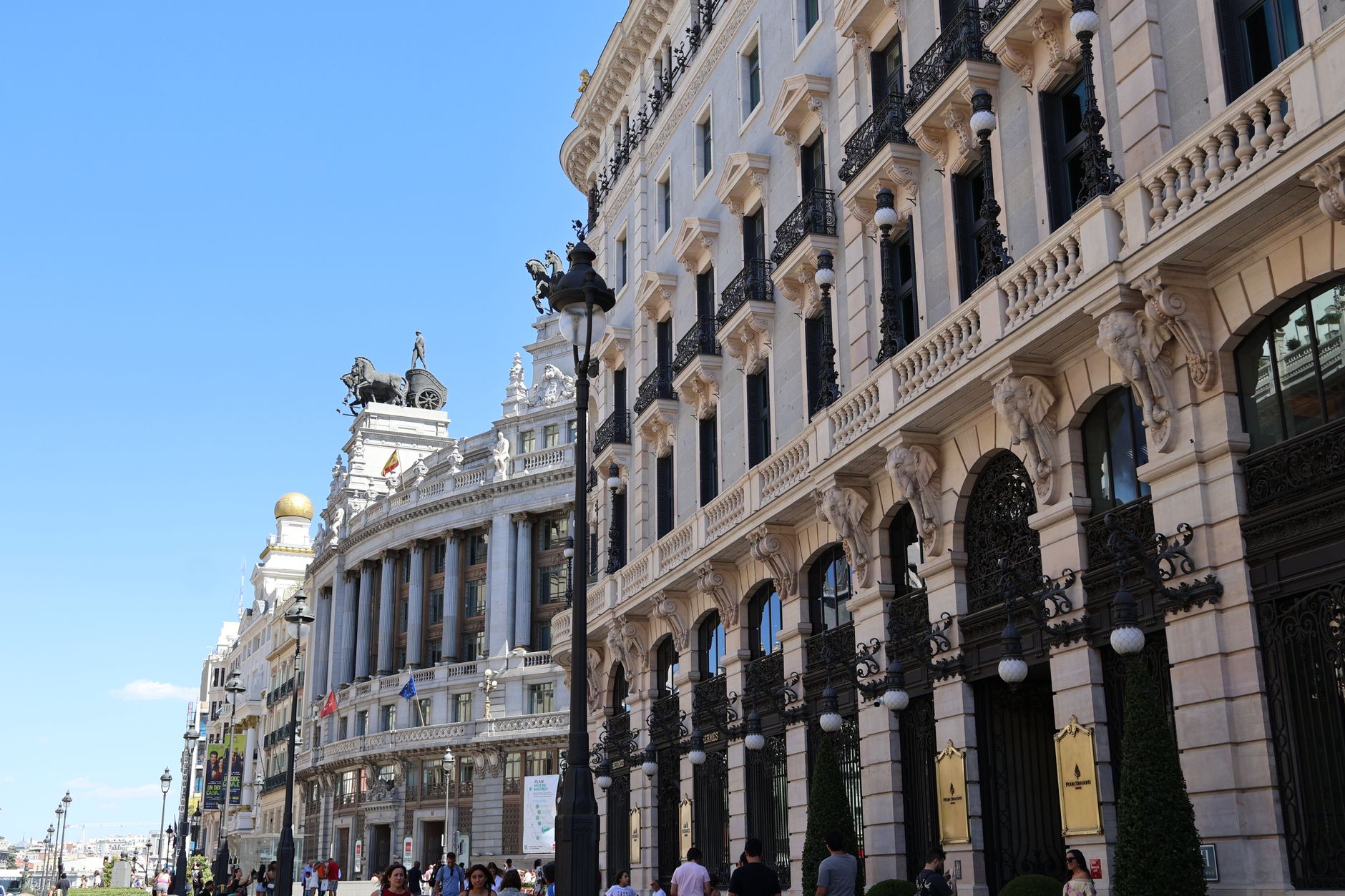
- Plazas, squares and streets covered in the landmarks and sights archive — Plaza Mayor, Puerta del Sol, the Gran Vía — are public space, open every day of the year by definition.
This is the practical logic of a Madrid Monday: monuments and public architecture fill the gap left by closed galleries.
What about Madrid’s parks and outdoor space?
Public parks in Madrid have no weekly closing day, which makes them one of the most reliable Monday options in the city.
Retiro, the former royal park now run by the city council, includes the Palacio de Cristal, an iron-and-glass exhibition pavilion built in 1887 that regularly hosts contemporary art shows organised by the Reina Sofía. The pavilion’s own exhibition hours can differ from the museum’s main calendar, and the surrounding park is open daily regardless. The park sits inside the wider Retiro district, covered in a separate piece on what the Retiro district is beyond the park itself, and the pavilion is detailed in an explainer on the Palacio de Cristal.
Madrid Río, the linear park built over the culverted Manzanares, and the district it runs through, are covered in the guide to Arganzuela and Madrid Río. Neither the riverside walkways nor the district’s public space observe a museum calendar.
What can you do with Madrid’s markets and neighbourhoods?
Food markets are commercial operations, not museums, and most trade through the week on their own hours, though a specific market’s exact schedule should be checked directly since retail hours are far more variable than a national museum’s published calendar. The food and markets archive covers Madrid’s principal market halls and what each one is built around.
Neighbourhoods themselves don’t close. Madrid de los Austrias, the dense core of narrow streets laid down under the Habsburg monarchs, and La Latina, the district immediately south of it known for its concentration of tapas bars, both function as they do on any other weekday — see what Madrid de los Austrias actually is and the La Latina district explained. Walking a district properly, rather than chasing a single sight, is arguably the best use of a day when the museum option is reduced; the neighbourhoods archive profiles the districts individually, and the guide to how Madrid divides into districts and barrios explains the administrative structure behind them.
Is Monday a good day for a resident to run errands, or for a visitor to travel?
For residents, Monday functions as an ordinary working and administrative day in Madrid — banks, offices, pharmacies and most shops run standard weekday hours, unaffected by museum closures. The distinction matters because visitors sometimes assume a citywide Monday slowdown that does not, in practice, exist outside the museum sector. The living in Madrid hub and its archive cover how the week actually structures daily life here, including which closures are real citywide patterns and which are specific to cultural institutions.
For visitors on a tight itinerary, Monday is often the sensible day to leave Madrid for a few hours rather than to force a museum-heavy schedule. High-speed rail from Madrid’s main stations reaches Toledo, Segovia and other cities within an hour or so; the mechanics of this are set out in the guide to reaching other Spanish cities by train and the explainer on Madrid’s main railway stations. A day trip sidesteps the closure question entirely rather than working around it.
How do you actually structure a Monday in Madrid?
A workable Monday tends to combine one open monument, one stretch of outdoor Madrid, and one district walked properly, rather than trying to substitute closed museums with a longer list of smaller sights.
- Morning: a monument with fixed opening hours independent of the museum calendar — the Royal Palace, the Almudena Cathedral, or the Templo de Debod.
- Midday: the Prado, which the museum’s own calendar keeps open on Mondays, or the Reina Sofía if the visit falls on a day other than Tuesday.
- Afternoon: Retiro park and the Palacio de Cristal, or a walk through Madrid de los Austrias and La Latina.
This is broadly the same logic used to plan around wet weather or extreme heat, when indoor options also narrow: see how to plan a Madrid day when it rains and how to plan a Madrid day in serious heat. The practical planning hub and the itineraries and day plans archive set out equivalent structures for other constrained days, and the guide to what’s reasonable in a single day is useful for calibrating how much a Monday schedule like this can realistically cover.
What’s the single most useful thing to know about a Madrid Monday?
The closures are real but narrower than they first appear: most small and mid-sized state museums shut, the Prado does not, the Reina Sofía closes on Tuesday instead, and nothing about the city’s monuments, parks or markets is affected at all.
Treat Monday as a monuments-and-outdoors day with one major gallery folded in, rather than as a day with nothing to do. The Madrid guide hub and the museums and galleries archive are the places to check a specific institution’s current calendar before building a day plan around it, since any individual museum’s hours can change with the season or a public holiday.
Access Madrid is an independent guide written from published, checkable sources. We have not visited the places described here and we do not publish personal recommendations or invented ‘local favourites’ — where something is singled out as notable, we say who says so. Opening times, fares, closures and prices change at short notice, so treat everything here as a starting point and confirm with the museum, operator or venue directly before building a day around it. We give no advice on visas, insurance, health or safety; use your own government’s official guidance for those.
Related reading
Prado, Reina Sofia, Thyssen: Free Entry or the Paseo del Arte Card?, Left Luggage in Madrid: The Stations Don’t Store Bags