Some links on this page are affiliate links. If you book through one, this site may earn a commission at no extra cost to you. It never changes which option we recommend, and the prices below are the same either way.
Most long-distance trains out of Madrid leave from one of two stations — Atocha, for the south and east, and Chamartín, for the north and northwest — using Spain’s high-speed AVE network. Journeys to Barcelona, Sevilla, Valencia, Málaga and Zaragoza typically run under three hours. Tickets are bought through the operator’s own site, not at a generic booking counter.
Which Madrid station do you leave from?
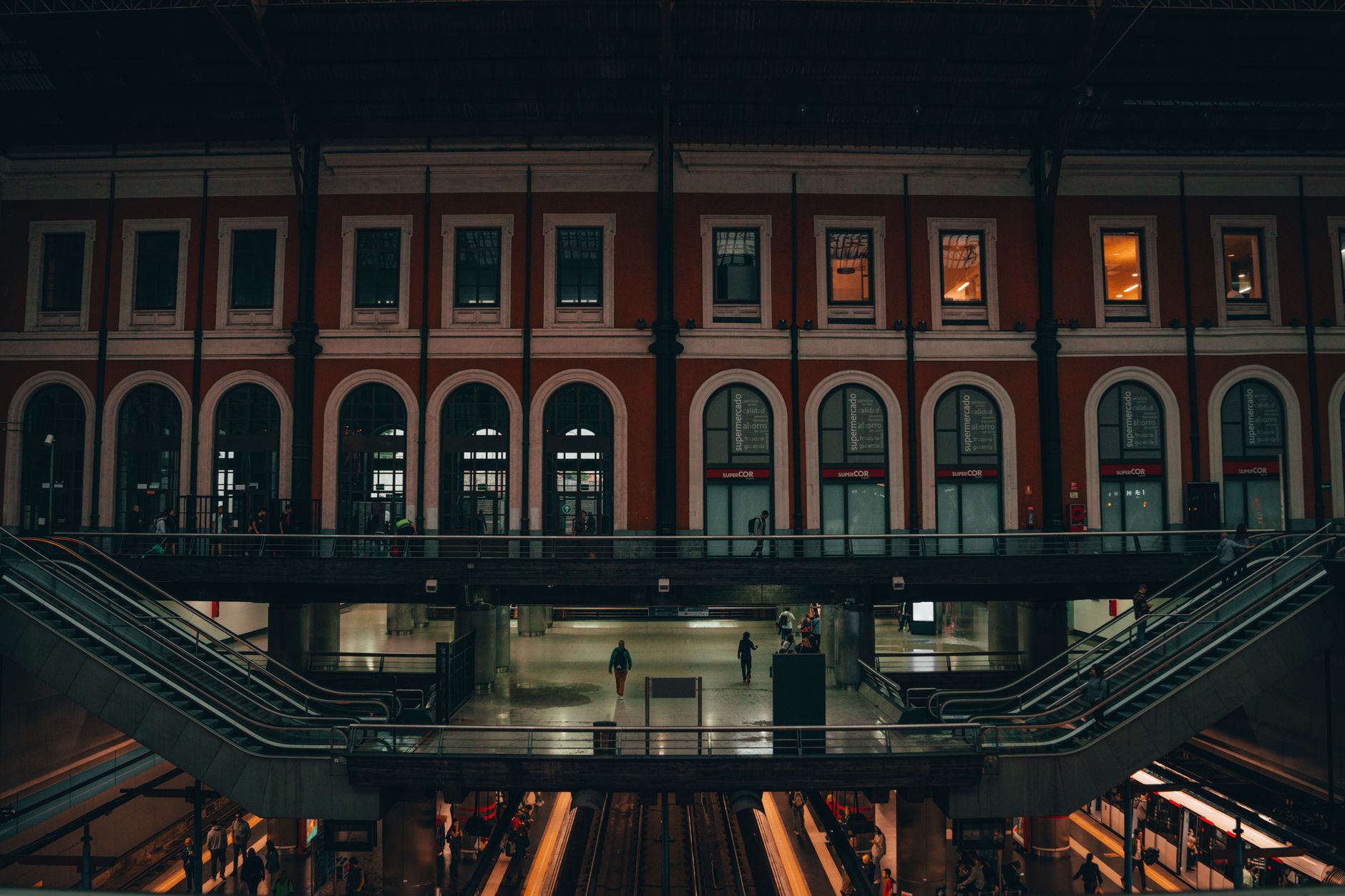
It depends on the direction of travel, and getting this wrong is the single most common mistake visitors make. Madrid Puerta de Atocha handles trains heading south and east — Sevilla, Córdoba, Málaga, Valencia, Alicante, Barcelona. Madrid Chamartín-Clara Campoamor handles the north and northwest — Valladolid, León, Santander, Galicia, the Basque Country and France. A detailed breakdown of what each station serves, including which is closer to which metro and Cercanías lines, is covered in Madrid’s main railway stations explained. Some long-distance services also call at Chamartín en route to or from Atocha, so it is worth checking the specific train, not just the destination city, before assuming which station applies.
What is the AVE, and which cities does it reach?
AVE (Alta Velocidad Española) is Spain’s high-speed rail brand, built on dedicated track separate from conventional lines, and it is the reason Madrid functions as the hub of the national network. Renfe, the state rail operator, runs AVE services on lines radiating from Madrid in a rough star pattern:
- Southeast to Toledo — one of the shortest AVE runs in the country, and often quicker than the road distance suggests.
- South to Córdoba, Sevilla, and onward regional connections into Andalusia.
- East to Cuenca, Valencia and Alicante.
- Northeast to Zaragoza and Barcelona, a corridor that also connects onward toward France.
- West and northwest to Valladolid, and from there toward León, Asturias and Galicia.
- South to Málaga via a branch off the Córdoba line.
Journey times matter more than distance here, because the whole point of the network is that it collapses geography. Madrid to Sevilla or Barcelona is generally under three hours by AVE; Madrid to Valencia is under two. These are the figures Renfe publishes on its own timetable pages and they should be checked there directly, since exact scheduled times vary by service.
Is Renfe the only operator, or are there alternatives?
Spain liberalised its high-speed rail market in 2021, and Madrid’s main long-distance corridors now have more than one operator running trains on the same infrastructure. Renfe remains the largest, and also runs a lower-cost high-speed brand called Avlo on some routes. Alongside it, two competitors now operate their own AVE-standard services out of Madrid:
- Ouigo, a French-owned low-cost high-speed operator, running from Madrid to Barcelona, Valencia, Alicante, Sevilla and other cities.
- Iryo, a joint venture including Trenitalia, running comparable routes with its own fare structure and branding.
For a reader planning a trip, this matters practically: prices and schedules are not uniform across a single national timetable the way they might be assumed to be. It is worth comparing the three operators’ own sites — renfe.com, ouigo.com and iryo.eu — for the same route and date, since fares can differ substantially between them for an identical journey.
What about medium-distance and regional trains?
Not every worthwhile destination is a major city reached by AVE. Renfe also runs Media Distancia (medium-distance) and Avant services, which use a mix of conventional and high-speed track to connect Madrid with closer towns and secondary cities — places like Segovia, Guadalajara, Ávila, Aranjuez and Ciudad Real. These trains are generally cheaper than full AVE fares, run more frequently across the day, and do not require the same advance booking discipline that long-distance high-speed travel rewards.
This is a genuinely useful distinction for residents as much as visitors: a day trip to Segovia or Toledo is a different kind of journey — shorter, cheaper, less scheduled — than a trip to Barcelona or Sevilla, even though both might be booked through the same Renfe interface.
How far in advance should tickets be bought?
Fares on Spanish high-speed rail are generally structured like airline pricing rather than a fixed walk-up price: cheaper fare classes sell out first, and the same route can cost markedly more booked the day before than booked weeks ahead. This is standard across Renfe, Ouigo and Iryo, and none of it is a fixed number this article can responsibly quote, since it changes by route, season and demand. The reliable pattern is that early booking tends to be cheaper, and that popular routes — Madrid–Barcelona especially — see fares rise fastest as departure approaches. Each operator’s own site is the only accurate source for a live fare on a specific date.
Fare classes typically bundle in different levels of flexibility, luggage allowance and seat selection, similar to budget airline tiers. Reading the fare conditions on the booking page before paying is worth the extra few minutes, since the cheapest fare is often non-refundable or non-changeable.
How do you actually get to Atocha or Chamartín?
Both stations sit on Madrid’s metro network and on Cercanías, the regional commuter rail system, which makes them straightforward to reach from most parts of the city without a taxi. Atocha is served by Line 1 of the metro and sits at the southern end of several Cercanías lines; it is also within reach of the Retiro district on foot, an area covered in what the Retiro district is, beyond the park. Chamartín has its own metro station on Lines 1 and 10 and is a major Cercanías interchange in the north of the city.
For a traveller arriving with luggage, or making a tight connection, taxis and ride-hailing remain a reasonable option, and how that market works in Madrid — official taxis versus app-based services, fare structures and where to find a rank — is set out in how taxis and ride-hailing work in Madrid. Anyone arriving into the city first via Barajas airport should also check how to get from Barajas airport into central Madrid, since the airport and the two main rail stations are separate journeys requiring their own planning.
If the train leaves hours after you check out, the stations are not the place to leave a bag for the afternoon — left luggage in Madrid explains why. Booking networks such as Radical Storage list shops and hotels around Atocha that hold luggage.
The broader distinction between Cercanías and the metro — which is faster for which kind of trip, and how the fare systems differ — is explained in full in what Cercanías is, and when it beats the metro. The wider Getting Around section covers the rest of Madrid’s transport network, including the metro fare structure and the travel cards residents use over a full year.
What if the destination isn’t on the high-speed network?
Spain’s rail network, however extensive, does not reach every town, and some smaller destinations are better served by intercity coach than by train. Where that is the case, it is generally faster and cheaper to check long-distance bus operators directly rather than assume a rail connection exists. For most major and mid-sized Spanish cities, though — the ones a visitor or new resident is most likely to want — Madrid’s dual-hub rail system means there usually is a direct train, and the main decision is which operator and which fare class to book, not whether the journey is possible at all.
A practical note on planning around Madrid itself
Because Atocha and Chamartín sit in different parts of the city, it is worth deciding a return station in advance if the trip involves changing plans mid-visit — a train that departed from Atocha does not necessarily return to Atocha. For visitors combining a rail trip with time in Madrid itself, the Neighbourhoods archive and Landmarks & Sights archive cover what sits around each station and across the wider city, useful for deciding how to structure a day either side of a train journey.
Access Madrid is an independent guide written from published, checkable sources. We have not visited the places described here and we do not publish personal recommendations or invented ‘local favourites’ — where something is singled out as notable, we say who says so. Opening times, fares, closures and prices change at short notice, so treat everything here as a starting point and confirm with the museum, operator or venue directly before building a day around it. We give no advice on visas, insurance, health or safety; use your own government’s official guidance for those.