The Palacio de Liria is the Madrid residence of the House of Alba, a Spanish noble family, and it still functions as one. It is not a converted museum. It opened to paying visitors only in 2019, on a limited, ticketed basis, and the collection inside spans Goya, Titian, Rubens, Rembrandt, and a private archive that includes a letter connected to Columbus’s first voyage.
What is the Palacio de Liria?
It is an 18th-century neoclassical palace built for the 3rd Duke of Berwick and Liria, completed in the 1780s. The architect was Ventura Rodríguez, among Madrid’s leading builders of that era. The palace sits west of the center, near Plaza de España, in the Moncloa-Aravaca area — a district covered in more detail on our guide to Moncloa-Aravaca.
It was badly damaged during the Spanish Civil War, when a fire in 1936 destroyed part of the structure and threatened the art inside. Much of the collection had already been moved for safekeeping, and the building was restored afterward. The Alba family returned, and still lives in part of it today.
Who owns it, and why can you visit now?
The palace belongs to the Fundación Casa de Alba, which manages the family’s properties and holdings. For most of the 20th century it stayed closed to the public, accessible only by private invitation.
That changed in 2019, when the foundation opened a portion of the palace on a paid, timed-entry basis. The shift reflects a broader pattern among Spain’s historic private estates: opening selectively, under controlled conditions, rather than becoming a full public museum. The family’s private quarters remain off-limits. Visitors see reception rooms, galleries, and a library wing — not the whole building.
What does the Alba collection actually contain?
It is one of the largest privately held art collections in Europe. The best-known piece is Goya’s 1795 portrait of the 13th Duchess of Alba, a full-length work showing her in a white dress — not the 1797 “Black Duchess” that hangs in the Hispanic Society in New York. The two are often confused.
Beyond Goya, the painting collection includes:
- Titian’s portraits of Spanish Habsburg sitters
- Works by Rubens and his workshop
- A Rembrandt
- Fra Angelico and other early Italian religious panels
- Zurbarán and other Spanish Golden Age painters
The palace also holds a family archive — manuscripts, letters, and historical documents — separate from the paintings. It includes a copy of a letter connected to Columbus and medieval illuminated texts. The foundation describes the archive as one of the largest private document collections in Spain. This is a claim worth attributing directly to the foundation rather than treating as independently verified, since no outside body audits a private archive the way a national library does.
How do you actually book a ticket, and what does it cost?
This is the part that determines whether a visit is realistic, and it is where most guides stop short.
Tickets go live on the palace’s own booking site roughly two to three months ahead of the visit date. They are not released a year out, and they are not available at the door. Weekend slots, especially Saturdays, tend to sell out within days of release. Weekday mornings hold availability longer.
There are two ticket tiers:
- Self-guided (individual) visit — you move through the open rooms at your own pace, with information panels and an included audio guide. This is the cheaper tier.
- Guided tour — a staff-led group walkthrough, priced higher, with access to some additional context and occasionally a few extra spaces.
As a rough order of magnitude, self-guided entry has run in the mid-teens of euros per adult, with guided tours priced noticeably above that — often around a third to a half more. Treat those figures as indicative only. The palace’s own ticketing site is the only reliable source for current prices, and it should be checked before planning around any number printed elsewhere, including this one.

Which rooms and pieces are reliably on view?
Short answer: most of the headline paintings, but not a guarantee on every single one, every single week.
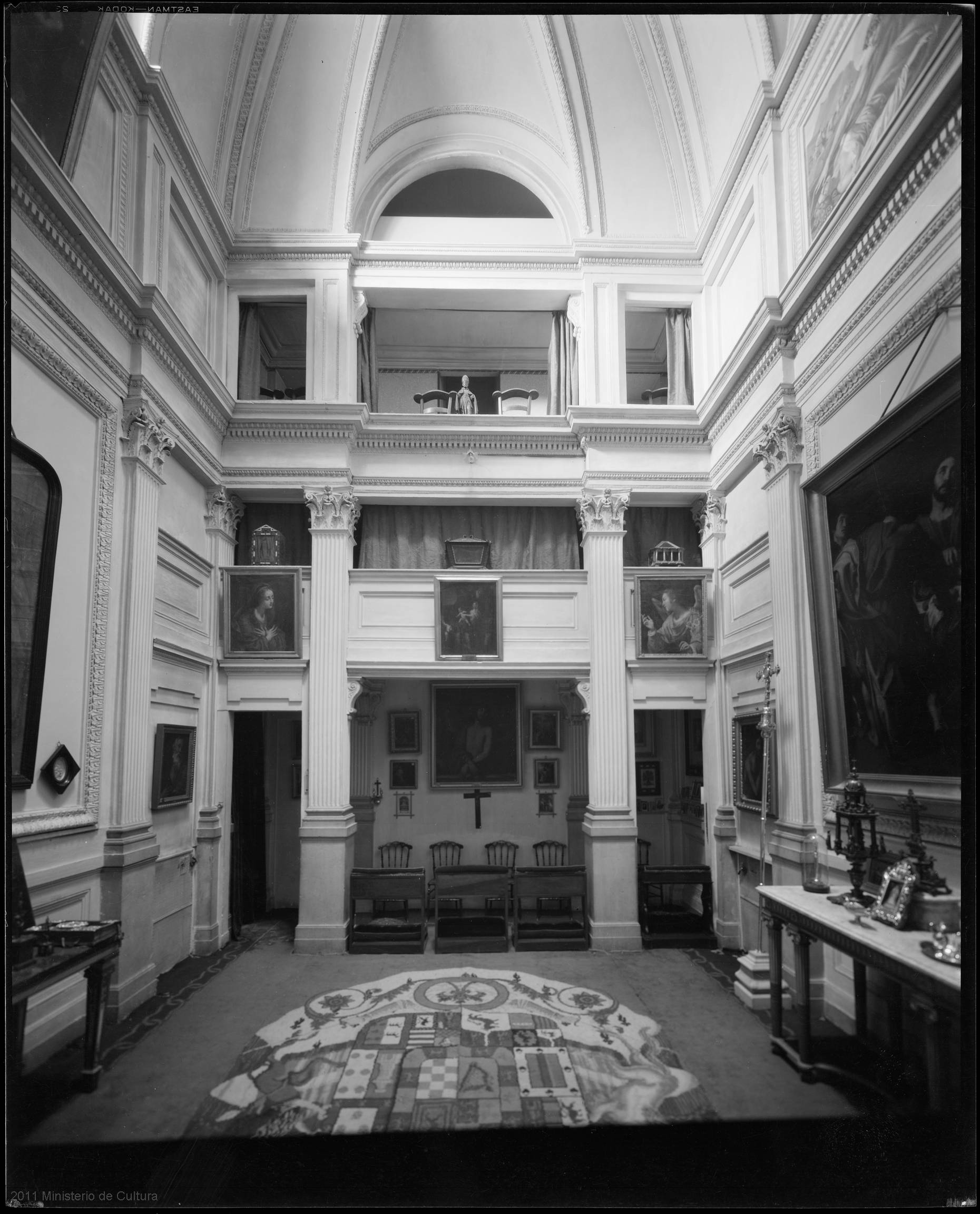
The route generally covers a sequence of staterooms, a grand staircase, and a long gallery hung with the major paintings — including, under normal circumstances, the Goya portrait. But this is a lived-in private collection, not a fixed museum hang. Works occasionally travel for loan to exhibitions elsewhere, and a handful of rooms are periodically closed for conservation or family use.
What this means practically:
- Do not book a visit purely to see one specific painting without checking current availability first.
- The archive and manuscript holdings are shown more selectively than the paintings, and sometimes only through the guided tier.
- Photography rules and which rooms permit it can change between visits — confirm on arrival, not from an old blog post.
None of this is unusual for a private foundation running limited public access. It is unusual compared to a state museum like the Prado, which publishes a fixed, catalogued collection online. Liria does not — and cannot, in the same way, because it is a family home with a rotating set of loans and restorations. For comparison, the structure and pricing of Madrid’s major state museums is covered in our guide to free entry versus the Paseo del Arte card.
How long does a visit take, and what should you plan around it?
A self-guided visit typically runs under two hours; the guided tour adds time for the group pace and commentary. Neither includes extensive gardens — the palace’s outdoor space is modest compared to, say, Campo del Moro next to the Royal Palace.
Because entry is timed and capacity-limited, it behaves more like a reserved museum slot than a drop-in landmark. The general pattern of advance booking at Madrid’s major sites — release windows, sell-outs, and what “timed entry” actually means for planning — is explained in our piece on timed entry at Madrid’s major sites.
The palace sits close to the Parque del Oeste and Plaza de España, making it easy to combine with a walk through that part of the city. Our guide to the Parque del Oeste covers that stretch of western Madrid in more detail.
Is it worth building a day around?
For anyone with a serious interest in Goya, Spanish portraiture, or how a noble family’s collection differs from a national one, yes — with the booking caveat taken seriously. For a first, short visit to Madrid focused on the Prado, Reina Sofía, and the Retiro, it is a reasonable second- or third-day addition rather than a priority.
It fits naturally into the broader picture of what Madrid’s museum landscape actually contains, covered on our Museums & Galleries pages, and alongside the city’s other landmark buildings listed under Landmarks & Sights. For a wider sense of how to sequence a visit to Madrid before adding something like Liria, the Madrid guide hub is the starting point.
Access Madrid is an independent guide written from published, checkable sources. We have not visited the places described here and we do not publish personal recommendations or invented ‘local favourites’ — where something is singled out as notable, we say who says so. Opening times, fares, closures and prices change at short notice, so treat everything here as a starting point and confirm with the museum, operator or venue directly before building a day around it. We give no advice on visas, insurance, health or safety; use your own government’s official guidance for those.
Featured image: Photo by Unknown, source, CC BY 4.0
