The Puerta de Toledo is a neoclassical stone gate standing at the southern end of Calle de Toledo, on the edge of central Madrid near the Manzanares river. It was built in the early nineteenth century as a triumphal arch, not a defensive fortification, and it is one of only two surviving gates from the ring that once marked the city’s fiscal boundary.
Where exactly is it?
The gate sits on a roundabout, the Glorieta de Puerta de Toledo, where Calle de Toledo — the old route running down from the historic centre through the La Latina district — meets the Ronda de Toledo and the approach to the Manzanares. It sits on the boundary between the La Latina and Embajadores neighbourhoods, close to the river’s east bank. A metro station on Line 5, Puerta de Toledo, takes its name from the gate and stands beside it.
Why was it built?
The gate was commissioned in the aftermath of the Peninsular War, to mark the restoration of Fernando VII to the Spanish throne after the expulsion of French forces in 1814. Construction ran through a difficult stretch of the 1810s and 1820s and the arch was finally completed in 1827, well after the events it commemorates. The architect was Antonio Aguado, working with a team of sculptors who supplied the allegorical figures and military trophies that decorate the structure.
It replaced an earlier, much simpler gate that had stood on or near the same spot as part of Madrid’s eighteenth-century customs perimeter — a boundary built under Carlos III not for defence but to control goods entering the city and collect duties on them. Madrid’s historic wall was never a proper fortification in the way that surrounded many European capitals; it was a tax line, and most of its gates were demolished once that system ended. The Puerta de Toledo and the Puerta de Alcalá, at the opposite side of the old city, are the principal survivors.
What does the gate look like?
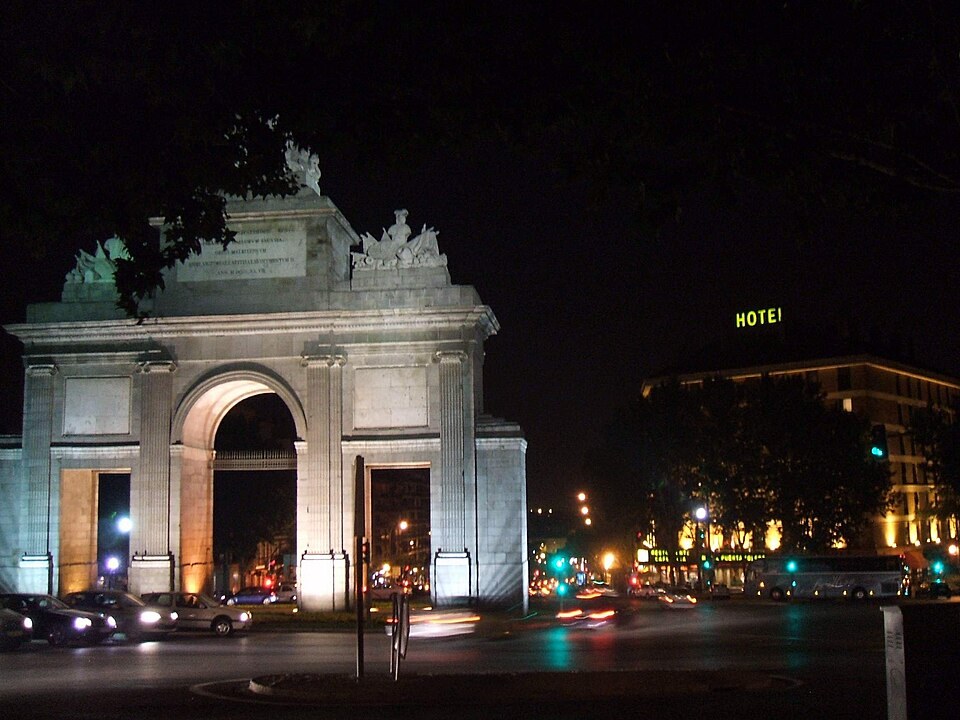
The Puerta de Toledo is built from granite in a restrained neoclassical style, with three arched openings — a taller central arch flanked by two lower ones — supported on paired columns. Above the entablature sits a sculptural group representing Spain, surrounded by figures and military trophies alluding to the recent war and the return of the monarchy. The overall design is more sculpturally dense than the Puerta de Alcalá, with the decoration concentrated at the crown of the arch rather than spread across the façade.

Is the Puerta de Toledo the same as the Puente de Toledo?
No, and the two are easy to confuse because they share a name and a general area. The Puente de Toledo is a separate, older structure — a stone bridge over the Manzanares built in the early eighteenth century to a design by Pedro de Ribera, decorated with baroque sculpture including figures of San Isidro and Santa María de la Cabeza. It lies further south, closer to the river itself, while the Puerta de Toledo is the landward gate on the roundabout near the metro station. Anyone searching for one after visiting the other should check which structure they mean before setting out.
Can you go inside it, or is it just viewed from outside?
The Puerta de Toledo is a freestanding monument on a traffic island rather than a building with an interior open to visitors. It is seen from the surrounding pavements and from the roundabout itself; there is no ticketed entry or interior route through the arch. This puts it in the same category as the Puerta de Alcalá — a monument read from the street rather than toured room by room, unlike a palace or museum.
Is it a protected monument?
The gate is included among Spain’s protected historic monuments, reflecting both its age and its place in the surviving record of Madrid’s former customs boundary. As with any legally protected structure, current details of its status are best confirmed through Spain’s official heritage listings rather than assumed from general description.
What else is in the surrounding area?
The Puerta de Toledo sits at the southern tip of a stretch of central Madrid dense with older buildings and markets rather than modern development. Calle de Toledo, running north from the gate, threads through the La Latina district and eventually reaches the area around Plaza Mayor, the walled market square built in the sixteenth and seventeenth centuries and covered in more detail in Access Madrid’s guide to Plaza Mayor.
Close to the gate, La Latina holds the Basílica de San Francisco el Grande, one of the largest domed churches in Spain, along with the streets that host the Sunday Rastro flea market, one of the largest open-air markets in Europe by the city’s own reckoning. Further along the Manzanares, the riverside also holds Matadero Madrid, a former municipal slaughterhouse complex converted into a public arts centre — a useful comparison for how the city has repeatedly repurposed nineteenth- and early twentieth-century infrastructure rather than demolishing it outright.
How does the Puerta de Toledo fit into the wider pattern of Madrid’s gates?
Madrid once had several gates marking the points where roads to Toledo, Alcalá, Segovia and other towns crossed its customs boundary. Most were dismantled as the city expanded in the nineteenth and twentieth centuries and the fiscal wall lost its purpose. The Puerta de Alcalá survived because it stood in an open, prominent square that was never built over; the Puerta de Toledo survived in a comparable way, anchoring a roundabout at a major road junction rather than blocking later development. Both now function purely as monuments, stripped of any administrative role, and both are documented in more detail in Access Madrid’s Landmarks & Sights archive, which covers Madrid’s surviving gates, arches and civic monuments as a group.
What should a visitor keep in mind before going?
Because the Puerta de Toledo is an outdoor monument on a roundabout rather than a ticketed site, there are no opening hours, admission fees or booking requirements to check. The practical planning is really about the surrounding area: confirming current Rastro market days, checking whether nearby churches or markets have their own visiting hours, and using the Puerta de Toledo metro stop on Line 5 as a fixed point for navigating between La Latina, Embajadores and the riverside. Anyone combining the gate with a wider day around southern-central Madrid should treat it as a short stop on a longer route through the old city rather than a destination requiring its own dedicated visit.
Access Madrid is an independent guide written from published, checkable sources. We have not visited the places described here and we do not publish personal recommendations or invented ‘local favourites’ — where something is singled out as notable, we say who says so. Opening times, fares, closures and prices change at short notice, so treat everything here as a starting point and confirm with the museum, operator or venue directly before building a day around it. We give no advice on visas, insurance, health or safety; use your own government’s official guidance for those.